Results by title
342 books match the query '16th century' and 5 start with j
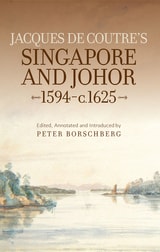
Jacques de Coutre's Singapore and Johor 1594-c. 1625
Edited by Peter Borschberg
National University of Singapore Press, 2015
The manuscripts come from a bundle of documents preserved at the National Library of Spain in Madrid that includes De Coutre’sautobiography and several memorials to the Crowns of Spain and Portugal. Chapters from the autobiography have been excerpted from book I, which covers the writer’s life in Southeast Asia between 1593 and 1603. A glossary and list of place names provide information about officials, goods and places mentioned in the text that will be unfamiliar to readers of English.

Jesuit Letters From China, 1583-84
M. Howard Rienstra, EditorTranslated by M. Howard Rienstra
University of Minnesota Press, 1986
Jesuit Letters From China, 1583–84 was first published in 1986. Minnesota Archive Editions uses digital technology to make long-unavailable books once again accessible, and are published unaltered from the original University of Minnesota Press editions.
The first eight letters from Jesuit missionaries on mainland China were written in 1583–84 and published in Europe in 1586. M Howard Rienstra's translated marks their first appearance in English. The letters chronicle the patient efforts of Michele Ruggieri and the famed Matteo Ricci to learn Chinese, to gain acceptance in Chinese society, and to explain Christianity to a highly sophisticated non-Christian culture. They also described the China of the late Ming dynasty (1368–1644), a country whose immense size and population had excited the imagination of Europeans for generations.
It was Francis Xavier's dream that this mighty kingdom and civilization be opened to the Christian gospel. His dream was at least tentatively fulfilled when Michele Ruggieri was granted residence first in Canton and then in Chao-ch'ing in 1583. Accompanied first by Francesco Pasio and later by Matteo Ricci, Ruggieri initiated the Christian mission in China. Their letters, published initially as an appendix to a volume of Jesuit letters from Japan, were abbreviated and censored by their European editor. In edited form, the letters appeared in 1586 in one French, on German, and three Italian editions.
The China of Ruggieri and Matteo Ricci had remained, however, both suspicious of, and closed to, foreigners - a fact which the original letters do not gloss over. Rienstra was carefully compared the abbreviated and censored versions of these letters in their originals, still preserved in the Jesuit archives in Rome. The letters in general indicate how tenuous the Jesuits' situation was and note candidly that only two baptisms had been performed on the mainland during their stay. These results stand in marked contracts to the reports from Japan of tens of thousands of baptisms and to the reports from Portuguese Macao, where Chinese converts were compelled to wear European cloths and to take European names.
Such Europeanization was thought to be inappropriate to a successful Christian mission in China. Though criticized at the time by their colleagues in Macao, Ruggieri, Pasio, and Ricci committed themselves to a program of cultural respect and accommodation. They learned both written and spoken Chinese, ingratiated themselves with the ruling classes by exhibiting their learning and courtesy, and appeared to have become Chinese themselves. When Matteo Ricci became Ruggieri's successor and his name became synonymous with the success of the Jesuit mission in China, it was to these methods that its success was owed. Unfortunately, the prevailing European ethnocentrism could not accept the concept of cultural accommodation. The editors thus censored the letters to convey the impression of a triumphant and culturally superior Christian mission in China.
Jesuit Letters From China is a publication of the James Ford Bell Library at the University of Minnesota.
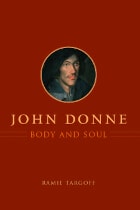
John Donne, Body and Soul
Ramie Targoff
University of Chicago Press, 2008
For centuries readers have struggled to fuse the seemingly scattered pieces of Donne’s works into a complete image of the poet and priest. In John Donne, Body and Soul, Ramie Targoff offers a way to read Donne as a writer who returned again and again to a single great subject, one that connected to his deepest intellectual and emotional concerns.
Reappraising Donne’s oeuvre in pursuit of the struggles and commitments that connect his most disparate works, Targoff convincingly shows that Donne believed throughout his life in the mutual necessity of body and soul. In chapters that range from his earliest letters to his final sermon, Targoff reveals that Donne’s obsessive imagining of both the natural union and the inevitable division between body and soul is the most continuous and abiding subject of his writing.
“Ramie Targoff achieves the rare feat of taking early modern theology seriously, and of explaining why it matters. Her book transforms how we think about Donne.”—Helen Cooper, University of Cambridge
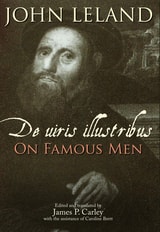
John Leland
De uiris illustribus / On Famous MenJohn Leland
Bodleian Library Publishing, 2010
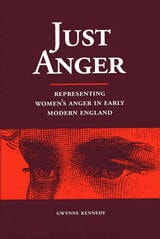
Just Anger
Representing Women's Anger in Early Modern EnglandGwynne Kennedy
Southern Illinois University Press, 2000
The first scholar to investigate the subject of women’s anger in early modern England, Gwynne Kennedy analyzes portrayals of and attitudes toward women’s anger in printed texts by or purporting to be written by women during the period.
Kennedy draws from recent critical work on emotions by historians, literary scholars, philosophers, and psychologists as well as comparative studies of the emotions by cultural anthropologists. Kennedy also examines a number of male-authored works, including sermons, conduct literature, philosophy, rhetoric, and medicine. The focus of her work, however, is on representations of women’s anger in printed works signed with women’s names in late sixteenth- and early seventeenth-century England. She addresses the ways these writings conform to, conflict with, or appear to reconfigure prevailing beliefs about women’s anger.
Kennedy looks at such literary texts as Mary Wroth’s romance, The Countess of Montgomery’s Urania, the first fiction by an English woman; Elizabeth Cary’s play, The Tragedy of Mariam, the earliest extant play in English by a woman; and Aemilia Lanyer’s verse collection, Salve Deus Rex Judaeorum. She also discusses religious writings by Protestant martyr Anne Askew and Elizabeth Cary’s history of Edward II. Kennedy considers as well defenses of women’s nature authored by women (Rachel Speght and Aemilia Lanyer) or published under female pseudonyms (“Jane Anger,” “Ester Sowernam,” and “Constantia Munda”).
Kennedy demonstrates the importance of class and race as factors affecting anger’s legitimacy and its forms of expression. She shows how early modern assumptions about women’s anger can help to create or exaggerate other differences among women. Her close scrutiny of anger against female inferiority emphasizes the crucial role of emotions in the construction of self-worth and identity.