Results by title
1116 books match the query 'Africa' and 11 start with j
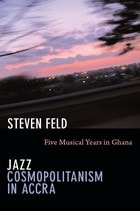
Jazz Cosmopolitanism in Accra
Five Musical Years in GhanaSteven Feld
Duke University Press, 2012
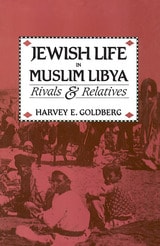
Jewish Life in Muslim Libya
Rivals and RelativesHarvey E. Goldberg
University of Chicago Press, 1990
Harvey E. Goldberg shows that the cultural and religious worlds of the Jewish and Muslim communities in Libya were deeply intertwined in daily life and largely remained so despite political and social changes under successive Ottoman and Italian rule. He documents the intricate symbolic linkages of Jews and Muslims in different periods and in a variety of settings. His accounts of traditional Jewish weddings, of mock fights between Jewish teams that took place in early nineteenth-century Tripoli, and of the profession of street peddling demonstrate that, despite age-old images of Jews as outsiders or infidels, Jews were also an essential and familiar part of the local Islamic society.
Goldberg's narrative continues through the British Military Administration in Libya, a period which saw growing Libyan nationalism and, in 1945, three days of riots in which more than 130 Jews were killed. Goldberg reflects on how these events both expressed and exacerbated a rupture in the social fabric linking Muslims and Jews, setting the scene for the mass emigration of Libyan Jews from their homeland.
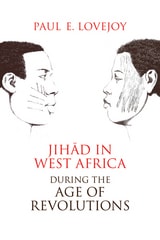
Jihad in West Africa during the Age of Revolutions
Paul E. Lovejoy
Ohio University Press, 2016
In Jihād in West Africa during the Age of Revolutions, a preeminent historian of Africa argues that scholars of the Americas and the Atlantic world have not given Africa its due consideration as part of either the Atlantic world or the age of revolutions. The book examines the jihād movement in the context of the age of revolutions—commonly associated with the American and French revolutions and the erosion of European imperialist powers—and shows how West Africa, too, experienced a period of profound political change in the late eighteenth through the mid-nineteenth centuries. Paul E. Lovejoy argues that West Africa was a vital actor in the Atlantic world and has wrongly been excluded from analyses of the period.
Among its chief contributions, the book reconceptualizes slavery. Lovejoy shows that during the decades in question, slavery expanded extensively not only in the southern United States, Cuba, and Brazil but also in the jihād states of West Africa. In particular, this expansion occurred in the Muslim states of the Sokoto Caliphate, Fuuta Jalon, and Fuuta Toro. At the same time, he offers new information on the role antislavery activity in West Africa played in the Atlantic slave trade and the African diaspora.
Finally, Jihād in West Africa during the Age of Revolutions provides unprecedented context for the political and cultural role of Islam in Africa—and of the concept of jihād in particular—from the eighteenth century into the present. Understanding that there is a long tradition of jihād in West Africa, Lovejoy argues, helps correct the current distortion in understanding the contemporary jihād movement in the Middle East, Afghanistan, Pakistan, and Africa.
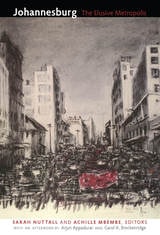
Johannesburg
The Elusive MetropolisSarah Nuttall and Achille Mbembe, eds.
Duke University Press, 2008
The volume’s essays include an investigation of representation and self-stylization in the city, an ethnographic examination of friction zones and practices of social reproduction in inner-city Johannesburg, and a discussion of the economic and literary relationship between Johannesburg and Maputo, Mozambique’s capital. One contributor considers how Johannesburg’s cosmopolitan sociability enabled the anticolonial projects of Mohandas Ghandi and Nelson Mandela. Journalists, artists, architects, writers, and scholars bring contemporary Johannesburg to life in ten short pieces, including reflections on music and megamalls, nightlife, built spaces, and life for foreigners in the city.
Contributors: Arjun Appadurai, Carol A. Breckenridge, Lindsay Bremner, David Bunn, Fred de Vries, Nsizwa Dlamini, Mark Gevisser, Stefan Helgesson, Julia Hornberger, Jonathan Hyslop, Grace Khunou, Frédéric Le Marcis, Xavier Livermon, John Matshikiza, Achille Mbembe, Robert Muponde, Sarah Nuttall, Tom Odhiambo, Achal Prabhala, AbdouMaliq Simone

Johannesburg
The Elusive Metropolis, Volume 16Sarah Nuttall and Achille Mbembe, eds.
Duke University Press, 0
Contributors to this issue—a mix of scholars, urban planners, and artists, many of whom hail from South Africa—reveal Johannesburg to be a polycentric and international city that has developed its own cosmopolitan culture. In a detailed study of three streets in the modern precinct of Melrose Arch, one essay shows how the thoroughly commodified and marketed Johannesburg cityscape has shaped the cultural sensitivities, aesthetics, and urban subjectivities of its inhabitants, at times even overriding the historical memory of apartheid. Another essay, focusing on the emergence of a new urban culture, examines how the city itself becomes a crucial site for the remixing and reassembling of racial identities. By tracking the movement of people with AIDS to various locations in the city to seek relief and treatment, another essay reveals an urban geography very different from what is seen from the highways. Finally, through interviews and commentaries, journalists, artists, and architects of Johannesburg offer reflections on the geography and shifting culture of the city and its townships, on the complicated relationship between Johannesburg and other African cities, and on the search for an architectural style that adequately expresses the complexity of this cosmopolitan city.
Contributors. Lindsay Bremner, Nsizwa Dlamini, Mark Gevisser, Grace Khunou, Frédéric Le Marcis, John Matshikiza, Achille Mbembe, Sarah Nuttall, Rodney Place, AbdouMaliq Simone, Michael Watts
John Dee
The Politics of Reading and Writing in the English RenaissanceWilliam H. Sherman
University of Massachusetts Press, 1995
Joining Africa
From Anthills to AsmaraCharles Cantalupo
Michigan State University Press, 2012
This eye-opening personal history tells the story of an American college professor’s twenty-year engagement with a thriving Africa rarely encountered by Western visitors, including an extraordinary connection to poets across the continent. At once adventurous, spiritual, political, dreamlike, and humorous, Joining Africa is a unique documentary of a journey through the continent, including an intense five-year encounter with economically struggling but culturally fertile Eritrea. The Africa presented here is neither a postcolonial study nor an exotic tourist destination. It is rich with the voices of its people, whose languages, Cantalupo argues, have greater potential to effect change than any NGO or high-profile celebrity. In vibrant prose, Cantalupo’s book extends a stirring invitation to reevaluate how we engage—both individually and collectively—with this remarkable part of the world.
Joint Enterprises
Collaborative Drama and the Institutionalization of the English Renaissance TheaterHeather Anne Hirschfeld
University of Massachusetts Press, 2004
Drawing on a range of documentary and literary sources as well as recent methodological advances in theater history, the book presents a sequence of case studies designed to accommodate both the larger cultural setting of the early modern theater and the localized, idiosyncratic factors influencing discrete literary productions. Each chapter chronicles the professional setting of a particular joint work and then investigates its rhetorical or linguistic traces in the resultant text. This approach allows Hirschfeld to locate specific links between modes of collaborative production and forms of dramatic representation and then explicate the literary and political implications of these connections.
Hirschfeld's case studies provide a fresh account of the institutionalization—the steady growth, organization, and incorporation—of the professional drama in sixteenth- and seventeenth-century English cultural life. By attending to the changing shapes and stakes of joint enterprises, she shows that dramatists did not unconsciously absorb the practice of collaborative writing from general social discourses, but rather were aware of the material and symbolic significances of their work, meanings structured by the traditions of the developing professional theater and by the cultural pressures and anxieties attendant upon a new and often fragile institution.

Journeys from Scandinavia
Travelogues of Africa, Asia, and South America, 1840—2000Elisabeth Oxfeldt
University of Minnesota Press, 2010
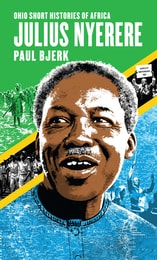
Julius Nyerere
Paul Bjerk
Ohio University Press, 2017
With vision, hard-nosed judgment, and biting humor, Julius Nyerere confronted the challenges of nation building in modern Africa. Constructing Tanzania out of a controversial Cold War union between Tanganyika and Zanzibar, Nyerere emerged as one of independent Africa’s most influential leaders. He pursued his own brand of African socialism, called Ujamaa, with unquestioned integrity, and saw it profoundly influence movements to end white minority rule in Southern Africa. Yet his efforts to build a peaceful nation created a police state, economic crisis, and a war with Idi Amin’s Uganda. Eventually—unlike most of his contemporaries—Nyerere retired voluntarily from power, paving the way for peaceful electoral transitions in Tanzania that continue today.
Based on multinational archival research, extensive reading, and interviews with Nyerere’s family and colleagues, as well as some who suffered under his rule, Paul Bjerk provides an incisive and accessible biography of this African leader of global importance. Recognizing Nyerere’s commitment to participatory government and social equality while also confronting his authoritarian turns and policy failures, Bjerk offers a portrait of principled leadership under the difficult circumstances of postcolonial Africa.

Justyna's Narrative
Gusta Davidson Draenger
University of Massachusetts Press, 1996
Written during World War II, Justyna's Narrative is a compelling account of the Krakow Jewish resistance. From February through April 1943, Gusta Davidson Draenger (aka “Justyna”) composed the narrative on scraps of paper smuggled into her prison cell. Between sessions of torture and interrogation at the hands of the Gestapo, she recorded the activities and spiritual aspirations of the clandestine group of young Jewish idealists who forged documents, acquired weapons, and committed acts of defiance against the Nazis.