Results by title
234 books match the query 'Americas (North, Central, South, West Indies)' and 4 start with j

J. Edgar Hoover and the Anti-interventionists
FBI Political Surveillance and the Rise of the Domestic Security State, 1939–1945Douglas M. Charles
The Ohio State University Press, 2007
In this very timely manuscript, Douglas M. Charles reveals how FBI Director J. Edgar Hoover catered to President Franklin D. Roosevelt’s political interests. Between 1939 and 1945, the Federal Bureau of Investigation monitored the political activities of President Roosevelt’s anti-interventionist foreign policy critics. Hoover, whose position as FBI director was tenuous within the left-of-center Roosevelt administration, catered to the president’s political and policy interests in order to preserve his position and to expand FBI authority. In his pragmatic effort to service administration political goals, Hoover employed illegal wiretaps and informers, collected derogatory information, conducted investigations that had the potential to discredit the anti-interventionists, forwarded political intelligence to administration officials, and coordinated some activity with British intelligence. This all occurred within a crisis atmosphere created with the onset of the Second World War, and it was this political dynamic that permitted Hoover to successfully cultivate his relationship with President Roosevelt. In the process, the administration's otherwise legitimate foreign policy opposition—regarded by some as subversive—had their civil liberties violated through intensive FBI scrutiny of their political dissent. Moreover, the FBI’s surveillance marks the origins of the FBI’s role in the later national security state. Among the targets examined in this book are Charles Lindbergh, the America First Committee, notable anti-interventionist senators and congressmen, the anti-interventionist press, and other prominent individuals who advocated American isolation from foreign war.
[more]
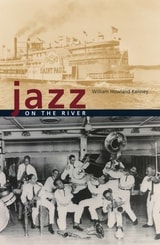
Jazz on the River
William Howland Kenney
University of Chicago Press, 2005
Just after World War I, the musical style called jazz began a waterborne journey outward from that quintessential haven of romance and decadence, New Orleans. For the first time in any organized way, steam-driven boats left town during the summer months to tramp the Mississippi River, bringing an exotic new music to the rest of the nation. For entrepreneurs promoting jazz, this seemed a promising way to spread northward the exciting sounds of the Crescent City. And the musicians no longer had to wait for folks upriver to make their way down to New Orleans to hear the vibrant rhythms, astonishing improvisations, and new harmonic idioms being created.
Simply put, when jazz went upstream, it went mainstream, and in Jazz on the River, William Howland Kenney brings to life the vibrant history of this music and its seduction of the men and women along America's inland waterways. Here for the first time readers can learn about the lives and music of the levee roustabouts promoting riverboat jazz and their relationships with such great early jazz adventurers as Louis Armstrong, Fate Marable, Warren "Baby" Dodds, and Jess Stacy. Kenney follows the boats from Memphis to St. Louis, where new styles of jazz were soon produced, all the way up the Ohio River, where the music captivated audiences in Cincinnati and Pittsburgh alike.
Jazz on the River concludes with the story of the decline of the old paddle wheelers-and thus riverboat jazz-on the inland waterways after World War II. The enduring silence of our rivers, Kenney argues, reminds us of the loss of such a distinctive musical tradition. But riverboat jazz still lives on in myriad permutations, each one in tune with our own times.
[more]
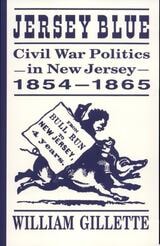
Jersey Blue
Civil War Politics in New Jersey, 1854–1865Gillette, William
Rutgers University Press, 1994
This political history of New Jersey during the Civil War and the years immediately before and after invites us to rethink New Jersey's role and in particular its relationship to the border states. William Gillette argues that there is little evidence supporting the idea that New Jersey's residents were pro-southern before the war, or even antiwar during it, although attitudes toward the abolition of slavery were more ambivalent. The perspectives Gillette offers in Jersey Blue, from the recruiting ground, the battlefield, and the home front, cast new light on New Jersey's wartime activities, state identity, and our understanding of the interrelationships between New Jersey's national, regional, and state developments.
Gillette takes a broader view of the politics of the Civil War as he touches on the economy, geography, demography, immigration, nativism, conscription, and law. The result is a pioneering history of New Jersey that deepens our understanding of the Civil War.
Gillette takes a broader view of the politics of the Civil War as he touches on the economy, geography, demography, immigration, nativism, conscription, and law. The result is a pioneering history of New Jersey that deepens our understanding of the Civil War.
[more]

Johnson, Nixon, and the Doves
Small, Melvin
Rutgers University Press, 1988
.
[more]