Results by title
1038 books match the query 'Antiquities' and 3 start with j
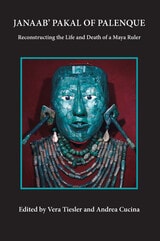
Janaab' Pakal of Palenque
Reconstructing the Life and Death of a Maya RulerEdited by Vera Tiesler and Andrea Cucina
University of Arizona Press, 2006
This volume communicates the broad scope of applied interdisciplinary research conducted on the Pakal remains to provide answers to old disputes over the accuracy of both skeletal and epigraphic studies, along with new questions in the field of Maya dynastic research. Contributions by scholars in epigraphy, anthropology, and bioarchaeology bring to light new evidence regarding the ruler’s age, clarify his medical history and the identification of the remains found with him, reevaluate his role in life, and offer modern insights into ritual and sacrificial practices associated with Pakal.
The book leads readers through the history of Pakal’s discovery, skeletal analysis, and interpretation of Maya biographies, and also devotes considerable attention to the tomb of the “Red Queen” discovered at the site. Findings from the new Transition Analysis aging method, histomorphometric analysis, and taphonomic imagery are presented to shed new light on the perplexing question of Pakal’s age at death. Royal Maya life and death histories from the written record are also analyzed from a regional perspective to provide a broad panorama of the twisted power politics of rulers’ families and the entangled genealogies of the Maya Classic period.
A benchmark in biological anthropology, this volume reconsiders assumptions concerning the practices and lives of Maya rulers, posing the prospect that researchers too often find what they expect to find. In presenting an updated study of a well-known personage, it also offers innovative approaches to the biocultural and interdisciplinary re-creation of Maya dynastic history.
Contributors
Jesper K. Boldseh
Jane E. Buikstra
James H. Burton
Andrea Cucina
Nikolai Grube
Patricia Hernández
Lourdes Márquez
Simon Martin
George R. Milner
T. Douglas Price
Arturo Romano
Carlos Serrano
Sam D. Stout
Margaret Streeter
Vera Tiesler
John W. Verano
Judah in the Neo-Babylonian Period
The Archaeology of DesolationAvraham Faust
SBL Press, 2012
Julian Steward and the Great Basin
The Making of an AnthropologistRichard O Clemmer
University of Utah Press, 1999
Julian Steward and the Great Basin is a critical assessment of Steward’s work, the factors that influenced him, and his deep effect on American anthropology. Steward (1902–1972) was one of the foremost American exponents of cultural ecology, the idea that societies evolve in adaptation to their human and natural environments. He was also central in shaping basic anthropological constructs such as "hunter-gatherer" and "adaptation." But his fieldwork took place almost entirely in the Great Basin.
In one sense, the phases of Steward’s career epitomize the successive schools of anthropological theory and practice. Each chapter explores a different aspect of his work ranging from early efforts at documenting trait distributions to his later role in the development of social transformation theory, area studies, and applied anthropology.
Julian Steward and the Great Basin also corrects long-standing misperceptions that originated with Steward about lifeways of the Indians living between the Great Plains and California. It charts new directions for research, demanding a more exacting study of environmental conditions, material adaptations, and organizational responses, as well as an appreciation of the ideological and humanistic dimensions of Basin Life.