57 books match the query 'Antisemitism' and 5 start with j
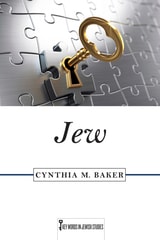
cover of Jew

Jew

Baker, Cynthia M

Rutgers University Press, 2017
Jew.  The word possesses an uncanny power to provoke and unsettle. For millennia, Jew has signified the consummate Other, a persistent fly in the ointment of Western civilization’s grand narratives and cultural projects. Only very recently, however, has Jew been reclaimed as a term of self-identification and pride.  
 
With these insights as a point of departure, this book offers a wide-ranging exploration of the key word Jew—a term that lies not only at the heart of Jewish experience, but indeed at the core of Western civilization. Examining scholarly debates about the origins and early meanings of Jew, Cynthia M. Baker interrogates categories like “ethnicity,” “race,” and “religion” that inevitably feature in attempts to define the word. Tracing the term’s evolution, she also illuminates its many contradictions, revealing how Jew has served as a marker of materialism and intellectualism, socialism and capitalism, worldly cosmopolitanism and clannish parochialism, chosen status, and accursed stigma.
 
Baker proceeds to explore the complex challenges that attend the modern appropriation of Jew as a term of self-identification, with forays into Yiddish language and culture, as well as meditations on Jew-as-identity by contemporary public intellectuals. Finally, by tracing the phrase new Jews through a range of contexts—including the early Zionist movement, current debates about Muslim immigration to Europe, and recent sociological studies in the United States—the book provides a glimpse of what the word Jew is coming to mean in an era of Internet cultures, genetic sequencing, precarious nationalisms, and proliferating identities.
 
[more]
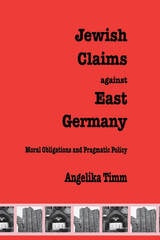
cover of Jewish Claims Against East Germany

Jewish Claims Against East Germany

Angelika Timm

Central European University Press, 1998

This is the first comprehensive history of Jewish negotiations with East Germany regarding restitution and reparations for Nazi war crimes. Angelika Timm analyzes the politics of old and new anti-Semitism and the context in which they grew under the officially propagated ideology of antifascism.


Investigating the mass of unpublished, newly available archival data from the United States, Israel, and the former German Democratic Republic, and more than forty personal interviews, Timm fills a critical gap in the scholarship on postwar Germany. She analyzes the role of the Holocaust and the image of Jews in the historical consciousness and political culture of East Germany and chronicles the efforts of Jewish organizations, especially the Conference on Jewish Material Claims Against Germany, to negotiate reparations with the East German state. The unique relationship between ideology and Realpolitik defined the manner in which East Germany confronted the crimes of its past and allowed anti-Semitism to reemerge.
[more]
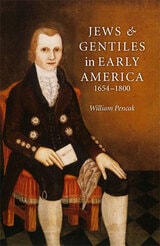
cover of Jews and Gentiles in Early America: 1654-1800

Jews and Gentiles in Early America

1654-1800

William Pencak

University of Michigan Press, 2005
"Jews and Gentiles in Early America is the best account I have seen about Jews in America in this era. William Pencak's research is extensive and the informative depth with which he addresses important political issues is unsurpassed. His analysis is unfailingly sophisticated and virtually unchallengeable. He paints with a broad stroke, putting his narrative and interpretations not only in a wide American context, but also in an international scope. . . . [A]n exceptional contribution to American Jewish history and colonial history in general." -Frederic Cople Jaher, University of Illinois at Champaign-Urbana "Bill Pencak is no stranger either to novel topics or unconventional ideas. In this eminently readable and substantive contribution to the history of Jews in early America, Pencak has once again pushed the boundaries of debate in original and constructive ways." ---Edith Gelles, Stanford University "William Pencak has produced a learned and informative volume on the nature of Jewish-Gentile relations in colonial America. The book's reconstruction of Jewish life in colonial New York, Newport, Charleston, Savannah, and Philadelphia is based on a broad array of primary and secondary source materials that persuasively demonstrate the fact that, despite a truly remarkable level of social acceptance, colonial Jews simultaneously encountered bouts of rejection. Scholars and general readers alike will be indebted to Dr. Pencak for deepening our understanding of the complex and often contradictory ways in which non-Jews related to their Jewish neighbors during this formative period in the nation's history." ---Dr. Gary P. Zola, Executive Director of The Jacob Rader Marcus Center of the American Jewish Archives and Associate Professor of the American Jewish Experience at Hebrew Union College-Jewish Institute of Religion Jews and Gentiles in Early America offers a uniquely detailed picture of Jewish life from the mid-seventeenth century through the opening decades of the new republic. Though the first national census in 1790 counted barely three thousand Jews, the Jewish community was nevertheless far more important in the history of early America than their numbers suggest, author William Pencak reveals in this fascinating chronicle of an often-overlooked aspect of American Jewish history. Pencak approaches his topic from the perspective of early American, rather than strictly Jewish, history. Rich in colorful narrative and animated with scenes of early American life, Jews and Gentiles in Early America tells the story of the five communities-New York, Newport, Charleston, Savannah, and Philadelphia-where most of colonial America's small Jewish population lived. How did these communities rise and fall? How did they interact with the larger gentile population? Pencak's exploration of popular anti-semitism in the pre-Revolutionary era describes the persistence of prejudices derived from traditional European society, and his abundantly detailed community studies explore the forms these prejudices took in colonial America, some of which continue to this day.
[more]
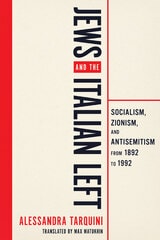
cover of Jews and the Italian Left: Socialism, Zionism, and Antisemitism from 1892 to 1992

Jews and the Italian Left

Socialism, Zionism, and Antisemitism from 1892 to 1992

Alessandra Tarquini, Translated by Max Matukhin

University of Wisconsin Press, 2026

Alessandra Tarquini, an expert on Italian Fascism, untangles the complicated relationship between the Italian left and Jews since the late nineteenth century. Due largely to indifference, and sometimes to antisemitism, Italian leftists consistently overlooked Jews in their visions for a collectivist future. Yet, from the birth of the Socialist Party in 1892 until 1992, when the heirs of the Marxist tradition dispersed or set out on a new path, questions continually arose in revolutionary efforts to remake the Italian state: Should Jews be seen as oppressed, and therefore welcome to participate in the struggle that would lead to the advent of a new civilization? Or might they hinder the realization of socialism because of their attachment to a religious identity? 

Tarquini’s research fills an important lacuna by analyzing the antisemitism of twentieth-century socialist movements. Crucially, however, Tarquini makes important distinctions between antisemitism on the Italian left and right, and identifies the relationship between leftism and antisemitism as a distinct formation.
[more]
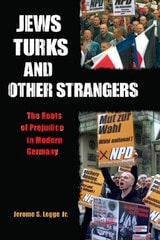
cover of Jews, Turks, and Other Strangers: Roots of Prejudice in Modern Germany

Jews, Turks, and Other Strangers

Roots of Prejudice in Modern Germany

Jerome S. Legge, Jr.

University of Wisconsin Press, 2003

Scholarly, objective, insightful, and analytical, Jews, Turks, and Other Strangers studies the causes of prejudice against Jews, foreign workers, refugees, and emigrant Germans in contemporary Germany. Using survey material and quantitative analyses, Legge convincingly challenges the notion that German xenophobia is rooted in economic causes. Instead, he sees a more complex foundation for German prejudice, particularly in a reunified Germany where perceptions of the "other" sometimes vary widely between east and west, a product of a traditional racism rooted in the German past. By clarifying the foundations of xenophobia in a new German state, Legge offers a clear and disturbing picture of a conflicted country and a prejudice that not only affects Jews but also fuels a larger, anti-foreign sentiment.

[more]