Results by title
855 books match the query 'Architecture' and 9 start with j
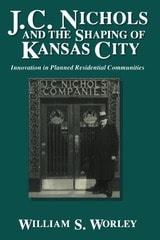
J. C. Nichols and the Shaping of Kansas City
Innovation in Planned Residential CommunitiesWilliam S. Worley
University of Missouri Press, 1993
Born and reared on the outskirts of Kansas City in Olathe, Kansas, Jesse Clyde Nichols (1880-1950) was a creative genius in land development. He grew up witnessing the cycles of development and decline characteristics of Kansas City and other American cities during the late nineteenth and early twentieth centuries. These early memories contributed to his interest in real estate and led him to pursue his goal of neighborhoods in Kansas City, an idea unfamiliar to that city and a rarity across the United States.
J.C. Nichols was one of the first developers in the country to lure buyers with a combination of such attractions as paved streets, sidewalks, landscaped areas, and access to water and sewers. He also initiated restrictive covenants and to control the use of structures built in and around his neighborhoods.
In addition, Nichols was involved in the placement of services such as schools, churches, and recreation and shopping areas, all of which were essential to the success of his developments. In 1923, Nichols and his company developed the Country Club Plaza, the first of many regional shopping centers built in anticipation of the increased use of automobiles. Known throughout the United States, the Plaza is a lasting tribute to the creativity of J.C. Nichols and his legacy to the United States.
With single-mindedness of purpose and unwavering devotion to achievement, J.C. Nichols left an indelible imprint on the Kansas City metropolitan area, and thereby influenced the design and development of major residential and commercial areas throughout the United States as well. Based on extensive research, J.C. Nichols and the Shaping of Kansas City is a valuable study of one of the most influential entrepreneurs in American land development.
[more]
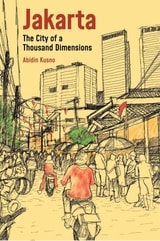
Jakarta
City of a Thousand DimensionsAbidin Kusno
National University of Singapore Press, 2023
A study of the forces that shaped Jakarta into the city it is today.
Indonesian writer Seno Gumira Ajidarma has called Jakarta a city of a thousand dimensions. A megacity of 30 million under threat from rising sea levels and temperatures, Jakarta and its resilient residents improvise and thrive. This book teases out some of the dimensions that have given shape to contemporary Jakarta, including the city’s expanded flexibility in accommodating capital and labor, and the consistent lack of planning that can be understood as a result of both politics and the poetics of governing in the region. Jakarta is essential reading for those seeking to understand one of Asia's most dynamic cities.
Indonesian writer Seno Gumira Ajidarma has called Jakarta a city of a thousand dimensions. A megacity of 30 million under threat from rising sea levels and temperatures, Jakarta and its resilient residents improvise and thrive. This book teases out some of the dimensions that have given shape to contemporary Jakarta, including the city’s expanded flexibility in accommodating capital and labor, and the consistent lack of planning that can be understood as a result of both politics and the poetics of governing in the region. Jakarta is essential reading for those seeking to understand one of Asia's most dynamic cities.
[more]
Jens Jensen
Nature’s ArtistWilliam H. Tishler
University of Illinois Press, 2026
A biography of the influential landscape architect
Celebrated as one of the great landscape architects of his era, Jens Jensen drew on his love of nature to transform Illinois and the Midwest. Chicago’s Columbus Park and the Lincoln Memorial Garden in Springfield, Illinois, remain part of his vast living legacy while Jensen’s conservation work influenced the establishment of national parks and natural spaces. A member of the Prairie School, Jensen’s affinity for nature found expression not only in public spaces but in his estate designs for Henry Ford and other industrialists. William H. Tishler tracks Jensen’s career and provides a wealth of new information on his personal life: his fierce dislike of and independence from the eastern establishment, and his bold proposals for the Indiana Dunes and other spaces. Tishler also examines Jensen’s semi-retirement in Door County and his creation of The Clearing, a folk school devoted to connecting human beings with nature.
Revealing and expert, Jens Jensen illuminates the processes, challenges, and passion that shaped a visionary’s work and world.
Revealing and expert, Jens Jensen illuminates the processes, challenges, and passion that shaped a visionary’s work and world.
[more]
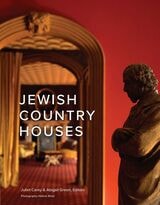
Jewish Country Houses
Edited by Juliet Carey and Abigail Green
Brandeis University Press, 2024
An exploration of the world of Jewish country houses, their architecture and collections, and the lives of the extraordinary men and women who created, transformed, and shaped them.
Country houses are powerful symbols of national identity, evoking the glamorous world of the landowning aristocracy. Jewish country houses—properties that were owned, built, or renewed by Jews—tell a more complex story of prejudice and integration, difference and connection. Many had spectacular art collections and gardens. Some were stages for lavish entertaining, while others inspired the European avant-garde. A few are now museums of international importance, many more are hidden treasures, and all were beloved homes that bear witness to the remarkable achievements of newly emancipated Jews across Europe—and to a dream of belonging that mostly came to a brutal end with the Holocaust.
Lavishly illustrated with historical images and a new body of work by the celebrated photographer Hélène Binet, this book is the first to tell the story of Jewish country houses, from the playful historicism of the National Trust’s Waddesdon Manor in Buckinghamshire to the modernist masterpiece that is the Villa Tugendhat in the Czech city of Brno—and across the pond to the United States, where American Jews infused the European country house tradition with their own distinctive concerns and experiences. This book emerges from a four-year research project funded by the UK Arts and Humanities Research Council that aims to establish Jewish country houses as a focus for research, a site of European memory, and a significant aspect of European Jewish heritage and material culture.
[more]
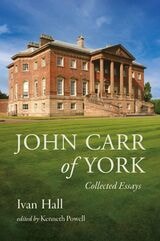
John Carr of York
Collected EssaysIvan Hall
Paul Holberton Publishing, 2023
An introduction to the life and mind of one of England’s most significant architects.
John Carr of York (1723–1807) was one of the most prolific and significant architects of the eighteenth century, with an output of more than four hundred designs, which range from simple gateways to the grandest schemes. Highly successful in his day, he had a recognizable style that was sensitive to the latest fashions as they continued to change. His ability to create beautiful buildings and marry this with a practical approach to both the purpose of the building and the budget of his clients won him many commissions.
Carr was born in Yorkshire in the North of England and remained there for the duration of his career. Because of this, he has often been overlooked as an architect, and his extensive output has defeated many attempts to write a complete study of his work. Although not a comprehensive review, John Carr of York seeks to situate Carr as an architect of national significance. It includes photographs and covers overarching themes such as landscape and color and some commissions in more detail.
[more]
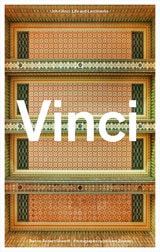
John Vinci
Life and LandmarksText by Robert Sharoff, Photographs by William Zbaren
Northwestern University Press, 2017
John Vinci: Life and Landmarks is the first authoritative survey of the life and work of one of Chicago’s most acclaimed architects and preservationists. Long awaited by scholars as well as by architecture aficionados, John Vinci provides an intimate look at an architect whose portfolio spans half a century and includes the restoration of some of the city’s most important historic structures as well as numerous award-winning original projects.
This illustrated biography traces Vinci’s origins as a child of Italian immigrants on Chicago’s South Side and his coming of age at the Illinois Institute of Technology, which was then under the direction of the legendary Modernist architect Ludwig Mies van der Rohe. It follows his career through his subsequent immersion in the historic preservation movement and the work of such early Chicago architects as Louis Sullivan, Frank Lloyd Wright, and John Wellborn Root.
Vinci’s pioneering restoration projects include Frank Lloyd Wright’s Robie House and Home Studio, Sullivan’s Chicago Stock Exchange Trading Room and the Carson Pirie Scott Building, and Root’s Monadnock Building. His original work, meanwhile, includes notable buildings such as the Arts Club of Chicago, numerous award-winning residences, and more than fifty major exhibitions at the Art Institute of Chicago and other museums.
John Vinci: Life and Landmarks also features portraits and profiles of Vinci’s friends and mentors over the years, including the architectural photographer Richard Nickel, the landscape designer Alfred Caldwell, the Art Institute curators James Speyer and Anne Rorimer, the architects Crombie Taylor and Myron Goldsmith, and the City of Chicago’s cultural historian Tim Samuelson.
The book includes new photos of twenty projects by noted architectural photographer William Zbaren as well as more than one hundred vintage photos and floorplans from Vinci’s personal archives, many never before published. A comprehensive catalogue raisonné rounds out this handsome and definitive work.
[more]
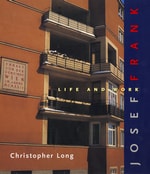
Josef Frank
Life and WorkChristopher Long
University of Chicago Press, 2002
Architect, designer, and theorist Josef Frank (1885-1967) was known throughout Europe in the 1920s as one of the continent's leading modernists. Yet despite his important contributions to the development of modernism, Frank has been largely excluded from histories of the movement. Josef Frank: Life and Work is the first study that comprehensively explores the life, ideas, and designs of this complex and controversial figure.
Educated in Vienna just after the turn of the century, Frank became the leader of the younger generation of architects in Austria after the First World War. But Frank fell from grace when he emerged as a forceful critic of the extremes of modern architecture and design during the early 1930s. Dismissing the demands for a unified modern style, Frank insisted that it was pluralism, not uniformity, that most characterized life in the new machine age. He called instead for a more humane modernism, one that responded to people's everyday needs and left room for sentimentality and historical influences. He was able to put these ideas into practice when, in 1933, he was forced to leave Vienna for Sweden. There his work came to define Swedish (or Scandinavian) modern design. For more than thirty years he was the chief designer for the Stockholm furnishings firm Svenskt Tenn, producing colorful, cozy, and eclectic designs that provided a refreshing alternative to the architectural mainstream of the day and presaged the coming revolt against modernism in the 1960s.
In this sensitive study of one of the twentieth century's seminal architects and thinkers, Christopher Long offers new insight into Josef Frank's work and ideas and provides an important contribution to the understanding of modernist culture and its history.
[more]
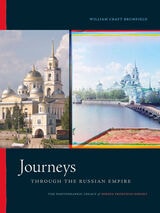
Journeys through the Russian Empire
The Photographic Legacy of Sergey Prokudin-GorskyWilliam Craft Brumfield
Duke University Press, 2020
At the turn of the twentieth century, the photographer Sergey Prokudin-Gorsky undertook a quest to document an empire that was undergoing rapid change due to industrialization and the building of railroads. Between 1903 and 1916 Prokudin-Gorsky, who developed a pioneering method of capturing color images on glass plates, scoured the Russian Empire with the patronage of Nicholas II. Intrepidly carrying his cumbersome and awkward camera from the western borderlands over the Volga River to Siberia and central Asia, he created a singular record of Imperial Russia.
In 1918 Prokudin-Gorsky escaped an increasingly chaotic, violent Russia and regained nearly 2,000 of his bulky glass negatives. His subsequent peripatetic existence before settling in Paris makes his collection's survival all the more miraculous. The U.S. Library of Congress acquired Prokudin-Gorsky's collection in 1948, and since then it has become a touchstone for understanding pre-revolutionary Russia. Now digitized and publicly available, his images are a sensation in Russia, where people visit websites dedicated to them.
William Craft Brumfield—photographer, scholar, and the leading authority on Russian architecture in the West—began working with Prokudin-Gorsky's photographs in 1985. He curated the first public exhibition of them in the United States and has annotated the entire collection. In Journeys through the Russian Empire, Brumfield—who has spent decades traversing Russia and photographing buildings and landscapes in their various stages of disintegration or restoration—juxtaposes Prokudin-Gorsky's images against those he took of the same buildings and areas. In examining the intersections between his own photography and that of Prokudin-Gorsky, Brumfield assesses the state of preservation of Russia's architectural heritage and calls into question the nostalgic assumptions of those who see Prokudin-Gorsky's images as the recovery of the lost past of an idyllic, pre-Soviet Russia.
This lavishly illustrated volume—which features some 400 stunning full-color images of ancient churches and mosques, railways and monasteries, towns and remote natural landscapes—is a testament to two brilliant photographers whose work prompts and illuminates, monument by monument, questions of conservation, restoration, and cultural identity and memory.
[more]
Just Below the Line
Disability, Housing, and Equity in the SouthKorydon H. Smith
University of Arkansas Press, 2010
With America on the brink of the largest number of older adults and persons with disabilities in the country’s history, the deceleration in housing production during the first decade of the twenty-first century, and a continued reliance on conventional housing policies and practices, a perfect storm has emerged in the housing industry. The lack of fit between the existing housing stock and the needs of the U.S. population is growing pronounced. Just as housing needed to be retooled at the end of WWII, the American housing industry is in dire need of change today. The South—with its high rates of poverty, older residents, residents with disabilities, extensive rural areas, and out-of-date housing policies and practices—serves as a “canary in the coal mine” for the impending, nationwide housing crisis. Just Below the Line discusses how reworking the policies and practices of the housing industry in the South can serve as a model for the rest of the nation in meeting the physical and social needs of persons with disabilities and aging boomers. Policy makers, designers, builders, realtors, advocates, and housing consumers will be able to use this book to promote the production of equitable housing nationwide.
Published in collaboration with the Fay Jones School of Architecture.
Published in collaboration with the Fay Jones School of Architecture.
[more]