Results by title
99 books match the query 'Art, Modern' and 2 start with j
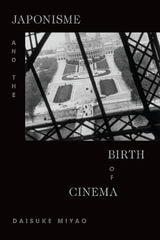
Japonisme and the Birth of Cinema
Daisuke Miyao
Duke University Press, 2020
In Japonisme and the Birth of Cinema, Daisuke Miyao explores the influence of Japanese art on the development of early cinematic visual style, particularly the actualité films made by the Lumière brothers between 1895 and 1905. Examining nearly 1,500 Lumière films, Miyao contends that more than being documents of everyday life, they provided a medium for experimenting with aesthetic and cinematic styles imported from Japan. Miyao further analyzes the Lumière films produced in Japan as a negotiation between French Orientalism and Japanese aesthetics. The Lumière films, Miyao shows, are best understood within a media ecology of photography, painting, and cinema, all indebted to the compositional principles of Japonisme and the new ideas of kinetic realism it inspired. The Lumière brothers and their cinematographers shared the contemporaneous obsession among Impressionist and Post-Impressionist artists about how to instantly and physically capture the movements of living things in the world. Their engagement with Japonisme, he concludes, constituted a rich and productive two-way conversation between East and West.
[more]
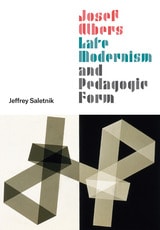
Josef Albers, Late Modernism, and Pedagogic Form
Jeffrey Saletnik
University of Chicago Press, 2022
An incisive analysis of the pedagogy of influential artist and teacher Josef Albers.
An extraordinary teacher whose influence continues today, Josef Albers helped shape the Bauhaus school in Germany and established the art and design programs at Black Mountain College in North Carolina and Yale University. His books about color theory have informed generations, and his artworks are included in the canon of high-modernist non-representational art. The pedagogy Albers developed was a dynamic approach to teaching that transcended the modernist agendas and cultivated a material way of thinking among his students.
With this book, Jeffrey Saletnik explores the origins of Albers’s teaching practices and their significance in conveying attitudes about form, material, and sensory understanding to artists Eva Hesse and Richard Serra. He demonstrates how pedagogy is a framework that establishes the possibility for artistic discourse and how the methods through which artists learn are manifested in their individual practices. Tracing through lines from Albers’s training in German educational traditions to his influence on American postwar art, Josef Albers, Late Modernism, and Pedagogic Form positions Albers’s pedagogy as central to the life of modernism.
[more]