Results by title
354 books match the query 'Authors, American' and 8 start with j
J. Frank Dobie
A Liberated MindBy Steven L. Davis
University of Texas Press, 2009
The first Texas-based writer to gain national attention, J. Frank Dobie proved that authentic writing springs easily from the native soil of Texas and the Southwest. In best-selling books such as Tales of Old-Time Texas, Coronado's Children, and The Longhorns, Dobie captured the Southwest's folk history, which was quickly disappearing as the United States became ever more urbanized and industrial. Renowned as "Mr. Texas," Dobie paradoxically has almost disappeared from view—a casualty of changing tastes in literature and shifts in social and political attitudes since the 1960s.
In this lively biography, Steven L. Davis takes a fresh look at a J. Frank Dobie whose "liberated mind" set him on an intellectual journey that culminated in Dobie becoming a political liberal who fought for labor, free speech, and civil rights well before these causes became acceptable to most Anglo Texans. Tracing the full arc of Dobie's life (1888–1964), Davis shows how Dobie's insistence on "free-range thinking" led him to such radical actions as calling for the complete integration of the University of Texas during the 1940s, as well as taking on governors, senators, and the FBI (which secretly investigated him) as Texas's leading dissenter during the McCarthy era.
Jack London's Women
Clarice Stasz
University of Massachusetts Press, 2001
Using newly available letters and diaries from private collections, Stasz brings this diverse constellation of women to life. London was the son of freethinking Flora Wellman, yet found more maternal comfort from freed slave Jennie Prentiss and his stepsister Eliza. His early loves included a British-born consumptive, a Jewish socialist, and an African American. His first wife, Bess Maddern, was a teacher and devoted mother to daughters Bess and Joan, while his second wife, Charmian Kittredge, shared his passion for adventure and served as a model for many characters in his writings. Following his death, the various women who survived him both promoted his legacy and suffered the consequences of being constantly identified with a famous man.
In recasting London's life through the eyes of three generations of women, Stasz manages to untangle his seemingly contradictory attitudes and actions. She also reveals the struggle that ensued, after his death, among family members and scholars over how he should be remembered. What emerges from this well-researched book is a new understanding of London and a compelling portrayal of the women who knew him best.
James Oliver Curwood
God's Country and the ManJudith A. Eldridge
University of Wisconsin Press, 1993
When the wounded bear he faced on a mountain ledge that day turned aside, James Curwood felt that he had been spared. From this encounter he became an avid conservationist. He wrote relentlessly—magazine stories and books and then for the new medium of motion pictures. Like many authors of his time, he was actively involved in movie-making until the plight of the forests and wildlife in his home state of Michigan turned his energies toward conservation.
A man ahead of his time, and quickly forgotten after his death in 1927, his gift of himself to his readers and to nature has finally come to be appreciated again two generations later.
Jean Stafford
The Savage HeartBy Charlotte Margolis Goodman
University of Texas Press, 1990
One of America's best short story writers and author of three fine novels, Boston Adventure (1944), The Mountain Lion (1947), and The Catherine Wheel (1952), Jean Stafford has been rediscovered by another generation of readers and scholars. Although her novels and her Pulitzer Prize–winning short stories were widely read in the 1940s and 1950s, her fiction has received less critical attention than that of other distinguished contemporary American women writers such as Carson McCullers, Flannery O'Connor, and Eudora Welty. In this literary biography, Charlotte M. Goodman traces the life of the brilliant yet troubled Jean Stafford and reassesses her importance.
Drawing on a wealth of original material, Goodman describes the vital connections between Stafford's life and her fiction. She discusses Stafford's difficult family relationships, her tempestuous first marriage to the poet Robert Lowell, her unresolved conflicts about gender roles, her alcoholism and bouts with depression—and her amazing ability to transform the chaotic details of her life into elegant works of fiction. These wonderfully crafted works offer insightful portraits of alienated and isolated characters, most of whom exemplify not only human estrangement in the modern world, but also the special difficulties of girls and women who refuse to play traditional roles.
Goodman locates Jean Stafford within the literary world of the 1940s and 1950s. In her own right, and through her marriages to Robert Lowell, Life magazine editor Oliver Jensen, and journalist A. J. Liebling, Stafford associated with many of the major literary figures of her day, including the Southern Fugitives, the New York intellectual coterie, and writers for the New Yorker, to which she regularly contributed short stories. Goodman also describes Stafford's sustaining friendships with other women writers, such as Evelyn Scott and Caroline Gordon, and with her New Yorker editor, Katharine S. White.
This highly readable biography will appeal to a wide audience interested in twentieth-century literature and the writing of women's lives.
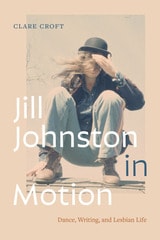
Jill Johnston in Motion
Dance, Writing, and Lesbian LifeClare Croft
Duke University Press, 2024
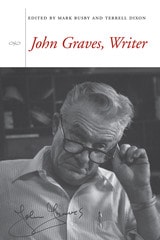
John Graves, Writer
Edited by Mark Busby and Terrell Dixon
University of Texas Press, 2007
Runner-up, Violet Crown Award, Writer's League of Texas, 2008
Renowned for Goodbye to a River, his now-classic meditation on the natural and human history of Texas, as well as for his masterful ability as a prose stylist, John Graves has become the dean of Texas letters for a legion of admiring readers and fellow writers. Yet apart from his own largely autobiographical works, including Hard Scrabble, From a Limestone Ledge, and Myself and Strangers, surprisingly little has been written about Graves's life or his work. John Graves, Writer seeks to fill that gap with interviews, appreciations, and critical essays that offer many new insights into the man himself, as well as the themes and concerns that animate his writing.
The volume opens with the transcript of a revealing, often humorous symposium session in which Graves responds to comments and stories from his old friend Sam Hynes, his former student and contemporary art critic Dave Hickey, and co-editor Mark Busby. Following this is a more formal interview of Graves by Dave Hamrick, who draws the author out on issues relating to each of his major works. John Graves's friends Bill Wittliff, Rick Bass, Bill Broyles, John R. Erickson, Bill Harvey, and James Ward Lee speak to the powerful influence that Graves has had on fellow writers.
In addition to these personal observations, nine scholars analyze essential aspects of Graves's work. These include the place of Goodbye to a River within environmental literature and how its writing was a rite of passage for its author; Graves as a prose stylist and a literary, rather than polemical, writer; the ways in which Graves's major works present different aspects of a single narrative about our relationship to the land; the question of gender in Graves's work; and Graves's sometimes contentious relationship with Texas Monthly magazine. Mark Busby introduces the volume with a critical overview of Graves's life and work, and Don Graham concludes it with a discussion of Graves's reception and literary reputation. A bibliography of works by and about Graves rounds out the book.
John Graves, Writer confirms Graves's stature not only within Texas letters, but also within American environmental writing, where Graves deserves to be more widely known.
Journal of the Fictive Life
Howard Nemerov
University of Chicago Press, 1981
"He often shows bravery and shrewdness; the book is full of fine criticism and psychological insight. As always, his prose has that ease and transparency that make one forget one is reading; one seems simply to hear a voice speaking. Nemerov's improvised self-analysis has weaknesses, but few that he himself doesn't eventually recognize."—New York Times Book Review
"In an age of explicitness, Nemerov's Journal of the Fictive Life is explicitly without vulgarity; in an age of revelation, it reveals only what counts. More then a book about creativity, it is a beautiful creation."—Richard G. Stern
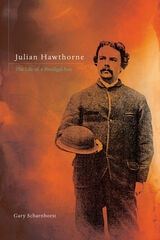
Julian Hawthorne
The Life of a Prodigal SonGary Scharnhorst
University of Illinois Press, 2014
Julian Hawthorne (1846-1934), Nathaniel Hawthorne's only son, lived a long and influential life marked by bad circumstances and worse choices. Raised among luminaries such as Thoreau, Emerson, and the Beecher family, Julian became a promising novelist in his twenties, but his writing soon devolved into mediocrity.
What talent the young Hawthorne had was spent chasing across the changing literary and publishing landscapes of the period in search of a paycheck, writing everything from potboilers to ad copy. Julian was consistently short of funds because--as biographer Gary Scharnhorst is the first to reveal--he was supporting two households: his wife in one and a longtime mistress in the other.
The younger Hawthorne's name and work ethic gave him influence in spite of his haphazard writing. Julian helped to found Cosmopolitan and Collier's Weekly. As a Hearst stringer, he covered some of the era's most important events: McKinley's assassination, the Galveston hurricane, and the Spanish-American War, among others.
When Julian died at age 87, he had written millions of words and more than 3,000 pieces, out-publishing his father by a ratio of twenty to one. Gary Scharnhorst, after his own long career including works on Mark Twain, Oscar Wilde, and other famous writers, became fascinated by the leaps and falls of Julian Hawthorne. This biography shows why.