Results by title
58 books match the query 'Basketball' and 4 start with j
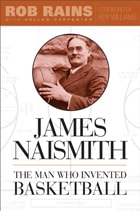
James Naismith
The Man Who Invented BasketballRob Rains with Hellen Carpenter, Foreword by Roy Williams
Temple University Press, 2009
James Naismith reveals how Naismith invented basketball in part to find an indoor activity to occupy students in the winter months. When he realized that the key to his game was that men could not run with the ball, and that throwing and jumping would eliminate the roughness of force, he was on to something. And while Naismith thought that other sports provided better exercise, he was pleased to create a game that “anyone could play.”
With unprecedented access to the Naismith archives and documents, Rains and Carpenter chronicle how Naismith developed the 13 rules of basketball, coached the game at the University of Kansas—establishing college basketball in the process—and was honored for his work at the 1936 Olympic games in Berlin.
Jesse Crosse
a novelMichael J. Moran
Parkhurst Brothers, Inc., 2011
Mike Moran first attended Little Rock Catholic High School for Boys-all four years. On the basketball team, he was a point guard. Then, as "Mr. Moran," he taught English for forty years, also at Little Rock Catholic High School for Boys. Recently retired, Moran wrote the boys a novel. The tale revolves around a struggling small-town basketball team with a nerdy manager and a Walter Mittyesque coach. Presented with too few players to scrimmage in practice, the manager takes it upon himself to spread the word throughout the school: "We need you on the team." Three young students appear, diminutive in stature and with scrawny chests, unimpressive at first sight. But with the trio, and their fleet leader Jesse Crosse, the team first experiences shock, then inspiration and constant surprises. The team bonds, leading to stories that will be retold a very long time in a small, out-of-the-way town. It's not a long novel; like one's high school years, it goes by before you know it. Only the message is eternal.
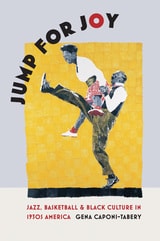
Jump for Joy
Jazz, Basketball, and Black Culture in 1930s AmericaGena Caponi-Tabery
University of Massachusetts Press, 2008
If the 1930s was the Swing Era, then the years from 1937 on might well be called the Jump Era. That summer Count Basie recorded “Jumping at the Woodside,” and suddenly jump tunes seemed to be everywhere. Along with the bouncy beat came a new dance step—the high-flying aerials of the jitterbuggers—and the basketball games that took place in the dance halls of African America became faster, higher, and flashier. Duke Ellington and a cast of hundreds put the buoyant spirit of the era on stage with their 1941 musical revue, Jump for Joy, a title that captured the momentum and direction of the new culture of exuberance.
Several high-profile public victories accompanied this increasing optimism: the spectacular successes of African American athletes at the 1936 Olympics, the 1937 union victory of the Brotherhood of Sleeping Car Porters, and Joe Louis's 1937 and 1938 heavyweight championship fights. For the first time in history, Black Americans emerged as cultural heroes and ambassadors, and many felt a new pride in citizenship.
In this book, Gena Caponi-Tabery chronicles these triumphs and shows how they shaped American music, sports, and dance of the 1930s and beyond. But she also shows how they emboldened ordinary African Americans to push for greater recognition and civil liberties—how cultural change preceded and catalyzed political action.
Tracing the path of one symbolic gesture—the jump—across cultural and disciplinary boundaries, Caponi-Tabery provides a unique political, intellectual, and artistic analysis of the years immediately preceding World War II.
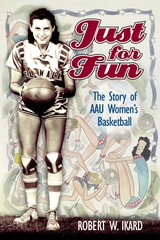
Just for Fun
The Story of AAU Women's BasketballRobert Ikard
University of Arkansas Press, 2005
Prior to the 1972 passage of Title IX, women’s basketball was a minor sport in the United States. It was played by companies such as Cook’s Goldblume Beer and Sunoco and for obscure colleges such as Iowa Wesleyan and Wayland Baptist as part of the Amateur Athletic Union (AAU). But during the two generations of the mid-twentieth century, women’s basketball improved and became more popular throughout the country. AAU All-Star teams dominated women’s international basketball until the emergence of subsidized national teams in the 1960s.
The women who played on these AAU teams helped to lay the foundation for women’s athletics today. Most of the teams came from central and southern states, and most of the players had rural origins. “Country girls” from Arkansas, Iowa, Oklahoma, Tennessee, and Texas competed at an elite level unknown to their city sisters. The AAU formed several successful international teams of gifted players that gained fame abroad but that were anonymous at home. Until nearly the last quarter of the century, skilled women basketball players had only one option after high school: the AAU.
This is the history of these gifted women, their coaches, and their teams—their records, motivations, and personal stories. Extensively illustrated, Just for Fun is the first book to thoroughly explore the complex history of the Amateur Athletic Union’s women’s basketball program and to bring to light the four decades of women’s basketball all but forgotten in the current success of women’s athletics.