384 books match the query 'Black Studies (Global)' and 3 start with j

cover of Journal of a Homecoming / Cahier d'un retour au pays natal

Journal of a Homecoming / Cahier d'un retour au pays natal

Aimé Césaire

Duke University Press, 2017
Originally published in 1939, Aimé Césaire’s Cahier d’un retour au pays natal is a landmark of modern French poetry and a founding text of the Négritude movement. This bilingual edition features a new authoritative translation, revised introduction, and extensive commentary, making it a magisterial edition of Césaire’s surrealist masterpiece.
[more]
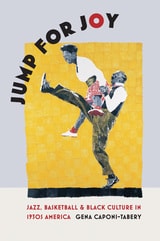
cover of Jump for Joy: Jazz, Basketball, and Black Culture in 1930s America

Jump for Joy

Jazz, Basketball, and Black Culture in 1930s America

Gena Caponi-Tabery

University of Massachusetts Press, 2008

If the 1930s was the Swing Era, then the years from 1937 on might well be called the Jump Era. That summer Count Basie recorded “Jumping at the Woodside,” and suddenly jump tunes seemed to be everywhere. Along with the bouncy beat came a new dance step—the high-flying aerials of the jitterbuggers—and the basketball games that took place in the dance halls of African America became faster, higher, and flashier. Duke Ellington and a cast of hundreds put the buoyant spirit of the era on stage with their 1941 musical revue, Jump for Joy, a title that captured the momentum and direction of the new culture of exuberance. 

Several high-profile public victories accompanied this increasing optimism: the spectacular successes of African American athletes at the 1936 Olympics, the 1937 union victory of the Brotherhood of Sleeping Car Porters, and Joe Louis's 1937 and 1938 heavyweight championship fights. For the first time in history, Black Americans emerged as cultural heroes and ambassadors, and many felt a new pride in citizenship. 

In this book, Gena Caponi-Tabery chronicles these triumphs and shows how they shaped American music, sports, and dance of the 1930s and beyond. But she also shows how they emboldened ordinary African Americans to push for greater recognition and civil liberties—how cultural change preceded and catalyzed political action. 

Tracing the path of one symbolic gesture—the jump—across cultural and disciplinary boundaries, Caponi-Tabery provides a unique political, intellectual, and artistic analysis of the years immediately preceding World War II.

[more]
cover of Just Neighbors?: Research on African American and Latino Relations in the United States

Just Neighbors?

Research on African American and Latino Relations in the United States

Edward Telles

Russell Sage Foundation, 2012

Blacks and Latinos have transformed the American city—together these groups now constitute the majority in seven of the ten largest cities. Large-scale immigration from Latin America has been changing U.S. racial dynamics for decades, and Latino migration to new destinations is changing the face of the American south. Yet most of what social science has helped us to understand about these groups has been observed primarily in relation to whites—not each other. Just Neighbors? challenges the traditional black/white paradigm of American race relations by examining African Americans and Latinos as they relate to each other in the labor market, the public sphere, neighborhoods, and schools. The book shows the influence of race, class, and received stereotypes on black-Latino social interactions and offers insight on how finding common ground may benefit both groups. From the labor market and political coalitions to community organizing, street culture, and interpersonal encounters, Just Neighbors? analyzes a spectrum of Latino-African American social relations to understand when and how these groups cooperate or compete. Contributor Frank Bean and his co-authors show how the widely held belief that Mexican immigration weakens job prospects for native-born black workers is largely unfounded—especially as these groups are rarely in direct competition for jobs. Michael Jones-Correa finds that Latino integration beyond the traditional gateway cities promotes seemingly contradictory feelings: a sense of connectedness between the native minority and the newcomers but also perceptions of competition. Mark Sawyer explores the possibilities for social and political cooperation between the two groups in Los Angeles and finds that lingering stereotypes among both groups, as well as negative attitudes among blacks about immigration, remain powerful but potentially surmountable forces in group relations. Regina Freer and Claudia Sandoval examine how racial and ethnic identity impacts coalition building between Latino and black youth and find that racial pride and a sense of linked fate encourages openness to working across racial lines. Black and Latino populations have become a majority in the largest U.S. cities, yet their combined demographic dominance has not abated both groups' social and economic disadvantage in comparison to whites. Just Neighbors? lays a much-needed foundation for studying social relations between minority groups. This trailblazing book shows that, neither natural allies nor natural adversaries, Latinos and African Americans have a profound potential for coalition-building and mutual cooperation. They may well be stronger together rather than apart.
[more]