3071 books match the query 'Business & Economics' and 108 start with j

cover of JLE vol 61 num 4

JLE vol 61 num 4

The University of Chicago Press

University of Chicago Press Journals, 2018

This is volume 61 issue 4 of The Journal of Law and Economics. Established in 1958, the Journal of Law and Economics publishes research on a broad range of topics, including the economic analysis of law, the economic analysis of regulation and the behavior of regulated firms, industrial organization and antitrust policy, the political economy of legislation and legislative processes, law and finance, and corporate finance and governance. The JLE has published some of the most influential and widely cited articles in these areas. It is an invaluable resource for academics and those interested in cutting-edge analysis of current public policy issues.
[more]
cover of Jacob H. Schiff: A Study in American Jewish Leadership

Jacob H. Schiff

A Study in American Jewish Leadership

Naomi W. Cohen

Brandeis University Press, 1999

The life of Jacob Schiff (1847 - 1920), banker, financier, and leader of the American Jewish community from 1880 to 1920, is in many ways the quintessential story of an immigrant's success in America. Born in Frankfurt in 1847, Schiff worked in several financial firms in Germany and the US before accepting a position at the New York banking firm of Kuhn, Loeb & Company in 1875 and settling for good in America. Part of a wealthy and powerful German Jewish circle that included the Warburgs and Rothschilds, Schiff played a central role in shaping American and European Jewish history. From his base on Wall Street, he was the foremost Jewish leader in what became known as the "Schiff era," grappling with all major issues and problems of the day, including the plight of Russian Jews under the czar, American and international anti-Semitism, care of needy Jewish immigrants, and the rise of Zionism. Based on a broad range of primary sources, Naomi W. Cohen's study emphasizes the role Schiff played as the preeminent leader of American Jewry at the turn of the century.
[more]
cover of Jakarta: City of a Thousand Dimensions

Jakarta

City of a Thousand Dimensions

Abidin Kusno

National University of Singapore Press, 2023

A study of the forces that shaped Jakarta into the city it is today.

Indonesian writer Seno Gumira Ajidarma has called Jakarta a city of a thousand dimensions. A megacity of 30 million under threat from rising sea levels and temperatures, Jakarta and its resilient residents improvise and thrive. This book teases out some of the dimensions that have given shape to contemporary Jakarta, including the city’s expanded flexibility in accommodating capital and labor, and the consistent lack of planning that can be understood as a result of both politics and the poetics of governing in the region. Jakarta is essential reading for those seeking to understand one of Asia's most dynamic cities.
[more]
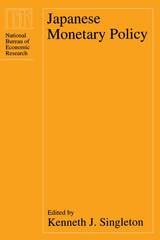
cover of Japanese Monetary Policy

Japanese Monetary Policy

Edited by Kenneth J. Singleton

University of Chicago Press, 1993

How has the Bank of Japan (BOJ) helped shape Japan's economic growth during the past two decades? This book comprehensively explores the relations between financial market liberalization and BOJ policies and examines the ways in which these policies promoted economic growth in the 1980s. The authors argue that the structure of Japan's financial markets, particularly restrictions on money-market transactions and the key role of commercial banks in financing corporate investments, allowed the BOJ to influence Japan's economic success.

The first two chapters provide the most in-depth English-language discussion of the BOJ's operating procedures and policymaker's views about how BOJ actions affect the Japanese business cycle. Chapter three explores the impact of the BOJ's distinctive window guidance policy on corporate investment, while chapter four looks at how monetary policy affects the term structure of interest rates in Japan. The final two chapters examine the overall effect of monetary policy on real aggregate economic activity.

This volume will prove invaluable not only to economists interested in the technical operating procedures of the BOJ, but also to those interested in the Japanese economy and in the operation and outcome of monetary reform in general.
[more]
cover of Japan’s Economy in War and Reconstruction

Japan’s Economy in War and Reconstruction

Jerome B. Cohen

University of Minnesota Press, 1949

Japan's Economy in War and Reconstruction was first published in 1949. Minnesota Archive Editions uses digital technology to make long-unavailable books once again accessible, and are published unaltered from the original University of Minnesota Press editions.

Dr. Cohen's substantial monograph is a carefully documented account of Japan's economic development from 1937 to 1949. It describes with much statistical evidence a remarkable experiment in planned industrial expansion prior to 1941, then continues with a survey of the war years, showing both the successes and failures of the planning, controlling, financing, and developing of Japan's war industries.

The last part of the book deals with the post-war problems of Japan from the war's end to the latter part of 1948—three years of occupation by the Allied Powers. Dr. Cohen discusses the three key economic factors: the basic reforms, the rapidly mounting inflation, and the slowly increasing, but still low level of production.

Dr. Cohen's first chapter is devoted to the careful planning of the years before the war. The next chapters discuss Japan's efforts to cope with the problems of munitions, food supply, and labor as the Allied war effort gradually wore her down. There are detailed studies of separate industries, shipping, and agriculture, and a discussion of the parts played respectively by air, sea, and land operations in the destruction of Japan's ability to wage successful war.

One of the main theses of these chapters is that the increasingly enveloping blockade of Japan shut off necessary industrial raw materials, and so brought Japanese war production to a virtual standstill before the main weight of the strategic air attack was delivered, and so made it impossible for Japan to continue the war.

The author's grim picture of inter-service quarrels and overlapping and inconsistent controls demonstrates that the Japanese army, navy, and civil service, in spite of their reputation for exact and strict organization, in practice failed to make good use of their unlimited powers.

[more]
cover of Jewish Mad Men: Advertising and the Design of the American Jewish Experience

Jewish Mad Men

Advertising and the Design of the American Jewish Experience

Steinberg, Kerri P

Rutgers University Press, 2015

It is easy to dismiss advertising as simply the background chatter of modern life, often annoying, sometimes hilarious, and ultimately meaningless. But Kerri P. Steinberg argues that a careful study of the history of advertising can reveal a wealth of insight into a culture. In Jewish Mad Men, Steinberg looks specifically at how advertising helped shape the evolution of American Jewish life and culture over the past one hundred years.  

Drawing on case studies of famous advertising campaigns—from Levy’s Rye Bread (“You don’t have to be Jewish to love Levy’s”) to Hebrew National hot dogs (“We answer to a higher authority”)—Steinberg examines advertisements from the late nineteenth-century in New York, the center of advertising in the United States, to trace changes in Jewish life there and across the entire country. She looks at ads aimed at the immigrant population, at suburbanites in midcentury, and at hipster and post-denominational Jews today. 

In addition to discussing campaigns for everything from Manischewitz wine to matzoh, Jewish Mad Men also portrays the legendary Jewish figures in advertising—like Albert Lasker and Bill Bernbach—and lesser known “Mad Men” like Joseph Jacobs, whose pioneering agency created the brilliantly successful Maxwell House Coffee Haggadah. Throughout, Steinberg uses the lens of advertising to illuminate the Jewish trajectory from outsider to insider, and the related arc of immigration, acculturation, upward mobility, and suburbanization.

Anchored in the illustrations, photographs, jingles, and taglines of advertising, Jewish Mad Men features a dozen color advertisements and many black-and-white images. Lively and insightful, this book offers a unique look at both advertising and Jewish life in the United States.
[more]
cover of Job Loss, Identity, and Mental Health

Job Loss, Identity, and Mental Health

Norris, Dawn R

Rutgers University Press, 2016
Our jobs are often a big part of our identities, and when we are fired, we can feel confused, hurt, and powerless—at sea in terms of who we are. Drawing on extensive, real-life interviews, Job Loss, Identity, and Mental Health shines a light on the experiences of unemployed, middle-class professional men and women, showing how job loss can affect both identity and mental health.
 
Sociologist Dawn R. Norris uses in-depth interviews to offer insight into the experience of losing a job—what it means for daily life, how the unemployed feel about it, and the process they go through as they try to deal with job loss and their new identities as unemployed people. Norris highlights several specific challenges to identity that can occur. For instance, the way other people interact with the unemployed either helps them feel sure about who they are, or leads them to question their identities. Another identity threat happens when the unemployed no longer feel they are the same person they used to be. Norris also examines the importance of the subjective meaning people give to statuses, along with the strong influence of society’s expectations. For example, men in Norris’s study often used the stereotype of the “male breadwinner” to define who they were. Job Loss, Identity, and Mental Health describes various strategies to cope with identity loss, including “shifting” away from a work-related identity and instead emphasizing a nonwork identity (such as “a parent”), or conversely “sustaining” a work-related identity even though he or she is actually unemployed. Finally, Norris explores the social factors—often out of the control of unemployed people—that make these strategies possible or impossible.
 
A compelling portrait of a little-studied aspect of the Great Recession, Job Loss, Identity, and Mental Health is filled with insight into the identity crises that unemployment can trigger, as well as strategies to help the unemployed maintain their mental strength.
 
[more]
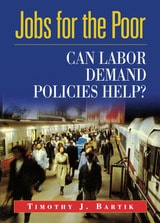
cover of Jobs for the Poor: Can Labor Demand Policies Help?

Jobs for the Poor

Can Labor Demand Policies Help?

Timothy J. Bartik

Russell Sage Foundation, 2001

Even as the United States enjoys a booming economy and historically low levels of unemployment, millions of Americans remain out of work or underemployed, and joblessness continues to plague many urban communities, racial minorities, and people with little education. In Jobs for the Poor, Timothy Bartik calls for a dramatic shift in the way the United States confronts this problem. Today, most efforts to address this problem focus on ways to make workers more employable, such as job training and welfare reform. But Bartik argues that the United States should put more emphasis on ways to increase the interest of employers in creating jobs for the poor—or the labor demand side of the labor market. Bartik's bases his case for labor demand policies on a comprehensive review of the low-wage labor market. He examines the effectiveness of government interventions in the labor market, such as Welfare Reform, the Earned Income Tax Credit, and Welfare-to-Work programs, and asks if having a job makes a person more employable. Bartik finds that public service employment and targeted employer wage subsidies can increase employment among the poor. In turn, job experience significantly increases the poor's long-run earnings by enhancing their skills and reputation with employers. And labor demand policies can avoid causing inflation or displacing other workers by targeting high-unemployment labor markets and persons who would otherwise be unemployed. Bartik concludes by proposing a large-scale labor demand program. One component of the program would give a tax credit to employers in areas of high unemployment. To provide disadvantaged workers with more targeted help, Bartik also recommends offering short-term subsidies to employers—particularly small businesses and nonprofit organizations—that hire people who otherwise would be unlikely to find jobs. With experience from subsidized jobs, the new workers should find it easier to obtain future year-round employment. Although these efforts would not catapult poor families into the middle class overnight, Bartik offers a powerful argument that having a full-time worker in every household would help improve the lives of millions. Jobs for the Poor makes a compelling case that full employment can be achieved if the country has the political will and adopts policies that address both sides of the labor market. Copublished with the W. E. Upjohn Institute for Economic Research
[more]
cover of Joe McCarthy and the Press

Joe McCarthy and the Press

Edwin R. Bayley

University of Wisconsin Press, 2003

This is a book for historians, journalists—and for all of us who need to remember this turbulent time on our nation's past, and its lessons for today.
[more]
cover of John H. Burdakin and the Grand Trunk Western Railroad

John H. Burdakin and the Grand Trunk Western Railroad

Mary Sharp

Michigan State University Press, 2016

John H. Burdakin and the Grand Trunk Western Railroad provides a look at the principles and personal values that guided John H. Burdakin through a long, successful career as a top manager at three railroads—the Pennsylvania, the Penn Central, and finally the Grand Trunk Western, where he was president of the regional carrier from 1974 to 1986. The book, written from interviews with Burdakin before his death in 2014, gives real-life examples of how Burdakin’s management principles and personal qualities helped him solve labor- management problems, update railroad technology, protect worker safety, and improve employee morale while managing a four thousand–person workforce. It introduces colorful characters who were involved in American railroads, as well as the serious, life-threatening issues that confronted railroads in the last half of the twentieth century in America. This book will provide insights for managers of any business as well as for those seeking to balance a successful career and a rewarding home life.
 
 
[more]
cover of John H. Burdakin: Railroader

John H. Burdakin

Railroader

Don L. Hofsommer

Michigan State University Press, 2015

Genuinely talented and successful managers in any field—business, government, military, academia—are scarce. John Howard Burdakin was a happy exception to the norm. This engaging biography examines Burdakin’s life in the railroad industry—at Pennsylvania Railroad, Penn Central, and finally at Grand Trunk Corporation—during a tumultuous time in the transportation business and underscores his core principles and how he employed them in the management of people and property. Some contemporary observers may consider Burdakin’s often conservative style as quite out of date, but a more sober assessment reveals that his approach has utility in any time and in any field. An excellent resource for leadership professionals, this study focuses on Burdakin’s career in management, ever stressing his foundational convictions—how he came by them, how he employed those principles as a manager, and how they were understood by those who worked for him or with him. Through teamwork, trust, hard work, honesty, diligence, and integrity, Burdakin would become respected as one of the railroad industry’s brightest guiding lights.
[more]
cover of John Kenneth Galbraith: His Life, His Politics, His Economics

John Kenneth Galbraith

His Life, His Politics, His Economics

Richard Parker

University of Chicago Press, 2006

John Kenneth Galbraith (1908-2006) was one of America’s most famous economists for good reason. From his acerbic analysis of America’s “private wealth and public squalor” to his denunciation of the wars in Vietnam and Iraq, Galbraith consistently challenged “conventional wisdom” (a phrase he coined). He did so as a witty commentator on America’s political follies and as a versatile author of bestselling books—such as The Affluent Society and The New Industrial State—that warn of the dangers of deregulated markets, corporate greed, and inattention to the costs of our military power. Here, in the first full-length biography of Galbraith and his times, Richard Parker provides not only a nuanced portrait of this extraordinary man, but also an important reinterpretation of twentieth-century public policy and economic practices.

“Whatever you may think of his ideas, John Kenneth Galbraith has led an extraordinary life. . . . Doing justice to this life story requires an outsize biography, one that not only tells Mr. Galbraith’s tale but sets it on the broader canvas of America’s political and economic evolution. And Richard Parker’s book does just that.”—Economist

“Parker’s book is more than a chronicle of Galbraith’s life; it’s a history of American politics and policy from FDR through George W. Bush. . . . It will make readers more economically and politically aware.”—USA Today

 “The most readable and instructive biography of the century.”—William F. Buckley, National Review


“The story of this man’s life and work is wonderfully rendered in this magnum opus, and offers an antidote to the public ennui, economic cruelty, and government malfeasance that poison life in America today.”—James Carroll, Boston Globe

[more]
cover of John L. Lewis: A Biography

John L. Lewis

A Biography

Melvyn Dubofsky and Warren Van Tine

University of Illinois Press, 1986

John L. Lewis (1880-1969), who ruled the United Mine Workers for four decades beginning in 1919, defied presidents, challenged Congress, and kept American political life in an uproar. Drawing upon previously untapped resources in the UMW archives and upon oral histories by major figures of the 1930s and 1940s, the authors have created a remarkable portrait of this 'self-made man' and his times.
 
 
[more]
cover of John Locke: Economist and Social Scientist

John Locke

Economist and Social Scientist

Karen Iversen Vaughn

University of Chicago Press, 1980

In John Locke: Economist and Social Scientist Karen Iversen Vaughn presents a comprehensive treatment of Locke's important position in the development of eighteenth century economic thought.
[more]
cover of John Nelligan: Wisconsin Lumberjack

John Nelligan

Wisconsin Lumberjack

John Zimm

Wisconsin Historical Society Press, 2015

Experience the adventures and tough life of a lumberjack in this newest addition to the Badger Biographies Series. Author John Zimm leads young readers on a journey through the lumbering heyday of Wisconsin’s North Woods as witnessed by lumberman John Nelligan, whose writings were the basis for John Nelligan: Wisconsin Lumberjack.
 
Born in 1852, Nelligan rose through the lumberjack ranks, starting out as a humble laborer and working his way up to foreman. He worked and lived in Maine, Pennsylvania, and even Canada before coming to Wisconsin in 1871. Learn what surviving and sawing wood for a living was like many years ago—from the story of one Wisconsin man who lived it!
[more]
cover of Journal of Human Capital, volume 16 number 3 (Fall 2022)

Journal of Human Capital, volume 16 number 3 (Fall 2022)

The University of Chicago Press

University of Chicago Press Journals, 2022
[more]
cover of Journal of Human Capital, volume 16 number 4 (Winter 2022)

Journal of Human Capital, volume 16 number 4 (Winter 2022)

The University of Chicago Press

University of Chicago Press Journals, 2022

This is volume 16 issue 4 of Journal of Human Capital. The Journal of Human Capital (JHC) is dedicated to human capital and its expanding economic and social roles in the contemporary knowledge economy. It explores the role human capital plays in the production, allocation, and distribution of economic resources and in supporting long-term economic growth and development. JHC is designed to bring together theoretical and empirical work on human capital—broadly defined to include education, skill, health, entrepreneurship, and intellectual and social capital—and related public policy issues.
[more]
cover of Journal of Human Capital, volume 17 number 1 (Spring 2023)

Journal of Human Capital, volume 17 number 1 (Spring 2023)

The University of Chicago Press

University of Chicago Press Journals, 2023
This is volume 17 issue 1 of Journal of Human Capital. The Journal of Human Capital (JHC) is dedicated to human capital and its expanding economic and social roles in the contemporary knowledge economy. It explores the role human capital plays in the production, allocation, and distribution of economic resources and in supporting long-term economic growth and development. JHC is designed to bring together theoretical and empirical work on human capital—broadly defined to include education, skill, health, entrepreneurship, and intellectual and social capital—and related public policy issues.
[more]
cover of Journal of Human Capital, volume 17 number 2 (Summer 2023)

Journal of Human Capital, volume 17 number 2 (Summer 2023)

The University of Chicago Press

University of Chicago Press Journals, 2023
This is volume 17 issue 2 of Journal of Human Capital. The Journal of Human Capital (JHC) is dedicated to human capital and its expanding economic and social roles in the contemporary knowledge economy. It explores the role human capital plays in the production, allocation, and distribution of economic resources and in supporting long-term economic growth and development. JHC is designed to bring together theoretical and empirical work on human capital—broadly defined to include education, skill, health, entrepreneurship, and intellectual and social capital—and related public policy issues.
[more]
cover of Journal of Human Capital, volume 17 number 3 (Fall 2023)

Journal of Human Capital, volume 17 number 3 (Fall 2023)

The University of Chicago Press

University of Chicago Press Journals, 2023

This is volume 17 issue 3 of Journal of Human Capital. The Journal of Human Capital (JHC) is dedicated to human capital and its expanding economic and social roles in the contemporary knowledge economy. It explores the role human capital plays in the production, allocation, and distribution of economic resources and in supporting long-term economic growth and development. JHC is designed to bring together theoretical and empirical work on human capital—broadly defined to include education, skill, health, entrepreneurship, and intellectual and social capital—and related public policy issues.
[more]
cover of Journal of Human Capital, volume 17 number 4 (Winter 2023)

Journal of Human Capital, volume 17 number 4 (Winter 2023)

The University of Chicago Press

University of Chicago Press Journals, 2023
This is volume 17 issue 4 of Journal of Human Capital. The Journal of Human Capital (JHC) is dedicated to human capital and its expanding economic and social roles in the contemporary knowledge economy. It explores the role human capital plays in the production, allocation, and distribution of economic resources and in supporting long-term economic growth and development. JHC is designed to bring together theoretical and empirical work on human capital—broadly defined to include education, skill, health, entrepreneurship, and intellectual and social capital—and related public policy issues.
[more]
cover of Journal of Human Capital, volume 18 number 1 (Spring 2024)

Journal of Human Capital, volume 18 number 1 (Spring 2024)

The University of Chicago Press

University of Chicago Press Journals, 2024
This is volume 18 issue 1 of Journal of Human Capital. The Journal of Human Capital (JHC) is dedicated to human capital and its expanding economic and social roles in the contemporary knowledge economy. It explores the role human capital plays in the production, allocation, and distribution of economic resources and in supporting long-term economic growth and development. JHC is designed to bring together theoretical and empirical work on human capital—broadly defined to include education, skill, health, entrepreneurship, and intellectual and social capital—and related public policy issues.
[more]
cover of Journal of Human Capital, volume 18 number 2 (Summer 2024)

Journal of Human Capital, volume 18 number 2 (Summer 2024)

The University of Chicago Press

University of Chicago Press Journals, 2024
This is volume 18 issue 2 of Journal of Human Capital. The Journal of Human Capital (JHC) is dedicated to human capital and its expanding economic and social roles in the contemporary knowledge economy. It explores the role human capital plays in the production, allocation, and distribution of economic resources and in supporting long-term economic growth and development. JHC is designed to bring together theoretical and empirical work on human capital—broadly defined to include education, skill, health, entrepreneurship, and intellectual and social capital—and related public policy issues.
[more]
cover of Journal of Human Capital, volume 18 number 3 (Fall 2024)

Journal of Human Capital, volume 18 number 3 (Fall 2024)

The University of Chicago Press

University of Chicago Press Journals, 2024
This is volume 18 issue 3 of Journal of Human Capital. The Journal of Human Capital (JHC) is dedicated to human capital and its expanding economic and social roles in the contemporary knowledge economy. It explores the role human capital plays in the production, allocation, and distribution of economic resources and in supporting long-term economic growth and development. JHC is designed to bring together theoretical and empirical work on human capital—broadly defined to include education, skill, health, entrepreneurship, and intellectual and social capital—and related public policy issues.
[more]
cover of Journal of Human Capital, volume 18 number 4 (Winter 2024)

Journal of Human Capital, volume 18 number 4 (Winter 2024)

The University of Chicago Press

University of Chicago Press Journals, 2024
This is volume 18 issue 4 of Journal of Human Capital. The Journal of Human Capital (JHC) is dedicated to human capital and its expanding economic and social roles in the contemporary knowledge economy. It explores the role human capital plays in the production, allocation, and distribution of economic resources and in supporting long-term economic growth and development. JHC is designed to bring together theoretical and empirical work on human capital—broadly defined to include education, skill, health, entrepreneurship, and intellectual and social capital—and related public policy issues.
[more]
cover of Journal of Human Capital, volume 19 number 1 (Spring 2025)

Journal of Human Capital, volume 19 number 1 (Spring 2025)

The University of Chicago Press

University of Chicago Press Journals, 2025
This is volume 19 issue 1 of Journal of Human Capital. The Journal of Human Capital (JHC) is dedicated to human capital and its expanding economic and social roles in the contemporary knowledge economy. It explores the role human capital plays in the production, allocation, and distribution of economic resources and in supporting long-term economic growth and development. JHC is designed to bring together theoretical and empirical work on human capital—broadly defined to include education, skill, health, entrepreneurship, and intellectual and social capital—and related public policy issues.
[more]
cover of Journal of Human Capital, volume 19 number 2 (Summer 2025)

Journal of Human Capital, volume 19 number 2 (Summer 2025)

The University of Chicago Press

University of Chicago Press Journals, 2025

This is volume 19 issue 2 of Journal of Human Capital. The Journal of Human Capital (JHC) is dedicated to human capital and its expanding economic and social roles in the contemporary knowledge economy. It explores the role human capital plays in the production, allocation, and distribution of economic resources and in supporting long-term economic growth and development. JHC is designed to bring together theoretical and empirical work on human capital—broadly defined to include education, skill, health, entrepreneurship, and intellectual and social capital—and related public policy issues.
[more]
cover of Journal of Human Capital, volume 19 number 3 (Fall 2025)

Journal of Human Capital, volume 19 number 3 (Fall 2025)

The University of Chicago Press

University of Chicago Press Journals, 2025

This is volume 19 issue 3 of Journal of Human Capital. The Journal of Human Capital (JHC) is dedicated to human capital and its expanding economic and social roles in the contemporary knowledge economy. It explores the role human capital plays in the production, allocation, and distribution of economic resources and in supporting long-term economic growth and development. JHC is designed to bring together theoretical and empirical work on human capital—broadly defined to include education, skill, health, entrepreneurship, and intellectual and social capital—and related public policy issues.
[more]
cover of Journal of Human Capital, volume 19 number 4 (Winter 2025)

Journal of Human Capital, volume 19 number 4 (Winter 2025)

The University of Chicago Press

University of Chicago Press Journals, 2025
This is volume 19 issue 4 of Journal of Human Capital. The Journal of Human Capital (JHC) is dedicated to human capital and its expanding economic and social roles in the contemporary knowledge economy. It explores the role human capital plays in the production, allocation, and distribution of economic resources and in supporting long-term economic growth and development. JHC is designed to bring together theoretical and empirical work on human capital—broadly defined to include education, skill, health, entrepreneurship, and intellectual and social capital—and related public policy issues.
[more]
cover of Journal of Human Capital, volume 20 number 1 (Spring 2026)

Journal of Human Capital, volume 20 number 1 (Spring 2026)

The University of Chicago Press

University of Chicago Press Journals, 2026
This is volume 20 issue 1 of Journal of Human Capital. The Journal of Human Capital (JHC) is dedicated to human capital and its expanding economic and social roles in the contemporary knowledge economy. It explores the role human capital plays in the production, allocation, and distribution of economic resources and in supporting long-term economic growth and development. JHC is designed to bring together theoretical and empirical work on human capital—broadly defined to include education, skill, health, entrepreneurship, and intellectual and social capital—and related public policy issues.
[more]
cover of Journal of Human Capital, volume 20 number 2 (Summer 2026)

Journal of Human Capital, volume 20 number 2 (Summer 2026)

The University of Chicago Press

University of Chicago Press Journals, 2026

This is volume 20 issue 2 of Journal of Human Capital. The Journal of Human Capital (JHC) is dedicated to human capital and its expanding economic and social roles in the contemporary knowledge economy. It explores the role human capital plays in the production, allocation, and distribution of economic resources and in supporting long-term economic growth and development. JHC is designed to bring together theoretical and empirical work on human capital—broadly defined to include education, skill, health, entrepreneurship, and intellectual and social capital—and related public policy issues.
[more]
cover of Journal of Human Capital, volume 20 number 3 (Fall 2026)

Journal of Human Capital, volume 20 number 3 (Fall 2026)

The University of Chicago Press

University of Chicago Press Journals, 2026

This is volume 20 issue 3 of Journal of Human Capital. The Journal of Human Capital (JHC) is dedicated to human capital and its expanding economic and social roles in the contemporary knowledge economy. It explores the role human capital plays in the production, allocation, and distribution of economic resources and in supporting long-term economic growth and development. JHC is designed to bring together theoretical and empirical work on human capital—broadly defined to include education, skill, health, entrepreneurship, and intellectual and social capital—and related public policy issues.
[more]
cover of Journal of Labor Economics, volume 40 number 3 (July 2022)

Journal of Labor Economics, volume 40 number 3 (July 2022)

The University of Chicago Press

University of Chicago Press Journals, 2022

[more]
cover of Journal of Labor Economics, volume 40 number 4 (October 2022)

Journal of Labor Economics, volume 40 number 4 (October 2022)

The University of Chicago Press

University of Chicago Press Journals, 2022
[more]
cover of Journal of Labor Economics, volume 41 number 1 (January 2023)

Journal of Labor Economics, volume 41 number 1 (January 2023)

The University of Chicago Press

University of Chicago Press Journals, 2023
This is volume 41 issue 1 of Journal of Labor Economics. Founded in 1983 as the first journal devoted specifically to labor economics, the Journal of Labor Economics (JOLE) presents international research on issues affecting social and private behavior, and the economy. JOLE’s contributors investigate various aspects of labor economics, including supply and demand of labor services, personnel economics, distribution of income, unions and collective bargaining, applied and policy issues in labor economics, and labor markets and demographics.
[more]
cover of Journal of Labor Economics, volume 41 number 2 (April 2023)

Journal of Labor Economics, volume 41 number 2 (April 2023)

The University of Chicago Press

University of Chicago Press Journals, 2023
This is volume 41 issue 2 of Journal of Labor Economics. Founded in 1983 as the first journal devoted specifically to labor economics, the Journal of Labor Economics (JOLE) presents international research on issues affecting social and private behavior, and the economy. JOLE’s contributors investigate various aspects of labor economics, including supply and demand of labor services, personnel economics, distribution of income, unions and collective bargaining, applied and policy issues in labor economics, and labor markets and demographics.
[more]
cover of Journal of Labor Economics, volume 41 number 3 (July 2023)

Journal of Labor Economics, volume 41 number 3 (July 2023)

The University of Chicago Press

University of Chicago Press Journals, 2023

This is volume 41 issue 3 of Journal of Labor Economics. Founded in 1983 as the first journal devoted specifically to labor economics, the Journal of Labor Economics (JOLE) presents international research on issues affecting social and private behavior, and the economy. JOLE’s contributors investigate various aspects of labor economics, including supply and demand of labor services, personnel economics, distribution of income, unions and collective bargaining, applied and policy issues in labor economics, and labor markets and demographics.
[more]
cover of Journal of Labor Economics, volume 41 number 4 (October 2023)

Journal of Labor Economics, volume 41 number 4 (October 2023)

The University of Chicago Press

University of Chicago Press Journals, 2023
This is volume 41 issue 4 of Journal of Labor Economics. Founded in 1983 as the first journal devoted specifically to labor economics, the Journal of Labor Economics (JOLE) presents international research on issues affecting social and private behavior, and the economy. JOLE’s contributors investigate various aspects of labor economics, including supply and demand of labor services, personnel economics, distribution of income, unions and collective bargaining, applied and policy issues in labor economics, and labor markets and demographics.
[more]
cover of Journal of Labor Economics, volume 41 number S1 (October 2023)

Journal of Labor Economics, volume 41 number S1 (October 2023)

The University of Chicago Press

University of Chicago Press Journals, 2023
This is volume 41 issue S1 of Journal of Labor Economics. Founded in 1983 as the first journal devoted specifically to labor economics, the Journal of Labor Economics (JOLE) presents international research on issues affecting social and private behavior, and the economy. JOLE’s contributors investigate various aspects of labor economics, including supply and demand of labor services, personnel economics, distribution of income, unions and collective bargaining, applied and policy issues in labor economics, and labor markets and demographics.
[more]
cover of Journal of Labor Economics, volume 42 number 1 (January 2024)

Journal of Labor Economics, volume 42 number 1 (January 2024)

The University of Chicago Press

University of Chicago Press Journals, 2024
This is volume 42 issue 1 of Journal of Labor Economics. Founded in 1983 as the first journal devoted specifically to labor economics, the Journal of Labor Economics (JOLE) presents international research on issues affecting social and private behavior, and the economy. JOLE’s contributors investigate various aspects of labor economics, including supply and demand of labor services, personnel economics, distribution of income, unions and collective bargaining, applied and policy issues in labor economics, and labor markets and demographics.
[more]
cover of Journal of Labor Economics, volume 42 number 2 (April 2024)

Journal of Labor Economics, volume 42 number 2 (April 2024)

The University of Chicago Press

University of Chicago Press Journals, 2024
This is volume 42 issue 2 of Journal of Labor Economics. Founded in 1983 as the first journal devoted specifically to labor economics, the Journal of Labor Economics (JOLE) presents international research on issues affecting social and private behavior, and the economy. JOLE’s contributors investigate various aspects of labor economics, including supply and demand of labor services, personnel economics, distribution of income, unions and collective bargaining, applied and policy issues in labor economics, and labor markets and demographics.
[more]
cover of Journal of Labor Economics, volume 42 number 3 (July 2024)

Journal of Labor Economics, volume 42 number 3 (July 2024)

The University of Chicago Press

University of Chicago Press Journals, 2024

This is volume 42 issue 3 of Journal of Labor Economics. Founded in 1983 as the first journal devoted specifically to labor economics, the Journal of Labor Economics (JOLE) presents international research on issues affecting social and private behavior, and the economy. JOLE’s contributors investigate various aspects of labor economics, including supply and demand of labor services, personnel economics, distribution of income, unions and collective bargaining, applied and policy issues in labor economics, and labor markets and demographics.
[more]
cover of Journal of Labor Economics, volume 42 number 4 (October 2024)

Journal of Labor Economics, volume 42 number 4 (October 2024)

The University of Chicago Press

University of Chicago Press Journals, 2024

This is volume 42 issue 4 of Journal of Labor Economics. Founded in 1983 as the first journal devoted specifically to labor economics, the Journal of Labor Economics (JOLE) presents international research on issues affecting social and private behavior, and the economy. JOLE’s contributors investigate various aspects of labor economics, including supply and demand of labor services, personnel economics, distribution of income, unions and collective bargaining, applied and policy issues in labor economics, and labor markets and demographics.
[more]
cover of Journal of Labor Economics, volume 42 number S1 (April 2024)

Journal of Labor Economics, volume 42 number S1 (April 2024)

The University of Chicago Press

University of Chicago Press Journals, 2024
This is volume 42 issue S1 of Journal of Labor Economics. Founded in 1983 as the first journal devoted specifically to labor economics, the Journal of Labor Economics (JOLE) presents international research on issues affecting social and private behavior, and the economy. JOLE’s contributors investigate various aspects of labor economics, including supply and demand of labor services, personnel economics, distribution of income, unions and collective bargaining, applied and policy issues in labor economics, and labor markets and demographics.
[more]
cover of Journal of Labor Economics, volume 43 number 1 (January 2025)

Journal of Labor Economics, volume 43 number 1 (January 2025)

The University of Chicago Press

University of Chicago Press Journals, 2025
This is volume 43 issue 1 of Journal of Labor Economics. Founded in 1983 as the first journal devoted specifically to labor economics, the Journal of Labor Economics (JOLE) presents international research on issues affecting social and private behavior, and the economy. JOLE’s contributors investigate various aspects of labor economics, including supply and demand of labor services, personnel economics, distribution of income, unions and collective bargaining, applied and policy issues in labor economics, and labor markets and demographics.
[more]
cover of Journal of Labor Economics, volume 43 number 2 (April 2025)

Journal of Labor Economics, volume 43 number 2 (April 2025)

The University of Chicago Press

University of Chicago Press Journals, 2025
This is volume 43 issue 2 of Journal of Labor Economics. Founded in 1983 as the first journal devoted specifically to labor economics, the Journal of Labor Economics (JOLE) presents international research on issues affecting social and private behavior, and the economy. JOLE’s contributors investigate various aspects of labor economics, including supply and demand of labor services, personnel economics, distribution of income, unions and collective bargaining, applied and policy issues in labor economics, and labor markets and demographics.
[more]
cover of Journal of Labor Economics, volume 43 number 3 (July 2025)

Journal of Labor Economics, volume 43 number 3 (July 2025)

The University of Chicago Press

University of Chicago Press Journals, 2025
This is volume 43 issue 3 of Journal of Labor Economics. Founded in 1983 as the first journal devoted specifically to labor economics, the Journal of Labor Economics (JOLE) presents international research on issues affecting social and private behavior, and the economy. JOLE’s contributors investigate various aspects of labor economics, including supply and demand of labor services, personnel economics, distribution of income, unions and collective bargaining, applied and policy issues in labor economics, and labor markets and demographics.
[more]
cover of Journal of Labor Economics, volume 43 number 4 (October 2025)

Journal of Labor Economics, volume 43 number 4 (October 2025)

The University of Chicago Press

University of Chicago Press Journals, 2025
This is volume 43 issue 4 of Journal of Labor Economics. Founded in 1983 as the first journal devoted specifically to labor economics, the Journal of Labor Economics (JOLE) presents international research on issues affecting social and private behavior, and the economy. JOLE’s contributors investigate various aspects of labor economics, including supply and demand of labor services, personnel economics, distribution of income, unions and collective bargaining, applied and policy issues in labor economics, and labor markets and demographics.
[more]
cover of Journal of Labor Economics, volume 43 number S1 (April 2025)

Journal of Labor Economics, volume 43 number S1 (April 2025)

The University of Chicago Press

University of Chicago Press Journals, 2025
This is volume 43 issue S1 of Journal of Labor Economics. Founded in 1983 as the first journal devoted specifically to labor economics, the Journal of Labor Economics (JOLE) presents international research on issues affecting social and private behavior, and the economy. JOLE’s contributors investigate various aspects of labor economics, including supply and demand of labor services, personnel economics, distribution of income, unions and collective bargaining, applied and policy issues in labor economics, and labor markets and demographics.
[more]
cover of Journal of Labor Economics, volume 44 number 1 (January 2026)

Journal of Labor Economics, volume 44 number 1 (January 2026)

The University of Chicago Press

University of Chicago Press Journals, 2026

This is volume 44 issue 1 of Journal of Labor Economics. Founded in 1983 as the first journal devoted specifically to labor economics, the Journal of Labor Economics (JOLE) presents international research on issues affecting social and private behavior, and the economy. JOLE’s contributors investigate various aspects of labor economics, including supply and demand of labor services, personnel economics, distribution of income, unions and collective bargaining, applied and policy issues in labor economics, and labor markets and demographics.
[more]