Results by title
475 books match the query 'Catholic' and 9 start with j
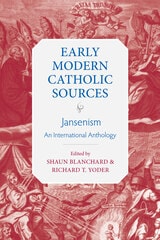
Jansenism
An International AnthologyShaun Blanchard
Catholic University of America Press, 2024
Jansenism: An International Anthology is the first comprehensive anthology of Jansenist texts in English translation. Covering the full sweep of the Jansenist movement from the 1630s until the early nineteenth century, this anthology is a major asset to historians of early modernity, theologians, advanced and beginner students, and interested non-specialists. Readers of English can now directly hear the voices of the women and men, nuns and priests, and politicians and pamphleteers embroiled in some of the most dynamic controversies of early modern Christianity.
While giving due attention to France, the anthology showcases the geographic breadth of Jansenism, from Portugal to Lebanon. Consequently, a team of translators have provided texts translated not just from French and Latin; selections from German, Spanish, Portuguese, Italian, and Arabic also appear here. Blanchard and Yoder present a diverse range of texts, including letters, tracts, periodical excerpts, books, treatises, and synodal documents.
These readings cover the controversies over divine grace and penance for which Jansenism is infamous, but they also show the widening scope of Jansenists’ reformist concerns as the movement developed and changed. They address issues such as liturgical reform, devotion to Mary and the saints, politics, religious toleration, prayer, gender and the role of women in the Church, polemics, and ecclesiastical reform. The whole volume is introduced by an essay introducing Jansenism, exposing the important themes, summarizing the relevant scholarship, and contextualizing the content that will follow.
Jansenism: An International Anthology provides the first port-of-call for the study of Jansenism in English. The anthology presents a diverse and rich selection of primary source texts and draws on the best recent research into the fascinating and controversial transnational phenomena called “Jansenism.”
[more]
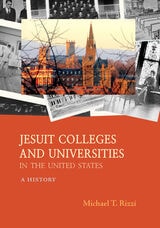
Jesuit Colleges and Universities in the United States
A HistoryMichael T. Rizzi
Catholic University of America Press, 2022
Jesuit Colleges and Universities in the United States provides a comprehensive history of Jesuit higher education in the United States, weaving together the stories of the fifty-four colleges and universities that the Jesuits have operated (successfully and unsuccessfully) since 1789. It emphasizes the connections among the institutions, exploring how certain Jesuit schools like Georgetown University gave birth to others like Boston College by sharing faculty, financial resources, accreditation, and even presidents throughout their history. The book also explores how the colleges responded to common challenges – including anti-Catholic prejudice in the United States, the push from government authorities to modernize their shared curriculum, and the pull from Roman authorities to remain loyal to Catholic tradition.
The story is comprehensive, covering the colonial era to the present, and takes a fresh look at themes like the rise of the research university in the 1880s and the administrative reforms of the 1960s. It also provides a modern and timely perspective on the role of Jesuit colleges in racial justice, women’s education, and other civil rights issues, drawing attention to underappreciated Jesuit contributions in these areas. It draws from both published and archival sources on the history of each institution to construct a single narrative, identifying common themes, challenges, and trends. Through the eyes of Jesuit colleges, it traces the evolution of American higher education and the role of Catholics in the United States over more than two centuries.
[more]
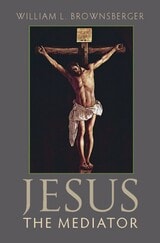
Jesus the Mediator
William Brownsberger
Catholic University of America Press, 2013
In Jesus the Mediator, William L. Brownsberger offers an account of the human psychology assumed by the Second Person of the Trinity in light of its salvific significance
[more]
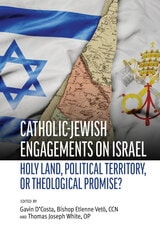
Jewish-Catholic Engagements on Israel
Holy Land, Political Territory, or Theological Promise?Gavin D'Costa
Catholic University of America Press, 2025
This is the first volume of its kind, bringing together a group of international Jewish and Catholic scholars in creative conversation addressing the question of the status of the land called Israel. Is Israel best viewed as political territory, the ‘Holy Land’, or part of the biblical promise? If committing to one of these options, what are the theological and political consequences?
The book is divided into sections that take the reader through several related questions that bear upon this topic. There is a preface with an overview of how far Catholic Jewish conversations have gone since Nostra Aetate, and how these conversations have now begun to address the land. Then there is an attempt to advance positive theological cases by Catholics and Jews affirming the people in the land as theologically significant, not without difficulties regarding the state itself. The next section deals with the bible/Tanakh as the basis of such claims and addresses the different reading strategies by each community. One of the central questions is then addressed: what of the Palestinian people, do the biblical promise to the Jewish people spell disaster for the Palestinians? Can revelation mean dispossession? The following essays address a stumbling block for both groups: do Jewish and Christian theologies underwrite a nation state? Isn’t this option perilously close to God underwriting nationalism? The book ends with subtle critiques of the entire venture undertaken in this volume.
Essential reading for Catholic Jewish relations and one that addresses one of the most pressing contemporary questions for both religions.
[more]
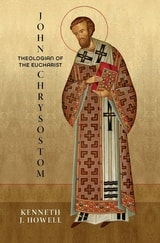
John Chrysostom, Theologian of the Eucharist
Kenneth J. Howell
Catholic University of America Press, 2024
Despite the fact that John Chrysostom wrote more on the Eucharist than any other Greek Church Father, there has never been a full treatment of his doctrine in English. In this book, Kenneth Howell brings together a wide array of sources from which he develops a many-sided portrait of Chrysostom’s eucharistic thought. While the Antiochene preacher assumed the real presence and the sacrificial nature of the Eucharist, he focused more on the moral and spiritual implications of communion. At the root of his theology lies the conviction that the Eucharist with its home in the liturgy is the extension of Christ’s incarnate life through space and time. All
that Christ accomplished in his life, death, and resurrection is present and available to the communing Christian who stands in union with the angelic hosts in the liturgy of the church. John’s preaching at times reaches encomiastic proportions as he never tires of praising the benefits and power of the Eucharist and he deftly applies the sacrament to the struggle of virtue and vice as he explores both the invitation and the obstacles to communion. Among the moral implications of the Eucharist, John seems to distinguish well between sins arising from human weakness versus malicious dispositions freely chosen. He is especially keen to exhort his hearers to lay aside
the remembrance of evil (mnesikakia) done to them in their past lives. Humility and forbearance are two essential virtues in arriving at forgiveness of past injuries. And lack of forgiveness is like greed in that both constitute a turn in on oneself. The Eucharist demands love of neighbor and active ministry to the less fortunate of the world. For John, God is interested in golden souls more than golden chalices.
[more]
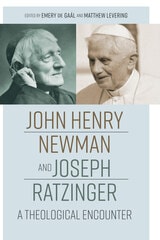
John Henry Newman and Joseph Ratzinger
A Theological EncounterEmery de Gaal
Catholic University of America Press, 2024
This book brings the thought of John Henry Newman into conversation with that of Joseph Ratzinger/Benedict XVI on a number of crucial theological themes. The book begins with a programmatic essay by Tracey Rowland connecting Newman’s approach with that of Ratzinger’s doktorvater Gottlieb Söhngen, along seven instructive paths. The book then delves into central themes of both Newman’s and Ratzinger’s thought, with essays that treat dogmatic development, the relationship of faith and reason, biblical inspiration, mystery, conscience, attentiveness to the “signs of the times,” interculturality and revelation, the Church as the Mystical Body, ecclesial authority, the relationship of faith and natural science, and deification. The essays in the volume come from many of the world’s leading Newman and Ratzinger scholars, with Ratzinger being represented by such experts as Rowland, Emery de Gaál, Aaron Pidel, SJ, Jacob Phillips, Matthew Ramage, and Jeremy Pilch; and Newman by such experts as Frederick D. Aquino, Andrew Meszaros, Marial Corona, Ryan Marr, and Elizabeth A. Huddleston. The Introduction briefly sets the scene for the encounter by describing the German reception of Newman during Ratzinger’s youth in comparison with the much less robust situation in German Newman scholarship today. It is the hope of the editors that this theological encounter will serve to promote and advance both Newman studies and Ratzinger studies in English- and German-speaking lands today.
[more]
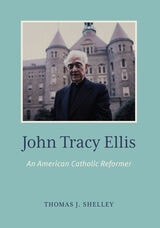
John Tracey Ellis
An American Church ReformerThomas J. Shelley
Catholic University of America Press, 2023
For several decades prior to his death in October1992, Monsignor John Tracy Ellis was the most prominent historian of American Catholicism. His bibliography lists 395 published works, including seventeen books, most famously, American Catholics and the Intellectual Life, a scathing indictment of the mediocrity of Catholic higher education and a clarion call for American Catholics to make a greater contribution to American intellectual life. Ellis’s ecumenically-minded scholarship led to his election in 1969 as the President of both the American Catholic Historical Association and the predominantly Protestant American Society of Church History.
As a professor at the Catholic University of America, Ellis trained numerous graduate students, who made their own contributions to American Catholic history, and he also furthered the careers of several talented young church historians. Especially in his later years, during the polarized atmosphere that followed Vatican II, Ellis became an outspoken but balanced advocate of reform in the Church, urging greater transparency and honesty, collegiality on the diocesan level, a role for the laity in the selection of bishops, reassessment of church teaching on birth control, decentralization to provide an enhanced role for the local churches, and an eloquent defense of religious freedom and the American Catholic commitment to separation of church and state.
His fellow church historian, Jay P. Dolan, remarked that Ellis “used history as an instrument to promote changes he believed necessary for American Catholicism. . . .No other historian of American Catholicism matched Ellis in this regard.”
[more]
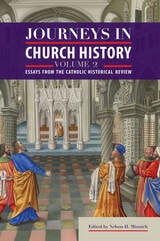
Journeys in Church History Volume 2
Essays from the <i>Catholic Historical Review</i>Nelson H. Minnich
Catholic University of America Press, 2025
Journeys in Church History, Volume 2 offers further reflections from leading contemporary church historians, who describe in their own words how they have come to practice their craft. They trace their family and educational backgrounds, the themes that attracted their attention, the challenges they encountered in researching them, the new methodologies they adopted to answer questions, and the reception given to their findings. They also tell of their experiences in the classroom, both as students and teachers, the difficulties they encountered in their careers due to prejudices based on gender or religion, and how the discipline of church history has changed over their lifetimes. Their often entertaining accounts will serve to inform and inspire fellow historians, both young and old.
Featured in this collection are essays from scholars who study the church across the centuries. Dame Avril Cameron focused her work on religion in the Byzantine Empire. John Van Engen has been interested in lay religion in the Middle Ages and has studied the rise of the Modern Devotion with its Imitation of Christ and experiments in communal religious life. Robert Bireley, SJ, specialized on Jesuit confessors to Catholic rulers during the Thirty Years War and laid out how both the Catholic and Protestant churches tried to adjust to a changing world in the early modern period. Asuncion Lavrin has studied the role of women in the religious life of colonial Latin America. Hugh Mc Leod used sociological data to map how various Christian denominations fared in the industrialized world of modern Europe. And Leslie Tentler has traced the changes in American Catholicism, especially those related to the Second Vatican Council and the Church’s teaching on women and sex. Each scholar shares the difficulties he or she encountered in doing their research and how their findings were initially received.
This collection of essays is taken from the pages of The Catholic Historical Review, the official organ of the American Catholic Historical Association and the only scholarly journal under Catholic auspices in the English-speaking world devoted to the history of the Universal Church.
[more]
Justice After War
<i>Jus Post Bellum</i> in the 21st CenturyDavid Chiwon Kwon
Catholic University of America Press, 2023
Justice After War is aimed especially to both undergraduate and graduate students, as well as the general audience who want to understand the significance of a recent development within the just war tradition, namely, the increasing attention given to the category of jus post bellum (postwar justice and peace). While examining the interrelated challenges of moral and social norms in both political and legal domains, as well as church practices, this work proposes an innovative methodology for linking theology, ethics, and social science so that the ideal and the real can inform each other in the ethics of war and peacebuilding. The main task of this project, then, is to identify what the author views as three key themes of jus post bellum, and three practices that are essential to implementing jus post bellum immediately after a war: just policing, just punishment, and just political participation.
David Kwon endeavors to challenge the view of those who suggest that reconciliation, mainly political reconciliation, is the foremost ambition of jus post bellum. Instead, he attempts to justify the proposition that achieving just policing, just punishment, and just political participation are essential to building a just peace, a peace in which the fundamental characteristic must be human security. It thus demonstrates that human security is an oft-neglected theme in the recent discourse of moral theologians and that a more balanced understanding of jus post bellum will direct attention to the elements composing human security in a postwar context.
[more]