Results by title
50 books match the query 'Catholics' and 2 start with j
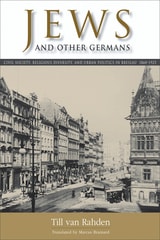
Jews and Other Germans
Civil Society, Religious Diversity, and Urban Politics in Breslau, 1860–1925Till van Rahden
University of Wisconsin Press, 2008
Closely analyzing the political, social, and cultural life in a major German city, van Rahden shows that Jews were a part of a broad urban community that encompassed diversity within unity, at once offering them a large measure of equality while permitting them to remain meaningfully Jewish. Jews and Other Germans also substantially revises the chronology of anti-Semitism in Germany, showing that Jews only began to experience exclusion from Breslau’s social world during World War I.
Yet van Rahden not only illuminates Breslau’s multicultural fabric; he also tells the story of this remarkable city as one of cultural and religious conflict and coexistence. Recounting the experiences of Jews, Protestants, and Catholics within a single narrative, he offers a critical intervention into scholarship on liberalism and civil society in nineteenth- and early twentieth-century Europe.
Joyce and the Two Irelands
By Willard Potts
University of Texas Press, 2001
Uniting Catholic Ireland and Protestant Ireland was a central idea of the "Irish Revival," a literary and cultural manifestation of Irish nationalism that began in the 1890s and continued into the early twentieth century. Yet many of the Revival's Protestant leaders, including W. B. Yeats, Lady Gregory, and John Synge, failed to address the profound cultural differences that made uniting the two Irelands so problematic, while Catholic leaders of the Revival, particularly the journalist D. P. Moran, turned the movement into a struggle for greater Catholic power.
This book fully explores James Joyce's complex response to the Irish Revival and his extensive treatment of the relationship between the "two Irelands" in his letters, essays, book reviews, and fiction up to Finnegans Wake. Willard Potts skillfully demonstrates that, despite his pretense of being an aloof onlooker, Joyce was very much a part of the Revival. He shows how deeply Joyce was steeped in his whole Catholic culture and how, regardless of the harsh way he treats the Catholic characters in his works, he almost always portrays them as superior to any Protestants with whom they appear. This research recovers the historical and cultural roots of a writer who is too often studied in isolation from the Irish world that formed him.