Results by title
401 books match the query 'Civil War, 1861-1865' and 3 start with j
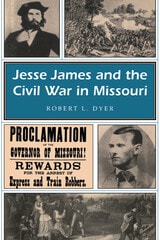
Jesse James and the Civil War in Missouri
Robert L. Dyer
University of Missouri Press, 1994
The Civil War in Missouri was a time of great confusion, violence, and destruction. Although several major battles were fought in the state between Confederate and Union forces, much of the fighting in Missouri was an ugly form of terrorism carried out by loose bands of Missouri guerrillas, by Kansas "Jayhawkers," or by marauding patrols of Union soldiers. This irregular warfare provided a training ground for people like Jesse and Frank James who, after the war, used their newly learned skills to form an outlaw band that ultimately became known all over the world.
Jesse James and the Civil War in Missouri discusses the underlying causes of the Civil War as they relate to Missouri and reveals how the war helped create both the legend and the reality of Jesse James and his gang. Written in an accessible style, this valuable little book will be welcomed by anyone with an interest in the Civil War, the legend of Jesse James, or Missouri history.
John Dooley, Confederate Soldier
His War JournalJohn Dooley
University of Alabama Press, 2005
One of the best primary accounts of the Civil War by a Confederate.
John Dooley was the youngest son of Irish immigrants to Richmond, Virginia, where his father prospered, and the family took a leading position among Richmond’s sizeable Irish community. Early in 1862, John left his studies at Georgetown University to serve in the First Virginia Infantry Regiment, in which his father John and brother James also served. John’s service took him to Second Manassas, South Mountain, Sharpsburg (Antietam), Fredericksburg, and Gettysburg; before that last battle, Dooley was elected a lieutenant. On the third day at Gettysburg, Dooley swept up the hill in Pickett’s charge, where he was shot through both legs and lay all night on the field, to be made a POW the next day. Held until February 27, 1865, Dooley made his way back south to arrive home very near the Confederacy’s final collapse.
Dooley’s account is valuable for the content of his service and because most of the material came from his diary, with some interpolations (which are indicated as such) that he made shortly after the war’s end when his memory was still fresh. Dooley’s health seems to have been permanently compromised by his wounds; he entered a Roman Catholic seminary after the war and died in 1873 several months before his ordination was to take place.
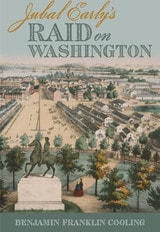
Jubal Early's Raid on Washington
Benjamin Franklin Cooling
University of Alabama Press, 2008
The raid that exposed the Union capital’s greatest danger.
The definitive description of the last Confederate invasion of the Union in 1864. The Civil War was in its fourth year, and the Union’s victory was not at all certain. The Lincoln administration seemed weak as the autumn election approached. Lee’s army remained strong in Virginia while Johnston’s forces feinted and dodged in north Georgia to shield Atlanta. The Union army and navy grew in strength, but Confederate forces continued to fight tenaciously.
Amid an air of stalemate, the Confederates planned a bold move to strike at Washington, DC and capture or scatter Lincoln and his cabinet. In command of the operation was the colorful and unpredictable Jubal “Old Jube” Anderson Early, brought in to replace the fallen Stonewall Jackson. Less well known than the bloodier Antietam and Gettysburg, Early's campaign, Cooling argues, had greater significance.
In addition to the persnickety bachelor Anderson, this account introduces many colorful participants, including railroad president John W. Garrett, the politically influential Blair family, and Elizabeth “Aunt Betty” Thomas, a free Black woman, who was said to have saved Lincoln’s life by shouting at him: “Get down, you fool!” when he came under fire at Fort Stevens. Exciting and comprehensive, Civil War scholars and readers will delight in this masterful account.