Results by title
80 books match the query 'Clergy' and 2 start with j
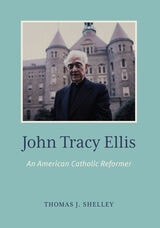
John Tracey Ellis
An American Church ReformerThomas J. Shelley
Catholic University of America Press, 2023
For several decades prior to his death in October1992, Monsignor John Tracy Ellis was the most prominent historian of American Catholicism. His bibliography lists 395 published works, including seventeen books, most famously, American Catholics and the Intellectual Life, a scathing indictment of the mediocrity of Catholic higher education and a clarion call for American Catholics to make a greater contribution to American intellectual life. Ellis’s ecumenically-minded scholarship led to his election in 1969 as the President of both the American Catholic Historical Association and the predominantly Protestant American Society of Church History.
As a professor at the Catholic University of America, Ellis trained numerous graduate students, who made their own contributions to American Catholic history, and he also furthered the careers of several talented young church historians. Especially in his later years, during the polarized atmosphere that followed Vatican II, Ellis became an outspoken but balanced advocate of reform in the Church, urging greater transparency and honesty, collegiality on the diocesan level, a role for the laity in the selection of bishops, reassessment of church teaching on birth control, decentralization to provide an enhanced role for the local churches, and an eloquent defense of religious freedom and the American Catholic commitment to separation of church and state.
His fellow church historian, Jay P. Dolan, remarked that Ellis “used history as an instrument to promote changes he believed necessary for American Catholicism. . . .No other historian of American Catholicism matched Ellis in this regard.”
[more]

Jonathan Fisher of Blue Hill, Maine
Commerce, Culture, and Community on the Eastern FrontierKevin D. Murphy
University of Massachusetts Press, 2010
This book examines the life of Jonathan Fisher (1768–1847), a native of Braintree, Massachusetts, and graduate of Harvard College who moved in his late twenties to Blue Hill, Maine, where he embarked on a multifaceted career as a pioneer minister, farmer, entrepreneur, and artist. Drawing on a vast record of letters, diaries, sermons, drawings, paintings, and buildings, Kevin D. Murphy reconstructs Fisher's story and uses it to explore larger issues of material culture, visual culture, and social history during the early decades of the American republic.
Murphy shows how Fisher, as pastor of the Congregational church in Blue Hill from 1796 to 1837, helped spearhead the transformation of a frontier settlement on the eastern shores of the Penobscot Bay into a thriving port community; how he used his skills as an architect, decorative painter, surveyor, and furniture maker not only to support himself and his family, but to promote the economic growth of his village; and how the fluid professional identity that enabled Fisher to prosper on the eastern frontier could only have existed in early America where economic relations were far less rigidly defined than in Europe.
Among the most important artifacts of Jonathan Fisher's life is the house he designed and built in Blue Hill. The Jonathan Fisher Memorial, as it is now known, serves as a point of departure for an examination of social, religious, and cultural life in a newly established village at the turn of the nineteenth century. Fisher's house provided a variety of spaces for agricultural and domestic work, teaching, socializing, artmaking, and more.
Through the eyes of Jonathan Fisher, we see his family grow and face the challenges of the new century, responding to religious, social, and economic change—sometimes succeeding and sometimes failing. We appreciate how an extraordinarily energetic man was able to capitalize on the wide array of opportunities offered by the frontier to give shape to his personal vision of community.
[more]