Results by title
90 books match the query 'Colonial period, ca. 1600-1775' and 3 start with j
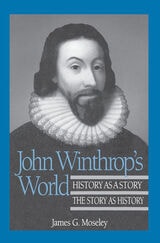
John Winthrop's World
History as a Story; The Story as HistoryJames G. Moseley
University of Wisconsin Press, 1992
In the first in-depth study of Winthrop since 1958, James G. Moseley provides a fascinating new look at this extraordinary man, paying careful attention to the connections between Winthrop’s political activity and his writing. Moseley first examines Winthrop as a writer, using the journal to analyze Winthrop as a man resolving challenges based as much on his acutely pragmatic intelligence as on his deeply felt religious convictions. Second, Moseley traces how historians have responded to Winthrop—how his famous journal has been read and misread by those who have filtered the man and his cultural context through many lenses.
By examining Winthrop’s ancestors and early life in England, especially the religious changes he experienced, Moseley removes the blinders of modernism, portraying Winthrop as never before. He shows how Winthrop’s successful struggle to accept the deaths of his first two wives led him away from moralistic views of Christianity, himself, and his world to more magnanimous views.
Arguing that writing was the medium through which Winthrop developed his capacity for leadership, Moseley shows how the journal enabled Winthrop to reflect objectively on his situation and to adjust his behavior. Winthrop was, Moseley suggests, not only a politician but a historian, and his interpretations of foundational events in American history in his journal are an invaluable resource for understanding the nature of leadership and the meaning of liberty in Puritan America.
Winthrop’s World is a very graceful, well-written, and engaging narrative that provides new insight into the Puritan way of life and into the man who provided a window between our world and his.

Jonathan Odell
The Loyalist Poet of the American RevolutionCynthia Dubin Edelberg
Duke University Press, 1987
One of the best-educated of the colonialists, Odell, a physician turned Anglican minister and then writer, lived the gamut of experience: powerful friends sustained him and the British commanders-in-chief Sir William Howe, Henry Clinton, and Sir Guy Carleton employed him; nevertheless, during the war he was a lonely exile ("Tory hunters" forced him from his home in 1775), and, at the end of the war, when his hope for reconciliation between the Loyalists and the Americans came to nothing, he reluctantly emigrated to Canada.
Here is a voice, all but silenced for over two hundred years, that must now be heard if we are to better understand the American Revolution.
Journeys in New Worlds
Early American Women's NarrativesWilliam L. Andrews
University of Wisconsin Press, 1990
Four early American women tell their own stories: Mary Rowlandson on her capture by Indians in 1676, Boston businesswoman Sarah Kemble Knight on her travels in New England, Elizabeth Ashbridge on her personal odyssey from indentured servant to Quaker preacher, and Elizabeth House Trist, correspondent of Thomas Jefferson, on her travels from Philadelphia to Natchez. Accompanied by introductions and extensive notes.
"The writings of four hearty women who braved considerable privation and suffering in a wild, uncultivated 17th- and 18th-century America. Although confined by Old World patriarchy, these women, through their narratives, have endowed the frontier experience with a feminine identity that is generally absent from early American literature."—Publishers Weekly