Results by title
319 books match the query 'Communication Studies' and 3 start with j
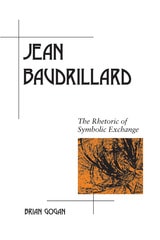
Jean Baudrillard
The Rhetoric of Symbolic ExchangeBrian Gogan
Southern Illinois University Press, 2018
Gogan examines both the theorist and his rhetoric, combining these two lines of inquiry in ways that allow for provocative insights. Part one of the book explains Baudrillard’s theory as compatible with the histories and traditions of rhetoric, outlining his novel understanding of rhetorical invention as involving thought, discourse, and perception. Part two evaluates Baudrillard’s work in terms of a perception of him—as an aphorist, an illusionist, an ignoramus, and an ironist. A biographical sketch and a critical review of the literature on Baudrillard and rhetoric round out the study.
This book makes the French theorist’s complex concepts understandable and relates them to the work of important thinkers, providing a thorough and accessible introduction to Baudrillard’s ideas.

Junctures in Women’s Leadership
Media and JournalismLinda Steiner
Rutgers University Press, 2025
This book offers profiles of inspiring women in prominent media positions from the nineteenth century to today, beginning with trailblazers like abolitionist publisher Mary Ann Shadd and Memphis Free Speech anti-lynching editor Ida B. Wells. The book takes an in-depth look at the leadership styles of well-known media moguls like Oprah Winfrey and Washington Post publisher Katharine Graham. Other chapters highlight women now emerging as media leaders, such as digital media executive S. Mitra Kalita and Iman Zawahry, a Muslim hijabi filmmaker. Bringing together cases from print, broadcast, public relations, film, and digital media, this book offers useful insights into how to be an effective leader in an ever-changing industry.
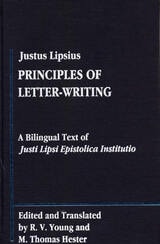
Justus Lipsius
Principles of Letter-Writing: A Bilingal Text of Justi Lipsi Epistolica InstitutioJustus Lipsius. Edited and translated by R. V. Young and M. Thomas Hester
Southern Illinois University Press, 1996
As part of the sixteenth century’s intellectual "triumvirate," which included Joseph Scaliger and Isaac Casaubon, Justus Lipsius formulated a humanist scholarship aimed ultimately at practical application in both public and personal affairs.
Justus Lipsius distinguished himself as a student of the classics, first at the Jesuit college at Cologne and then at the university in Leuven (Louvain). In 1569, soon after completing his studies, he published a precocious volume of Varia Lectiones, a collection of philological observations on classical texts. This initial work had significant and lasting effects on his career, the most immediate being an appointment as Latin secretary to Cardinal Granvelle, chief minister of Philip II in the Low Countries, who took the young man to Rome, where he was introduced to international power politics as well as to the treasures of Italian libraries, including the Vatican’s. After two years in Rome, Lipsius began his uneasy roaming, traveling from Vienna to Jena to Cologne, serving in a variety of posts. In 1579, he accepted a position at Leiden University in Holland, where he found a haven from his home province for nearly thirteen years. It was there that he delivered the lectures on letter-writing that later became Epistolica Institutio. In 1591, when Leiden University became too stridently Calvinist for Lipsius, he returned to Leuven as professor of Latin and was once again reconciled with the Catholic Church. There he remained for the rest of his life, resisting numerous appeals from foreign courts and especially from Italian churchmen.
As a particularly suitable commentator on the letter, Lipsius, like so many humanist scholars, was a prolific correspondent and published many of his own letters. In the manner typical of his age, he used the published letter as a kind of forerunner to the scholarly article. Yet his chief distinction as an epistolary theorist lies in his view of the letter as a means of personal expression. His purpose was to recover the classical Roman view of the letter as written conversation, a conception lost during the Middle Ages and only imperfectly restored during the earlier Renaissance. Hence, the Epistolica Institutio assumes an important position in the Lipsius canon: as an effort to restore the authentic features of the classical genre, it bespeaks the humanist scholar; in marking out a space for individual self-definition during a period of increasingly powerful and alienating social and religious pressures, it anticipates the ideological preoccupations of the contemporary world.