Results by title
69 books match the query 'Conduct of life' and 2 start with j
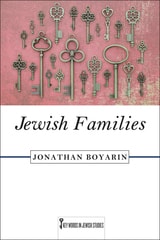
Jewish Families
Boyarin, Jonathan
Rutgers University Press, 2013
From stories of biblical patriarchs and matriarchs and their children, through the Gospel’s Holy Family of Jesus, Mary, and Joseph, and to modern Jewish families in fiction, film, and everyday life, the family has been considered key to transmitting Jewish identity. Current discussions about the Jewish family’s supposed traditional character and its alleged contemporary crisis tend to assume that the dynamics of Jewish family life have remained constant from the days of Abraham and Sarah to those of Tevye and Golde in Fiddler on the Roof and on to Philip Roth’s Portnoy’s Complaint.
Jonathan Boyarin explores a wide range of scholarship in Jewish studies to argue instead that Jewish family forms and ideologies have varied greatly throughout the times and places where Jewish families have found themselves. He considers a range of family configurations from biblical times to the twenty-first century, including strictly Orthodox communities and new forms of family, including same-sex parents. The book shows the vast canvas of history and culture as well as the social pressures and strategies that have helped shape Jewish families, and suggests productive ways to think about possible futures for Jewish family forms.
Jonathan Boyarin explores a wide range of scholarship in Jewish studies to argue instead that Jewish family forms and ideologies have varied greatly throughout the times and places where Jewish families have found themselves. He considers a range of family configurations from biblical times to the twenty-first century, including strictly Orthodox communities and new forms of family, including same-sex parents. The book shows the vast canvas of history and culture as well as the social pressures and strategies that have helped shape Jewish families, and suggests productive ways to think about possible futures for Jewish family forms.
[more]
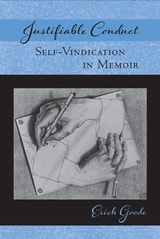
Justifiable Conduct
Self-Vindication in MemoirErich Goode
Temple University Press, 2013
How do memoirists make their work interesting, daring, exciting, and unorthodox enough so that they attract an audience, yet not so heinous and scandalous that their readers are unable to empathize or identify with them? In Justifiable Conduct, renowned sociologist Erich Goode explores the different strategies memoirists use to "neutralize" their alleged wrongdoing and fashion a more positive image of themselves for audiences. He examines how writers, including James Frey, Susan Cheever, Roman Polanski, Charles Van Doren and Elia Kazan, explain, justify, contextualize, excuse, or warrant their participation in activities such as criminal behavior, substance abuse, sexual transgressions, and political radicalism.
Using a theory of deviance neutralization, Goode assesses the types of behavior exhibited by these memoirists to draw out generic narratives that are most effective in attempting to absolve the actor-author. Despite the highly individualistic and variable lives of these writers, Goode demonstrates that memoirists use a conventional vocabulary for their unconventional behavior.
Using a theory of deviance neutralization, Goode assesses the types of behavior exhibited by these memoirists to draw out generic narratives that are most effective in attempting to absolve the actor-author. Despite the highly individualistic and variable lives of these writers, Goode demonstrates that memoirists use a conventional vocabulary for their unconventional behavior.
[more]