341 books match the query 'Cooking' and 3 start with j
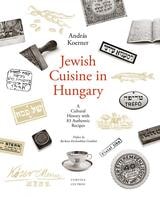
cover of Jewish Cuisine in Hungary: A Cultural History with 83 Authentic Recipes

Jewish Cuisine in Hungary

A Cultural History with 83 Authentic Recipes

András Koerner

Central European University Press, 2020

Winner of the 2019 National Jewish Book Award in the category of Food Writing & Cookbooks.

The author refuses to accept that the world of pre-Shoah Hungarian Jewry and its cuisine should disappear almost without a trace and feels compelled to reconstruct its culinary culture. His book―with a preface by Barbara Kirshenblatt-Gimblett―presents eating habits not as isolated acts, divorced from their social and religious contexts, but as an organic part of a way of life.

According to Kirshenblatt-Gimblett: “While cookbooks abound, there is no other study that can compare with this book. It is simply the most comprehensive account of a Jewish food culture to date.” Indeed, no comparable study exists about the Jewish cuisine of any country, or―for that matter―about Hungarian cuisine. It describes the extraordinary diversity that characterized the world of Hungarian Jews, in which what could or could not be eaten was determined not only by absolute rules, but also by dietary traditions of particular religious movements or particular communities. 

Ten chapters cover the culinary culture and eating habits of Hungarian Jewry up to the 1940s, ranging from kashrut (the system of keeping the kitchen kosher) through the history of cookbooks, the food traditions of weekdays and holidays, the diversity of households, and descriptions of food and hospitality industries to the history of some typical dishes. Although this book is primarily a cultural history and not a cookbook, it includes 83 recipes, as well as nearly 200 fascinating pictures of daily life and documents.i
[more]
cover of Jewish Soul Food: Traditional Fare and What It Means

Jewish Soul Food

Traditional Fare and What It Means

Carol Ungar

Brandeis University Press, 2015
Jewish traditional foods often have symbolic meanings. A Passover matzo is a taste of Egyptian slavery. The Hanukkah latke reminds us of the little jug of oil that burned, miraculously, for eight nights. Noshing hamentaschen at Purim, we remember the villain Haman, and his thwarted plan to destroy the Jews. Even more than in the synagogue, Jewish life takes place around the dining table. Jewish sages compare the dining table to an altar, and that isn’t an exaggeration. Jewish meals are ceremonies and celebrations that forge a pathway between body and soul. In this unique cookbook, Carol Ungar links the cultural and religious symbolism of Jewish foods to more than one hundred recipes drawn from international Jewish cultures and traditions. She offers easy-to-follow recipes for Shabbat meals and all the Jewish holidays, from Rosh Hashana to the nine days before Tisha b’Av, along with fascinating briefs on how many Jewish foods—challah, kreplach, farfel, and more—express core Jewish beliefs. With ingredients that can be found in any supermarket, and recipes adapted for the time- and health-conscious cook, this volume is for anyone who wishes to flavor Shabbat and holiday meals with Jewish soul.
[more]
cover of Julia Child's The French Chef

Julia Child's The French Chef

Dana Polan

Duke University Press, 2011

Julia Child’s TV show, The French Chef, was extraordinarily popular during its broadcast from 1963 until 1973. Child became a cultural icon in the 1960s, and, in the years since, she and her show have remained enduring influences on American cooking, American television, and American culture. In this concise book, Dana Polan considers what made Child’s program such a success. It was not the first televised cooking show, but it did define and popularize the genre. Polan examines the development of the show, its day-to-day production, and its critical and fan reception. He argues that The French Chef changed the conventions of television’s culinary culture by rendering personality indispensable. Child was energetic and enthusiastic, and her cooking lessons were never just about food preparation, although she was an effective and unpretentious instructor. They were also about social mobility, the discovery of foreign culture, and a personal enjoyment and fulfillment that promised to transcend domestic drudgery. Polan situates Julia Child and The French Chef in their historical and cultural moment, while never losing sight of Child’s unique personality and captivating on-air presence.
[more]