Results by title
304 books match the query 'Death' and 3 start with j
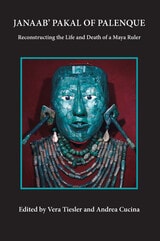
Janaab' Pakal of Palenque
Reconstructing the Life and Death of a Maya RulerEdited by Vera Tiesler and Andrea Cucina
University of Arizona Press, 2006
This volume communicates the broad scope of applied interdisciplinary research conducted on the Pakal remains to provide answers to old disputes over the accuracy of both skeletal and epigraphic studies, along with new questions in the field of Maya dynastic research. Contributions by scholars in epigraphy, anthropology, and bioarchaeology bring to light new evidence regarding the ruler’s age, clarify his medical history and the identification of the remains found with him, reevaluate his role in life, and offer modern insights into ritual and sacrificial practices associated with Pakal.
The book leads readers through the history of Pakal’s discovery, skeletal analysis, and interpretation of Maya biographies, and also devotes considerable attention to the tomb of the “Red Queen” discovered at the site. Findings from the new Transition Analysis aging method, histomorphometric analysis, and taphonomic imagery are presented to shed new light on the perplexing question of Pakal’s age at death. Royal Maya life and death histories from the written record are also analyzed from a regional perspective to provide a broad panorama of the twisted power politics of rulers’ families and the entangled genealogies of the Maya Classic period.
A benchmark in biological anthropology, this volume reconsiders assumptions concerning the practices and lives of Maya rulers, posing the prospect that researchers too often find what they expect to find. In presenting an updated study of a well-known personage, it also offers innovative approaches to the biocultural and interdisciplinary re-creation of Maya dynastic history.
Contributors
Jesper K. Boldseh
Jane E. Buikstra
James H. Burton
Andrea Cucina
Nikolai Grube
Patricia Hernández
Lourdes Márquez
Simon Martin
George R. Milner
T. Douglas Price
Arturo Romano
Carlos Serrano
Sam D. Stout
Margaret Streeter
Vera Tiesler
John W. Verano

Jurors' Stories of Death
How America's Death Penalty Invests in InequalityBenjamin Fleury-Steiner
University of Michigan Press, 2004
-David Cole, from the Foreword
"Perhaps the most powerful, routinely enacted civic ritual in American public life is that of capital punishment. This state-sanctioned extirpation of human life in the collective pursuit of justice is a searing act of civic pedagogy, made legitimate only by the deliberative endorsement of a small group of ordinary citizens-the jury. In Jurors' Stories of Death, Benjamin Fleury-Steiner has taken a cold, hard look at how these ordinary citizens come to terms with their extraordinary role, and how they rationalize their irreversible decisions. The result is a chilling portrait of how we---that is, all of us Americans---constitute ourselves as a political community."
-Glenn Loury, Director, Institute on Race and Social Division
"This illuminating and insightful examination of jury deliberations makes a terrific contribution to the study of capital punishment. Fleury-Steiner's synthesis of sociological, legal and theoretical concepts with vivid juror narratives and statistical data, thoughtfully animates and details how race and class consciousness continue to shape America's death penalty."
---Bryan Stevenson, Professor of Clinical Law, NYU School of Law, Executive Director, Equal Justice Initiative of Alabama
Jurors' Stories of Death is more than just another book on the death penalty; it is the first systematic survey of how death penalty decisions are made.
Benjamin Fleury-Steiner draws on real-life accounts of white and black jurors in capital punishment trials to discuss the effect of race on the sentencing process. He finds that race is invariably a factor in sentencing, with jurors relying on accounts that deny the often marginalized defendants their individuality and complexity, while reinforcing the jurors' own identities as superior, moral, and law-abiding citizens-a system that punishes in the name of dominance. This biased story of "us versus them" continues to infuse political rhetoric on crime and punishment in the United States even today.
Jurors' Stories of Death concludes with an original argument for abolition of the death penalty: If America values multiculturalism and cultural diversity, it must do away with institutions such as state-sanctioned capital punishment in order to begin to free itself from the racism and classicism that so insidiously plague social relations today.

Just Enough to Put Him Away Decent
Death Care, Life Extension, and the Making of a Healthier South, 1900-1955Kristine M. McCusker
University of Illinois Press, 2023
Kristine McCusker charts the dramatic transformation that took place when southerners in particular and Americans in general changed their thinking about when one should die, how that death could occur, and what decent burial really means. As she shows, death care evolved from being a community act to a commercial one where purchasing a purple coffin and hearse ride to the cemetery became a political statement and the norm. That evolution also required interactions between perfect strangers, especially during the world wars as families searched for their missing soldiers. In either case, being put away decent, as southerners called burial, came to mean something fundamentally different in 1955 than it had just fifty years earlier.