Results by title
239 books match the query 'Diaries' and 8 start with j
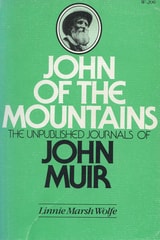
John of the Mountains
The Unpublished Journals of John MuirEdited by Linnie Marsh Wolfe
University of Wisconsin Press, 1979
The sixty extant journals and numerous notes in this volume were written from 1867 to 1911. They start seven years after the time covered in The Story of My Boyhood and Youth, Muir’s uncompleted autobiography. The earlier journals capture the essence of the Sierra Nevada and Alaska landscapes. The changing appearance of the Sierras from Sequoia north and beyond the Yosemites enthralled Muir, and the first four years of the journals reveal his dominating concern with glacial action. The later notebooks reflect his changes over the years, showing a mellowing of spirit and a deep concern for human rights.
Like all his writings, the journals concentrate on his observations in the wilderness. His devotion to his family, his many warm friendships, and his many-sided public life are hardly mentioned. Very little is said about the quarter-century battle for national parks and forest reserves. The notebooks record, in language fuller and freer than his more formal writings, the depth of his love and transcendental feeling for the wilderness. The rich heritage of his native Scotland and the unconscious music of the poetry of Burns, Milton, and the King James Bible permeate the language of his poetic fancy.
In his later life, Muir attempted to sort out these journals and, at the request of friends, published a few extracts. A year after his death in 1914, his literary executor and biographer, William Frederick Badè, also published episodes from the journals. Linnie Marsh Wolfe set out to salvage the best of his writings still left unpublished in 1938 and has thus added to our understanding of the life and thought of a complex and fascinating American figure.
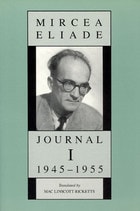
Journal I, 1945-1955
Mircea Eliade
University of Chicago Press, 1990
During the lean years in Paris Eliade lived and worked in small, cold rooms; prepared meals on a Primus stove; pawned his valuables; and asked friends for loans. Eventually he secured a research stipend from the Bollingen Foundation. His ten years in Paris were among his most productive; the books he wrote during this period brought him worldwide acclaim as a historian of religions. He records his first meetings with Carl Jung, Pierre Teilhard de Chardin, Gershom Scholem, Georges Bataille, André Breton, Raffaele Pettazzoni, and many other scholars and writers.
Eliade also continued to write literary works. Numerous entries describe his five-year struggle with his novel The Forbidden Forest. Spanning the twelve fateful years from 1936 to 1948, it expresses within a fictional framework the central themes of Eliade's work on religions. Writing the novel was a Herculean task in which Eliade summarized and memorialized his old Romanian life.
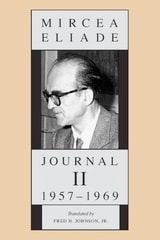
Journal II, 1957-1969
Mircea Eliade
University of Chicago Press, 1989

Journal III, 1970-1978
Mircea Eliade
University of Chicago Press, 1989
Quite apart from the personal, biographical interest the journal holds, it is a document of cultural and intellectual significance. Eliade remarks on such colleagues and friends as Jung, Dumézil, Ricoeur, Bellow, and Ionesco. Moreover, the period covered encompasses Eliade's most active years as a teacher, and the journal beautifully reflects his developing views on religion, history, and the nature of academic culture. Bits and pieces of Eliade's past life are juxtaposed with thoughts about ongoing projects and work yet to be undertaken as well as with anecdotes of his travels and comments on world events.
A genuine treat for Eliade readers and those interested in history of religions, Journal III provides new perspectives on many of Eliade's other works—the History of Religious Ideas, Ordeal by Labyrinth, the Autobiography. At the same time the journal is a mature scholar's record of the aftermath of the 1960s, a turbulent period that profoundly affected American university life. As such, these writings hold valuable insights into not only the life and work of one man but also the cultural history of an entire era.
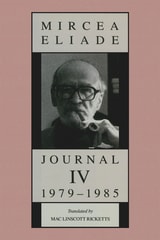
Journal IV, 1979-1985
Mircea Eliade
University of Chicago Press, 1989
Running like a fault line through the peak of his success, however, is Eliade's painful awareness of his physical decline—failing vision, arthritic hands, and continual fatigue. Again and again he repeats how little time he has to finish the projects he is working on—his autobiography, the third and fourth volumes of his History of Religious Ideas, and the duties associated with his editorship of the Encyclopedia of Religion. He poignantly recounts the sharpest blow: the disorganization and eventual destruction by fire of his personal library.
Within the scope of Journal IV Eliade and his world go to ruin. What does not decline is the vivid and persistent voice of Eliade the writer, an unbreaking voice that—with death only months away—plans a reply to critics, plots out an article, and ruminates on characters to people another novella.
Journals
Volume FifteenHerman Melville
Northwestern University Press, 1989
The editors supply full annotations of Melville's allusions and terse entries and an exhaustive index makes available the range of his acquaintance with people, places, and works of art. Also included are related documents, illustrations, maps, and many pages and passages reproduced from the journals. This scholarly edition aims to present a text as close to the author's intention as his difficult handwriting permits. It is an Approved Text of the Center for Editions of American Authors (Modern Language Association of America).
Journey of Five Capuchin Nuns
Madre María Rosa
Iter Press, 2009
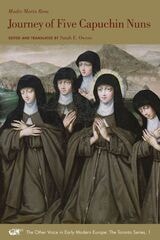
Journey of Five Capuchin Nuns contains all the elements of a riveting adventure story. Through the eyes of the Mother Abbess, María Rosa, the reader is taken along on this journey through wars, pirates, disease, travel on the high seas, and treacherous mountain passes in the Andes. Five nuns set out in the early 1700s from their cloistered convent in Madrid, Spain, to travel halfway around the world to Lima, Peru. The journey lasted three years—an odyssey not all of them would complete. Yet, this unique historical document is so much more than a typical travel narrative. It illuminates the eighteenth-century way of life of religious women on both sides of the Atlantic basin. María Rosa’s lively prose attests to the literary connection among women religious writers of Spain and Latin America. This annotated edition and first-ever English translation of the manuscript will be of interest to scholars, students and anyone who wants to learn more about women’s history.
Journeys in the Canyon Lands of Utah and Arizona, 1914-1916
George C. Fraser; Edited by Frederick H. Swanson; Foreword by Hal K. Rothman
University of Arizona Press, 2005
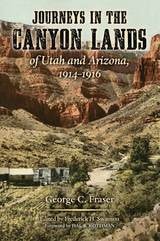
Frederick H. Swanson has edited Fraser’s voluminous journals into a single volume covering three trips taken from 1914 to 1916. As Fraser wades the bone-chilling waters of the Zion Narrows, crosses the Grand Canyon in midsummer heat, and rides through the trackless forest of the Aquarius Plateau, he conveys impressions of the land that will fascinate any reader who wonders what the canyon country was like before it became a popular tourist destination—and one that will inform historians interested in early accounts of the region. Accompanied by a selection of photographs taken by Fraser and his fellow travelers, Journeys in the Canyon Lands brings to life the Southwest’s breathtaking backcountry on the brink of discovery.