Results by title
347 books match the query 'Early works to 1800' and 8 start with j
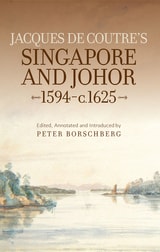
Jacques de Coutre's Singapore and Johor 1594-c. 1625
Edited by Peter Borschberg
National University of Singapore Press, 2015
The manuscripts come from a bundle of documents preserved at the National Library of Spain in Madrid that includes De Coutre’sautobiography and several memorials to the Crowns of Spain and Portugal. Chapters from the autobiography have been excerpted from book I, which covers the writer’s life in Southeast Asia between 1593 and 1603. A glossary and list of place names provide information about officials, goods and places mentioned in the text that will be unfamiliar to readers of English.
Jerome, Epistle 106 (On the Psalms)
Michael Graves
SBL Press, 2022
A fresh interpretation of the nature, purpose, and date of Jerome’s Epistle 106
In this volume of the Writings from the Greco-Roman World series, Michael Graves offers the first accessible English translation and commentary on Jerome’s Epistle 106, an important work of patristic biblical interpretation. In his treatise Jerome discusses different textual and exegetical options according to various Greek and Latin copies of the Psalms with input from the Hebrew. Epistle 106 provides insightful commentary on the Gallican Psalter, Jerome’s translation of Origen’s hexaplaric edition. Jerome’s work offers a unique window into the complex textual state of the Psalter in the late fourth century and serves as an outstanding example of ancient philological scholarship on the Bible. Graves’s translation and commentary is an essential resource for scholars and students of patristic exegesis, biblical textual criticism, and late antique Christianity.
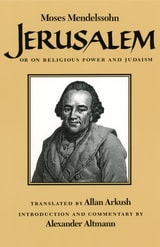
Jerusalem
Or on Religious Power and JudaismMoses Mendelssohn
Brandeis University Press, 1983
John Chrysostom, Homilies on Colossians
Pauline Allen
SBL Press, 2021
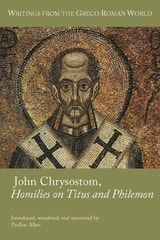
John Chrysostom, Homilies on Titus and Philemon
Pauline Allen
SBL Press, 2024

John Dygon's Proportiones practicabiles secundum Gaffurium
New Critical Text, Translation, Annotations, and Indices by Theodor Dumitrescu
University of Illinois Press, 2006
A rare example of musical scholarship from the Tudor period, in translation and fully annotated
John Dygon was the prior of St. Augustine’s monastery in Canterbury when Henry VIII boldly dissolved the English Catholic Church during the 1530s and reorganized it under royal control. Only a single copy of Dygon’s manuscript on music theory has survived, held by Trinity College, Cambridge. This volume will be the first publication of these two treatises, providing both a scholarly transcription and English translation.
Dygon’s treatise provides a rare and important example of musical scholarship from the early Tudor period, demonstrating the status of music education at the time, the affiliations of English scholarship with music study in Europe, and the music that was actually performed in England. The treatises address questions of musical notation, especially regarding rhythmic proportions, as well as practical issues about performance. Theodor Dumitrescu’s introduction situates Dygon’s treatises within the larger history of European music, paying close attention to its borrowings from and adaptations of prior treatises.
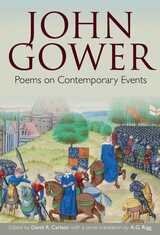
John Gower
Poems on Contemporary EventsDavid R. Carlson
Bodleian Library Publishing, 2011
Justus Lipsius
Principles of Letter-Writing: A Bilingal Text of Justi Lipsi Epistolica InstitutioJustus Lipsius. Edited and translated by R. V. Young and M. Thomas Hester
Southern Illinois University Press, 1996
As part of the sixteenth century’s intellectual "triumvirate," which included Joseph Scaliger and Isaac Casaubon, Justus Lipsius formulated a humanist scholarship aimed ultimately at practical application in both public and personal affairs.
Justus Lipsius distinguished himself as a student of the classics, first at the Jesuit college at Cologne and then at the university in Leuven (Louvain). In 1569, soon after completing his studies, he published a precocious volume of Varia Lectiones, a collection of philological observations on classical texts. This initial work had significant and lasting effects on his career, the most immediate being an appointment as Latin secretary to Cardinal Granvelle, chief minister of Philip II in the Low Countries, who took the young man to Rome, where he was introduced to international power politics as well as to the treasures of Italian libraries, including the Vatican’s. After two years in Rome, Lipsius began his uneasy roaming, traveling from Vienna to Jena to Cologne, serving in a variety of posts. In 1579, he accepted a position at Leiden University in Holland, where he found a haven from his home province for nearly thirteen years. It was there that he delivered the lectures on letter-writing that later became Epistolica Institutio. In 1591, when Leiden University became too stridently Calvinist for Lipsius, he returned to Leuven as professor of Latin and was once again reconciled with the Catholic Church. There he remained for the rest of his life, resisting numerous appeals from foreign courts and especially from Italian churchmen.
As a particularly suitable commentator on the letter, Lipsius, like so many humanist scholars, was a prolific correspondent and published many of his own letters. In the manner typical of his age, he used the published letter as a kind of forerunner to the scholarly article. Yet his chief distinction as an epistolary theorist lies in his view of the letter as a means of personal expression. His purpose was to recover the classical Roman view of the letter as written conversation, a conception lost during the Middle Ages and only imperfectly restored during the earlier Renaissance. Hence, the Epistolica Institutio assumes an important position in the Lipsius canon: as an effort to restore the authentic features of the classical genre, it bespeaks the humanist scholar; in marking out a space for individual self-definition during a period of increasingly powerful and alienating social and religious pressures, it anticipates the ideological preoccupations of the contemporary world.