Results by title
66 books match the query 'Edge' and 2 start with j

Japanoise
Music at the Edge of CirculationDavid Novak
Duke University Press, 2013
For its scattered listeners, Noise always seems to be new and to come from somewhere else: in North America, it was called "Japanoise." But does Noise really belong to Japan? Is it even music at all? And why has Noise become such a compelling metaphor for the complexities of globalization and participatory media at the turn of the millennium?
In Japanoise, David Novak draws on more than a decade of research in Japan and the United States to trace the "cultural feedback" that generates and sustains Noise. He provides a rich ethnographic account of live performances, the circulation of recordings, and the lives and creative practices of musicians and listeners. He explores the technologies of Noise and the productive distortions of its networks. Capturing the textures of feedback—its sonic and cultural layers and vibrations—Novak describes musical circulation through sound and listening, recording and performance, international exchange, and the social interpretations of media.
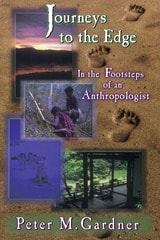
Journeys to the Edge
In the Footsteps of an AnthropologistPeter M. Gardner
University of Missouri Press, 2013
Because Gardner’s primary research since 1962 has been with hunter-gatherers, much of his story transpires either in the equatorial jungle of south India or more than one hundred miles beyond the end of the road in Canada’s Northwest Territories. Other ventures transport readers to Japan and back to India, allowing them to savor ancient sights and sounds. Gardner closes the book with a journey of quite another sort, as he takes us into the world of nature, Taoist philosophy, and the experimental treatment of advanced cancer.
Throughout this fast-moving book, Gardner deftly describes the goals and techniques of his research, as well as his growing understanding of the cultures to which he was exposed. Few personal accounts of fieldwork describe enough of the research to give a complete sense of the experience in the way this book does. Anyone with an interest in travel and adventure, including the student of anthropology as well as the general reader, will be totally intrigued by Gardner’s story, one of a daily existence so very different from our own.