Results by title
434 books match the query 'Ethics & Moral Philosophy' and 12 start with j

Javanmardi
The Ethics and Practice of Persianate PerfectionEdited by Lloyd Ridgeon
Gingko, 2018
The present collection is the product of a three-year project financed by the British Institute of Persian Studies on the theme of "Javanmardi in the Persianate world." The articles in this volume represent the sheer range, influence, and importance that the concept has had in creating and contributing to Persianate identities over the past one hundred and fifty years. The contributions are intentionally broad in scope. Rather than focus, for example, on medieval Sufi manifestations of javanmardi, both medieval and modern studies were encouraged, as were literary, artistic, archaeological, and sociological studies among others. The opening essays examine the concept’s origin in medieval history and legends throughout a geographical background that spans from modern Iran to Turkey, Armenia, and Bosnia, among both Muslim and Christian communities. Subsequent articles explore modern implications of javanmardi within such contexts as sportsmanship, political heroism, gender fluidity, cinematic representations, and the advent of digitalization.
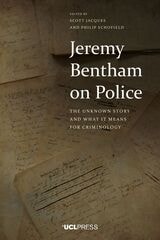
Jeremy Bentham on Police
The Unknown Story and What It Means for CriminologyEdited by Scott Jacques and Philip Schofield
University College London, 2021
Jeremy Bentham theorized the panopticon as modern policing emerged across the British Empire, yet while his theoretical writing became canonical in criminology, his perspective on the police remains obscure. Jeremy Bentham on Police recovers the reformer’s writings on policing alongside a series of essays that demonstrate their significance to the past, present, and future of criminology.

Jewish Universalisms
Mendelssohn, Cohen, and Humanity’s Highest GoodJeremy Fogel
Brandeis University Press, 2023
Any version of universalism relevant to a more attentive, pluralistic, and postcolonial outlook would balance the urgent current need for a universalistic perspective with the desire to maintain the richness of human diversity. The modern Jewish philosophers who sought to partake in the Enlightenment’s universalistic vision while maintaining their distinct identities as members of a religious minority within Europe offer insightful answers.
Jewish Universalisms analyzes how two major figures, Moses Mendelssohn and Hermann Cohen, dealt with the perceived tension between the universal values characteristic of the Enlightenment and aspects of Judaism often depicted as particularistic and parochial. Jeremy Fogel joins this lively debate in modern Jewish philosophy, offering a comparative examination of these thinkers and analyzing their worldviews from an innovative axiological perspective. Fogel writes that to gain a precise understanding of how Mendelssohn and Cohen argued for the concordance of Judaism and universalism, one must first seek out what they delineated as ultimately valuable. Then one can work out how that highest good, and the method of valuation it sustains, are universal.

Jews and Gender
Responses to Otto WeiningerNancy Harrowitz
Temple University Press, 1994
Journal of Practical Ethics, Vol. 11, No. 2
Liz Sanders
Michigan Publishing Services, 2024
Longevity - Douglas MacLean
Lying To Our Children" - Joseph Millum
Why We Should Negatively Discount the Well-Being of Future Generations - Matthew Price
Why Me? - Sarah Buss
The Ethics of Social Media: Why Content Moderation is a Moral Duty - Jeffrey Howard
Journal of Practical Ethics, Vol. 12, No. 1
Liz Sanders
Michigan Publishing Services, 2024
Past emissions and distributive climate duties: A reply to my critics - Axel Gosseries
On Axel Gosseries' "What is Intergenerational Justice?" - Charlotte Franziska Unruh
Climate Justice and the Moral Relevance of the Past - Simon Caney
Climate Change, Historical Emissions, and Unjust Benefits: A Comment on Axel Gosseries' Account for Climate Justice - Gordan Duus-Otterstrom
What is Intergenerational Justice? A Precis - Axel Gosseries

Journal of Practical Ethics, Vol. 13, No. 1
Rachel Gaminiratne
Michigan Publishing Services, 2025
In This Issue:
Together again: The value of our encounters, offline - Emily McTernan
The Moral Importance of Low-Welfare Species - Jakob Lohmar
Promises and Consent - Arjan S. Heir
Journal of Practical Ethics, Vol. 9, No. 1
Liz Sanders
Michigan Publishing Services, 2021
Reciprocity and Resources - Elizabeth Fenton
Prioritizing Parents - Moti Gorin
How AI Can Aid Bioethics - Walter Sinnott-Armstrong and Joshua August Skorburg
Journal of Practical Ethics, Vol. 9, No. 2
Liz Sanders
Michigan Publishing Services, 2022
Précis of Evil Online - Dean Cocking and Jeroen van den Hoven
Moral Intensifiers and the Efficiency of Communication - Dale Dorsey
Losing Your Way in the Fog - Philip Kitcher
Self-Presentation and Privacy Online - Carissa Véliz
Moral Fog and the Appreciation of Value - Dean Cocking and Jeroen van den Hoven
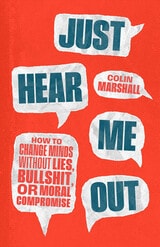
Just Hear Me Out
How to Change Minds Without Lies, Bullshit, or Moral CompromiseColin Marshall
University of Chicago Press, 2026
A guide to persuasion for people who want to change minds without manipulation or coercion.
Most of us have given up on persuasion. We say our problems are too pressing, people are too polarized, and success is too dubious—and it’s true! After all, when was the last time you heard someone actually change their mind? To improve our persuasive powers, self-help books often ask us to stoop to dishonest, manipulative tricks that rarely achieve lasting results. But perhaps there is a way to persuade people that is neither hopelessly misguided nor morally suspect.
In Just Hear Me Out, philosopher Colin Marshall describes a persuasive method that is both effective and ethical. Rather than share a flurry of tips for how to win friends and influence people, Marshall invites us to take up persuasion as fundamentally civil work, good both for our conscience and our communities. Real-world persuaders such as Jane Addams, Daryl Davis, and Fred Rogers show us an ethical route, he argues, to changing hearts through patience, respect, and compassion.
Accessible, practical, and buoyed by hope, Just Hear Me Out offers a powerful method for all who want to persuade others but aren’t interested in winning at any cost. When it works, people don’t just change their minds; they discover anew how to value our common humanity.
Just Hear Me Out
How to Change Minds Without Lies, Bullshit, or Moral CompromiseColin Marshall
University of Chicago Press, 2026
A guide to persuasion for people who want to change minds without manipulation or coercion.
Most of us have given up on persuasion. We say our problems are too pressing, people are too polarized, and success is too dubious—and it’s true! After all, when was the last time you heard someone actually change their mind? To improve our persuasive powers, self-help books often ask us to stoop to dishonest, manipulative tricks that rarely achieve lasting results. But perhaps there is a way to persuade people that is neither hopelessly misguided nor morally suspect.
In Just Hear Me Out, philosopher Colin Marshall describes a persuasive method that is both effective and ethical. Rather than share a flurry of tips for how to win friends and influence people, Marshall invites us to take up persuasion as fundamentally civil work, good both for our conscience and our communities. Real-world persuaders such as Jane Addams, Daryl Davis, and Fred Rogers show us an ethical route, he argues, to changing hearts through patience, respect, and compassion.
Accessible, practical, and buoyed by hope, Just Hear Me Out offers a powerful method for all who want to persuade others but aren’t interested in winning at any cost. When it works, people don’t just change their minds; they discover anew how to value our common humanity.

Just War, Second Edition
Richard J. Regan
Catholic University of America Press, 2013