Results by title
80 books match the query 'Foreign economic relations' and 2 start with j

Japan in the World
Masao Miyoshi and H. D. Harootunian, eds.
Duke University Press, 1993
Since the end of World War II, Japan has determinately remained outside the current of world events and uninvolved in the processes determining global history and politics. In Japan and the World, distinguished scholars, novelists, and intellectuals articulate how Japan—despite unprecedented economic prowess in securing dominance in the world's market—is caught in a complex dependency with the United States. Drawing on critical and postmodernist theory, this timely volume situates this dependency in a broader historical context and assesses Japan's current dealings in international politics, society, and culture.
Among the many topics covered are: racism in U.S.-Japanese relations; productivity and workplace discourse; Western cultural hegemony; the constructing of a Japanese cultural history; and the place of the novelist in today's world. Originally published as a special issue of boundary 2 (Fall 1991), this edition includes four new essays on Japanese industrial revolution; the place of English studies in Japan; how American cultural, historical, and political discourse represented Japan and in turn how America's version of Japan became Japan's version of itself; and an "archaeology" of hegemonic relationships between Japan and America and Britain in the first half of the twentieth century.
Contributors. Eqbal Ahmad, Perry Anderson, Bruce Cumings, Arif Dirlik, H.D. Harootunian, Kazuo Ishuro, Fredric Jameson, Kojin Karatani, Oe Kenzaburo, Masao Miyoshi, Tetsuo Najita, Leslie Pincus, Naoki Sakai, Miriam Silverberg, Christena Turner, Rob Wilson, Mitsuhiro Yoshimoto
[more]
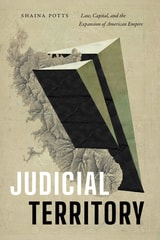
Judicial Territory
Law, Capital, and the Expansion of American EmpireShaina Potts
Duke University Press, 2024
In Judicial Territory, Shaina Potts reveals how the American empire has benefited from the post-World War II expansion of United States judicial authority over the economic decisions of postcolonial governments. Introducing the term “judicial territory” to refer to the increasingly transnational space over which US courts wield authority, Potts argues that law is an essential tool for US geopolitical and economic interests. Through close examination of cases involving private US companies, on the one hand, and foreign state-owned enterprises, nationalizations, and sovereign debt, on the other, she shows that technical changes relating to the treatment of foreign sovereigns in domestic US law allowed the United States to extend its purview over global financial and economic relations, including many economic decisions of foreign governments. Throughout, Potts argues, US law has not become divorced from territoriality but instead actively remapped it; it has not merely responded to globalization, but actively produced it—making the whole world part of US economic space in the process.
[more]