Results by title
98 books match the query 'Government' and 2 start with j
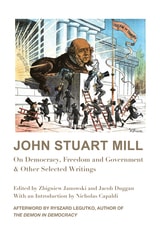
John Stuart Mill
On Democracy, Freedom and Government & Other Selected WritingsJohn Stuart Mill
St. Augustine's Press, 2019
In addition to “On Liberty” and “On Representative Government,” this new selection of Mill’s writings includes, among others, a number of less known of his writings, such as: “Civilization,” “Perfectibility,” “The Negro Question,” “On Education,” “On Aristocracy,” “On Marriage,” “On Free Press,” “Socialism,” Mill’s review of Tocqueville’s “Democracy in America,” his letters to Tocqueville, and several other writings.
If one can use a somewhat exaggerated language, Mill’s writings are to liberal-democracy what Marx and Engels’ writings were to Communism. Both systems gave expression to 19th century man’s longing for equality and justice, both promised to liberate him from the shackles of oppression, authority and tradition. Instead of liberating man, Communism created the most brutal system in human history, and its spectacular fall in 1989 is one of history’s greatest events. Western world today shows that liberal-democracy is no longer a benign doctrine, which advocates free market, minimum state and individual liberties, but, like Communism, is an all-encompassing ideology which forces an individual to abdicate his freedom and soul in favor of a Communist-like collective.
As many critics of real Socialism could see the seeds of totalitarianism in the writings of Marx and Engels, so one can see the seeds of liberal totalitarianism in Mill’s writings. This new edition is intended to help readers to understand why democratic-liberalism came so close to its 19th century ideological rival.
[more]
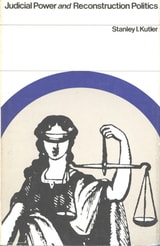
Judicial Power and Reconstruction Politics
Stanley I. Kutler
University of Chicago Press, 1968
A study of the Supreme Court in the wake of the Dred Scott decision.
This book investigates the political and public standing of the Supreme Court following the Dred Scott decision. Arguing against interpretations by previous historians, Kutler asserts instead that the "Chase Court" was neither enfeebled by the decision itself, nor by congressional Republicans during reconstruction. Instead, Kutler suggests that during reconstruction, the Court was characterized by forcefulness and judicious restraint rather than timidity and cowardice, holding a creative and determining role rather than abdicating its rightful powers. This volume assembles a series of essays by Kutler arguing for this characterization. Provocative and persuasive at turns, this collection of essays provides a bold and innovative reinterpretation of the Supreme Court after the Civil War.
This book investigates the political and public standing of the Supreme Court following the Dred Scott decision. Arguing against interpretations by previous historians, Kutler asserts instead that the "Chase Court" was neither enfeebled by the decision itself, nor by congressional Republicans during reconstruction. Instead, Kutler suggests that during reconstruction, the Court was characterized by forcefulness and judicious restraint rather than timidity and cowardice, holding a creative and determining role rather than abdicating its rightful powers. This volume assembles a series of essays by Kutler arguing for this characterization. Provocative and persuasive at turns, this collection of essays provides a bold and innovative reinterpretation of the Supreme Court after the Civil War.
[more]