767 books match the query 'Hispanic & Latino Studies' and 7 start with j
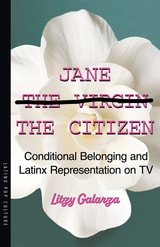
cover of Jane the Citizen: Conditional Belonging and Latinx Representation on TV

Jane the Citizen

Conditional Belonging and Latinx Representation on TV

Litzy Galarza

University of Arizona Press, 2027

What does it mean to belong in the United States—and what does it cost? Jane the Citizen confronts one of the most urgent questions in contemporary cultural life by turning to an unlikely archive: the CW’s celebrated telenovela-inspired series Jane the Virgin (2014–2019).

Litzy Galarza argues that beneath the show’s warmth and wit lies a sustained interrogation of citizenship’s limits. Building on Hector Amaya’s framework of citizenship excess and extending it to theorize reproductive citizenship excess and deficit, the book exposes the widening gap between citizenship as formal legal status and citizenship as livable, protected belonging—a gap that Jane the Virgin maps with extraordinary precision.

Across five seasons and two presidential administrations, Galarza demonstrates how the series tracks the lived costs of immigration policy, racial hierarchy, and gendered control over reproduction. She shows how Latinx characters experience belonging differently as political conditions shift in real time.
[more]
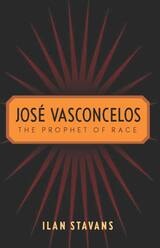
cover of José Vasconcelos: The Prophet of Race

José Vasconcelos

The Prophet of Race

Stavans, Ilan

Rutgers University Press, 2011
Mexican educator and thinker Jose Vasconcelos is to Latinos what W.E.B. Du Bois is to African Americans a controversial scholar who fostered an alternative view of the future. In Josè Vasconcelos: The Prophet of Race, his influential 1925 essay, "Mestizaje" key to understanding the role he played in the shaping of multiethnic America—is for the first time showcased and properly analyzed. Freshly translated here by John H. R. Polt, "Mestizaje" suggested that the Brown Race from Latin America was called to dominate the world, a thesis embraced by activists and scholars north and south of the Rio Grande. Ilan Stavans insightfully and comprehensively examines the essay in biographical and historical context, and considers how many in the United States, especially Chicanos during the civil rights era, used it as a platform for their political agenda. The volume also includes Vasconcelos's long-forgotten 1926 Harris Foundation Lecture at the University of Chicago, "The Race Problem in Latin America," where he cautioned the United States that rejecting mestizaje in our own midst will ultimately bankrupt the nation.
[more]
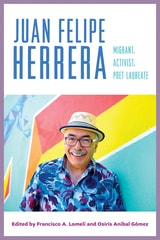
cover of Juan Felipe Herrera: Migrant, Activist, Poet Laureate

Juan Felipe Herrera

Migrant, Activist, Poet Laureate

Edited by Francisco A. Lomelí and Osiris Aníbal Gómez

University of Arizona Press, 2023

For the first time, this book presents the distinguished, prolific, and highly experimental writer Juan Felipe Herrera. This wide-ranging collection of essays by leading experts offers critical approaches on Herrera, who transcends ethnic and mainstream poetics. It expertly demonstrates Herrera’s versatility, resourcefulness, innovations, and infinite creativity.

As a poet Herrera has had an enormous impact within and beyond Chicano poetics. He embodies much of the advancements and innovations found in American and Latin American poetry from the early l970s to the present. His writings have no limits or boundaries, indulging in the quotidian as well as the overarching topics of his era at different periods of his life. Both Herrera and his work are far from being unidimensional. His poetics are eclectic, incessantly diverse, transnational, unorthodox, and distinctive.

Reading Herrera is an act of having to rearrange your perceptions about things, events, historical or intra-historical happenings, and people. The essays in this work delve deeply into Juan Felipe Herrera’s oeuvre and provide critical perspectives on his body of work. They include discussion of Chicanx indigeneity, social justice, environmental imaginaries, Herrera’s knack for challenging theory and poetics, transborder experiences, transgeneric constructions, and children’s and young adult literature.

This book includes an extensive interview with the poet and a voluminous bibliography on everything by, about, and on the author. The chapters in this book offer a deep dive into the life and work of an internationally beloved poet who, along with serving as the poet laureate of California and the U.S. poet laureate, creates work that fosters a deep understanding of and appreciation for people’s humanity.

Contributors
Trevor Boffone
Marina Bernardo-Flórez
Manuel de Jesús Hernández-G.
Whitney DeVos
Michael Dowdy
Osiris Aníbal Gómez
Carmen González Ramos
Cristina Herrera
María Herrera-Sobek
Francisco A. Lomelí
Tom Lutz
Manuel M. Martín-Rodríguez
Marzia Milazzo
Maria Antònia Oliver-Rotger
Rafael Pérez-Torres
Renato Rosaldo
Donaldo W. Urioste
Luis Alberto Urrea
Santiago Vaquera-Vásquez

[more]
cover of Junot Díaz and the Decolonial Imagination

Junot Díaz and the Decolonial Imagination

Monica Hanna, Jennifer Harford Vargas, José David Saldívar, editors

Duke University Press, 2016

The first sustained critical examination of the work of Dominican-American writer Junot Díaz, this interdisciplinary collection considers how Díaz's writing illuminates the world of Latino cultural expression and trans-American and diasporic literary history. Interested in conceptualizing Díaz's decolonial imagination and his radically re-envisioned world, the contributors show how his aesthetic and activist practice reflect a significant shift in American letters toward a hemispheric and planetary culture. They examine the intersections of race, Afro-Latinidad, gender, sexuality, disability, poverty, and power in Díaz's work. Essays in the volume explore issues of narration, language, and humor in The Brief Wondrous Life of Oscar Wao, the racialized constructions of gender and sexuality in Drown and This Is How You Lose Her, and the role of the zombie in the short story "Monstro." Collectively, they situate Díaz’s writing in relation to American and Latin American literary practices and reveal the author’s activist investments. The volume concludes with Paula Moya's interview with Díaz.

Contributors: Glenda R. Carpio, Arlene Dávila, Lyn Di Iorio, Junot Díaz, Monica Hanna, Jennifer Harford Vargas, Ylce Irizarry, Claudia Milian, Julie Avril Minich, Paula M. L. Moya, Sarah Quesada, José David Saldívar, Ramón Saldívar, Silvio Torres-Saillant, Deborah R. Vargas
[more]
cover of Junot Díaz: On the Half-Life of Love

Junot Díaz

On the Half-Life of Love

José David Saldívar

Duke University Press, 2022
In Junot Díaz: On the Half-Life of Love, José David Saldívar offers a critical examination of one of the leading American writers of his generation. He explores Díaz’s imaginative work and the diasporic and immigrant world he inhabits, showing how his influences converged in his fiction and how his writing—especially his Pulitzer Prize--winning novel The Brief Wondrous Life of Oscar Wao—radically changed the course of US Latinx literature and created a new way of viewing the decolonial world. Saldívar examines several aspects of Díaz’s career, from his vexed relationship to the literary aesthetics of Whiteness that dominated his MFA experience and his critiques of the colonialities of power, race, and gender in culture and societies of the Dominican Republic, United States, and the Américas to his use of the science-fiction imaginary to explore the capitalist zombification of our planet. Throughout, Saldívar shows how Díaz’s works exemplify the literary currents of the early twenty-first century.
[more]
cover of Just Between Us: An Ethnography of Male Identity and Intimacy in Rural Communities of Northern Mexico

Just Between Us

An Ethnography of Male Identity and Intimacy in Rural Communities of Northern Mexico

Guillermo Núñez Noriega

University of Arizona Press, 2014

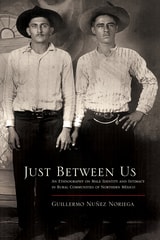
A photograph of two men, cowboy-hatted and -booted and discreetly holding hands, is the departure point in a groundbreaking study on masculinity and homosexuality in Mexico. Just Between Us, an ethnography of intimacy and affection between men, explores the concept of masculine identity and homoeroticism, expressing the difficulties men face in maintaining their masculinity while expressing intimacy and affection.

Using fieldwork from rural Sonora, Mexico, Guillermo Núñez Noriega posits that men accept this intimacy outside gender categories and stereotypes, despite the traditional patriarchal society. This work contests homophobia and the heterosexual ideal of men and attempts to break down the barriers between genders.

The photograph Núñez Noriega uses to explore the shifting attitudes and perceptions of sexuality and gender provokes more questions than answers. Recognizing the societal regulations at play, the author demonstrates the existence in contemporary Mexico of an invisible regime of power that constructs and regulates the field of possibilities for men’s social actions, especially acts of friendship, affection, and eroticism with other men. The work investigates “modes of speaking” about being a man, on being gay, on the implicit meanings of the words homosexual, masculine, trade, fairy, and others—words that construct possibilities for intimacy, particularly affective and erotic intimacy among men.

Multiple variants of homoeroticism fall outside the dominant model, Núñez Noriega argues, a finding that offers many lessons on men and masculine identities. This book challenges patriarchal definitions of sex, gender, and identity; it promotes the unlearning of dominant conventions of masculinity to allow new ways of being.
 
[more]
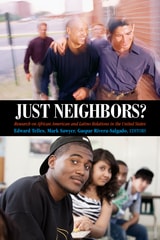
cover of Just Neighbors?: Research on African American and Latino Relations in the United States

Just Neighbors?

Research on African American and Latino Relations in the United States

Edward Telles

Russell Sage Foundation, 2012

Blacks and Latinos have transformed the American city—together these groups now constitute the majority in seven of the ten largest cities. Large-scale immigration from Latin America has been changing U.S. racial dynamics for decades, and Latino migration to new destinations is changing the face of the American south. Yet most of what social science has helped us to understand about these groups has been observed primarily in relation to whites—not each other. Just Neighbors? challenges the traditional black/white paradigm of American race relations by examining African Americans and Latinos as they relate to each other in the labor market, the public sphere, neighborhoods, and schools. The book shows the influence of race, class, and received stereotypes on black-Latino social interactions and offers insight on how finding common ground may benefit both groups. From the labor market and political coalitions to community organizing, street culture, and interpersonal encounters, Just Neighbors? analyzes a spectrum of Latino-African American social relations to understand when and how these groups cooperate or compete. Contributor Frank Bean and his co-authors show how the widely held belief that Mexican immigration weakens job prospects for native-born black workers is largely unfounded—especially as these groups are rarely in direct competition for jobs. Michael Jones-Correa finds that Latino integration beyond the traditional gateway cities promotes seemingly contradictory feelings: a sense of connectedness between the native minority and the newcomers but also perceptions of competition. Mark Sawyer explores the possibilities for social and political cooperation between the two groups in Los Angeles and finds that lingering stereotypes among both groups, as well as negative attitudes among blacks about immigration, remain powerful but potentially surmountable forces in group relations. Regina Freer and Claudia Sandoval examine how racial and ethnic identity impacts coalition building between Latino and black youth and find that racial pride and a sense of linked fate encourages openness to working across racial lines. Black and Latino populations have become a majority in the largest U.S. cities, yet their combined demographic dominance has not abated both groups' social and economic disadvantage in comparison to whites. Just Neighbors? lays a much-needed foundation for studying social relations between minority groups. This trailblazing book shows that, neither natural allies nor natural adversaries, Latinos and African Americans have a profound potential for coalition-building and mutual cooperation. They may well be stronger together rather than apart.
[more]