Results by title
260 books match the query 'Holocaust' and 5 start with j
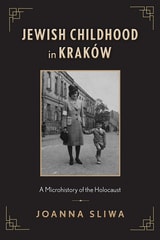
Jewish Childhood in Kraków
A Microhistory of the HolocaustJoanna Sliwa
Rutgers University Press, 2021
Jewish Childhood in Kraków is the first book to tell the history of Kraków in the second World War through the lens of Jewish children’s experiences. Here, children assume center stage as historical actors whose recollections and experiences deserve to be told, analyzed, and treated seriously.
Sliwa scours archives to tell their story, gleaning evidence from the records of the German authorities, Polish neighbors, Jewish community and family, and the children themselves to explore the Holocaust in German-occupied Poland and in Kraków in particular. A microhistory of a place, a people, and daily life, this book plumbs the decisions and behaviors of ordinary people in extraordinary times.
Offering a window onto human relations and ethnic tensions in times of rampant violence, Jewish Childhood in Kraków is an effort both to understand the past and to reflect on the position of young people during humanitarian crises.
Jewish Claims Against East Germany
Angelika Timm
Central European University Press, 1998
This is the first comprehensive history of Jewish negotiations with East Germany regarding restitution and reparations for Nazi war crimes. Angelika Timm analyzes the politics of old and new anti-Semitism and the context in which they grew under the officially propagated ideology of antifascism.
Investigating the mass of unpublished, newly available archival data from the United States, Israel, and the former German Democratic Republic, and more than forty personal interviews, Timm fills a critical gap in the scholarship on postwar Germany. She analyzes the role of the Holocaust and the image of Jews in the historical consciousness and political culture of East Germany and chronicles the efforts of Jewish organizations, especially the Conference on Jewish Material Claims Against Germany, to negotiate reparations with the East German state. The unique relationship between ideology and Realpolitik defined the manner in which East Germany confronted the crimes of its past and allowed anti-Semitism to reemerge.
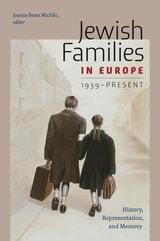
Jewish Families in Europe, 1939-Present
History, Representation, and MemoryEdited by Joanna Beata Michlic
Brandeis University Press, 2017
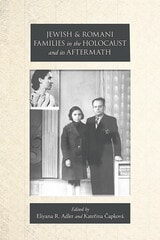
Jewish and Romani Families in the Holocaust and its Aftermath
Eliyana R. Adler
Rutgers University Press, 2021
In this work, scholars from the United States, Israel, and across Europe bring a variety of backgrounds and disciplines to their study of the Holocaust and its aftermath from the family perspective. Drawing on research from Belarus to Great Britain, and examining both Jewish and Romani families, they demonstrate the importance of recognizing how people continued to function within family units—broadly defined—throughout the war and afterward.

Jewish-American Artists and the Holocaust
Baigell, Matthew
Rutgers University Press, 1997
Jewish themes in American art were not very visible until the last two decades, although many famous twentieth-century artists and critics were and are Jewish. Few artists responded openly to the Holocaust until the 1960s, when it finally began to act as a galvanizing force, allowing Jewish-American artists to express their Jewish identity in their work. Baigell describes how artists initially deflected their responses into abstract forms or by invoking biblical and traditional figures and then in more recent decades confronted directly Holocaust imagery and memory. He traces the development of artistic work from the late 1930s to the present in a moving study of a long overlooked topic in the history of American art.