Results by title
51 books match the query 'Holocaust survivors' and 3 start with j
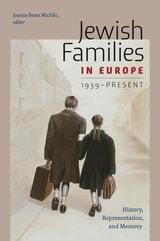
Jewish Families in Europe, 1939-Present
History, Representation, and MemoryEdited by Joanna Beata Michlic
Brandeis University Press, 2017
This book offers an extensive introduction and 13 diverse essays on how World War II, the Holocaust, and their aftermath affected Jewish families and Jewish communities, with an especially close look at the roles played by women, youth, and children. Focusing on Eastern and Central Europe, themes explored include: how Jewish parents handled the Nazi threat; rescue and resistance within the Jewish family unit; the transformation of gender roles under duress; youth’s wartime and early postwar experiences; postwar reconstruction of the Jewish family; rehabilitation of Jewish children and youth; and the role of Zionism in shaping the present and future of young survivors. Relying on newly available archival material and novel research in the areas of families, youth, rescue, resistance, gender, and memory, this volume will be an indispensable guide to current work on the familial and social history of the Holocaust.
[more]
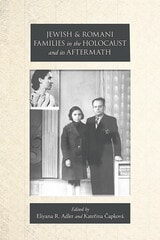
Jewish and Romani Families in the Holocaust and its Aftermath
Eliyana R. Adler
Rutgers University Press, 2021
Diaries, testimonies and memoirs of the Holocaust often include at least as much on the family as on the individual. Victims of the Nazi regime experienced oppression and made decisions embedded within families. Even after the war, sole survivors often described their losses and rebuilt their lives with a distinct focus on family. Yet this perspective is lacking in academic analyses.
In this work, scholars from the United States, Israel, and across Europe bring a variety of backgrounds and disciplines to their study of the Holocaust and its aftermath from the family perspective. Drawing on research from Belarus to Great Britain, and examining both Jewish and Romani families, they demonstrate the importance of recognizing how people continued to function within family units—broadly defined—throughout the war and afterward.
In this work, scholars from the United States, Israel, and across Europe bring a variety of backgrounds and disciplines to their study of the Holocaust and its aftermath from the family perspective. Drawing on research from Belarus to Great Britain, and examining both Jewish and Romani families, they demonstrate the importance of recognizing how people continued to function within family units—broadly defined—throughout the war and afterward.
[more]
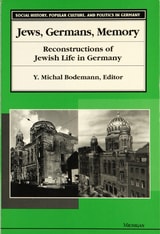
Jews, Germans, Memory
Reconstructions of Jewish Life in GermanyY. Michal Bodemann, Editor
University of Michigan Press, 1996
How was it possible that a new and sizeable Jewish community developed after the Holocaust in Germany of all places? Jews, Germans, Memory undertakes to assess the past, present, and future of German-Jewish relations in the light of recent political changes and the opening up of historical resources. This welcome new volume investigates how the groundwork was laid for the new Jewish community in the post-war period, with different objectives by Jewish leaders and German politicians. Its contributors touch upon history, literature, the media, ethnicity, politics, and social movements, and attempt to answer the question of how Jews are socially constructed and how the glorious German Jewish past and the Holocaust have been remembered in the course of recent decades. In recent years, German Jewry has seen fundamental transformations with the influx from Eastern Europe and a new leadership in the community. A new self-definition, even self-assurance and reappraisal in Israel and elsewhere, has evolved. Historians, scholars of cultural studies, and those interested in debates on memory and ethnicity will all find something of interest in this diverse volume. Jews, Germans, Memory joins in debate Michael Brenner, Micha Brumlik, Dan Diner, Cilly Kugelmann, and Martin Löw-Beer, among the most prominent younger Jewish intellectuals in Germany today, with others who have long observed Germany from both inside and outside: Y. Michal Bodemann, John Borneman, Andrei Markovits, Robin Ostrow, Moishe Postone, Frank Stern, and Jack Zipes. Y. Michal Bodemann is Professor of Sociology, University of Toronto.
[more]