468 books match the query 'Identity' and 17 start with j
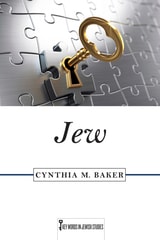
cover of Jew

Jew

Baker, Cynthia M

Rutgers University Press, 2017
Jew.  The word possesses an uncanny power to provoke and unsettle. For millennia, Jew has signified the consummate Other, a persistent fly in the ointment of Western civilization’s grand narratives and cultural projects. Only very recently, however, has Jew been reclaimed as a term of self-identification and pride.  
 
With these insights as a point of departure, this book offers a wide-ranging exploration of the key word Jew—a term that lies not only at the heart of Jewish experience, but indeed at the core of Western civilization. Examining scholarly debates about the origins and early meanings of Jew, Cynthia M. Baker interrogates categories like “ethnicity,” “race,” and “religion” that inevitably feature in attempts to define the word. Tracing the term’s evolution, she also illuminates its many contradictions, revealing how Jew has served as a marker of materialism and intellectualism, socialism and capitalism, worldly cosmopolitanism and clannish parochialism, chosen status, and accursed stigma.
 
Baker proceeds to explore the complex challenges that attend the modern appropriation of Jew as a term of self-identification, with forays into Yiddish language and culture, as well as meditations on Jew-as-identity by contemporary public intellectuals. Finally, by tracing the phrase new Jews through a range of contexts—including the early Zionist movement, current debates about Muslim immigration to Europe, and recent sociological studies in the United States—the book provides a glimpse of what the word Jew is coming to mean in an era of Internet cultures, genetic sequencing, precarious nationalisms, and proliferating identities.
 
[more]
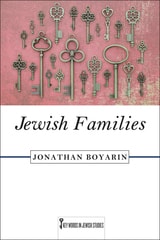
cover of Jewish Families

Jewish Families

Boyarin, Jonathan

Rutgers University Press, 2013

From stories of biblical patriarchs and matriarchs and their children, through the Gospel’s Holy Family of Jesus, Mary, and Joseph, and to modern Jewish families in fiction, film, and everyday life, the family has been considered key to transmitting Jewish identity. Current discussions about the Jewish family’s supposed traditional character and its alleged contemporary crisis tend to assume that the dynamics of Jewish family life have remained constant from the days of Abraham and Sarah to those of Tevye and Golde in Fiddler on the Roof and on to Philip Roth’s Portnoy’s Complaint.

Jonathan Boyarin explores a wide range of scholarship in Jewish studies to argue instead that Jewish family forms and ideologies have varied greatly throughout the times and places where Jewish families have found themselves. He considers a range of family configurations from biblical times to the twenty-first century, including strictly Orthodox communities and new forms of family, including same-sex parents. The book shows the vast canvas of history and culture as well as the social pressures and strategies that have helped shape Jewish families, and suggests productive ways to think about possible futures for Jewish family forms.
[more]
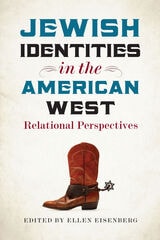
cover of Jewish Identities in the American West: Relational Perspectives

Jewish Identities in the American West

Relational Perspectives

Edited by Ellen Eisenberg

Brandeis University Press, 2022

Jewish Identities in the American West fills a significant gap in racial identity scholarship.
 
Since the onset of New Western History in the 1980s, the complexity of race and ethnicity as it developed in the American West has increasingly been recognized by scholars and the wider public alike. Ethnic studies scholars have developed new perspectives on racial formation in the West that complicate older notions that often relied on binary descriptions, such as Black/white racialization. In the past few decades, these studies have relied on relational approaches that focus on how race is constructed, by both examining interactions with the white dominant group, and by exploring the multiple connections with other racial/ethnic groups in society. Historians are discovering new stories of racial construction, and revising older accounts, to integrate these new perspectives into the formation of racial and ethnic identities. This collection of essays on Jews in the American West advances this field in multiple ways. With essays that cover the period from the mid-nineteenth century to the present, these authors present a collective portrait of change over time that allows us to view the shifting nature of Jewish identity in the West, as well as the evolving frameworks for racial construction. Thorough and thought-provoking, Jewish Identities in the American West takes readers on a journey of racial and ethnic identity in the American West.
[more]
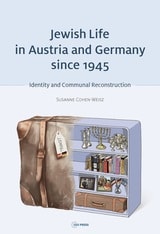
cover of Jewish Life in Austria and Germany Since 1945: Identity and Communal Reconstruction

Jewish Life in Austria and Germany Since 1945

Identity and Communal Reconstruction

Susanne Cohen-Weisz

Central European University Press, 2016
Based on published primary and secondary materials and oral interviews with some eighty communal and organizational leaders, experts and scholars, this book provides a comparative account of the reconstruction of Jewish communal life in both Germany and in Austria (where 98% live in the capital, Vienna) after 1945. The author explains the process of reconstruction over the next six decades, and its results in each country. The monograph focuses on the variety of prevailing perceptions about topics such as: the state of Israel, one’s relationship to the country of residence, the Jewish religion, the aftermath of the Holocaust, and the influx of post-soviet immigrants. Cohen-Weisz examines the changes in Jewish group identity and its impact on the development of communities. The study analyzes the similarities and differences in regard to the political, social, institutional and identity developments within the two countries, and their changing attitudes and relationships with surrounding societies; it seeks to show the evolution of these two country’s Jewish communities in diverse national political circumstances and varying post-war governmental policies.
[more]
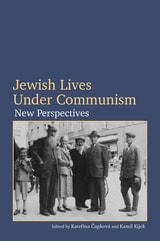
cover of Jewish Lives under Communism: New Perspectives

Jewish Lives under Communism

New Perspectives

Katerina Capková

Rutgers University Press, 2022
This volume provides new, groundbreaking views of Jewish life in various countries of the pro-Soviet bloc from the end of the Second World War until the collapse of Communism in late 1989. The authors, twelve leading historians and anthropologists from Europe, Israel and the United States, look at the experience of Jews under Communism  by digging beyond formal state policy and instead examining the ways in which Jews creatively seized opportunities to develop and express their identities, religious and secular, even under great duress. The volume shifts the focus from Jews being objects of Communist state policy (and from anti-Jewish prejudices in Communist societies) to the agency of Jews and their creativity in Communist Europe after the Holocaust. The examination of Jewish history from a transnational vantage point challenges a dominant strand in history writing today, by showing instead the wide variety of Jewish experiences in law, traditions and institutional frameworks as conceived from one Communist country to another and even within a single country, such as Poland, Czechoslovakia, Hungary, East Germany, and the Soviet Union. By focusing on networks across east-central Europe and beyond and on the forms of identity open to Jews in this important period, the volume begins a crucial rethinking of social and cultural life under Communist regimes.
 
[more]
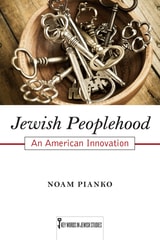
cover of Jewish Peoplehood: An American Innovation

Jewish Peoplehood

An American Innovation

Pianko, Noam

Rutgers University Press, 2015

Winner of the 2017 Saul Viener Book Prize from the American Jewish Historical Society​

Although fewer American Jews today describe themselves as religious, they overwhelmingly report a strong sense of belonging to the Jewish people. Indeed, Jewish peoplehood has eclipsed religion—as well as ethnicity and nationality—as the essence of what binds Jews around the globe to one another. In Jewish Peoplehood, Noam Pianko highlights the current significance and future relevance of “peoplehood” by tracing the rise, transformation, and return of this novel term. 
 
The book tells the surprising story of peoplehood. Though it evokes a sense of timelessness, the term actually emerged in the United States in the 1930s, where it was introduced by American Jewish leaders, most notably Rabbi Stephen Wise and Rabbi Mordecai Kaplan, with close ties to the Zionist movement. It engendered a sense of unity that transcended religious differences, cultural practices, geographic distance, economic disparity, and political divides, fostering solidarity with other Jews facing common existential threats, including the Holocaust, and establishing a closer connection to the Jewish homeland. But today, Pianko points out, as globalization erodes the dominance of nationalism in shaping collective identity, Jewish peoplehood risks becoming an outdated paradigm. He explains why popular models of peoplehood fail to address emerging conceptions of ethnicity, nationalism, and race, and he concludes with a much-needed roadmap for a radical reconfiguration of Jewish collectivity in an increasingly global era.
 
Innovative and provocative, Jewish Peoplehood provides fascinating insight into a term that assumes an increasingly important position at the heart of American Jewish and Israeli life.
 
[more]
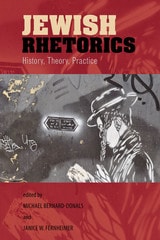
cover of Jewish Rhetorics: History, Theory, Practice

Jewish Rhetorics

History, Theory, Practice

Edited by Michael Bernard-Donals and Janice W. Fernheimer

Brandeis University Press, 2014
This volume, the first of its kind, establishes and clarifies the significance of Jewish rhetorics as its own field and as a field within rhetoric studies. Diverse essays illuminate and complicate the editors’ definition of a Jewish rhetorical stance as allowing speakers to maintain a “resolute sense of engagement” with their fellows and their community, while also remaining aware of the dislocation from the members of those communities. Topics include the historical and theoretical foundations of Jewish rhetorics; cultural variants and modes of cultural expression; and intersections with Greco-Roman, Christian, Islamic, and contemporary rhetorical theory and practice. In addition, the contributors examine gender and Yiddish, and evaluate the actual and potential effect of Jewish rhetorics on contemporary scholarship and on the ways we understand and teach language and writing. The contributors include some of the world’s leading scholars of rhetoric, writing, and Jewish studies.
[more]
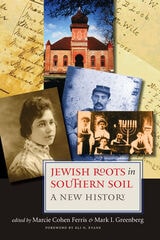
cover of Jewish Roots in Southern Soil: A New History

Jewish Roots in Southern Soil

A New History

Edited by Marcie Ferris and Mark I. Greenberg

Brandeis University Press, 2006
Jews have long been a presence in the American South, first arriving in the late seventeenth century as part of exploratory voyages from Europe to the New World. Two of the nation’s earliest Jewish communities were founded in Savannah in 1733 and Charleston in 1749. By 1800, more Jews lived in Charleston than in New York City. Today, Jews comprise less than one half of one percent of the southern population but provide critical sustenance and support for their communities. Nonetheless, southern Jews have perplexed scholars. For more than a century, historians have wrestled with various questions. Why study southern Jewish history? What is the southern Jewish experience? Is southern Jewish culture distinctive from that of other regions of the country, and if so, why? Jewish Roots in Southern Soil: A New History addresses these questions through the voices of a new generation of scholars of the Jewish South. Each of this book’s thirteen chapters reflects a response with particular attention paid to new studies on women and gender; black/Jewish relations and the role of race, politics, and economic life; popular and material culture; and the changes wrought by industrialization and urbanization in the twentieth century. Essays address historical issues from the colonial era to the present and in every region of the South. Topics include assimilation and American Jewish identity, southern Jewish women writers, the Jewish Confederacy, Jewish peddlers, southern Jewish racial identity, black/Jewish relations, demographic change, the rise of American Reform Judaism, and Jews in southern literature.
[more]
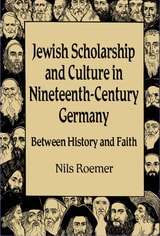
cover of Jewish Scholarship and Culture in Nineteenth-Century Germany: Between History and Faith

Jewish Scholarship and Culture in Nineteenth-Century Germany

Between History and Faith

Nils Roemer

University of Wisconsin Press, 2005

    German Jews were fully assimilated and secularized in the nineteenth century—or so it is commonly assumed. In Jewish Scholarship and Culture in the Nineteenth Century, Nils Roemer challenges this assumption, finding that religious sentiments, concepts, and rhetoric found expression through a newly emerging theological historicism at the center of modern German Jewish culture.
    Modern German Jewish identity developed during the struggle for emancipation, debates about religious and cultural renewal, and battles against anti-Semitism. A key component of this identity was historical memory, which Jewish scholars had begun to infuse with theological perspectives beginning in the 1850s. After German reunification in the early 1870s, Jewish intellectuals reevaluated their enthusiastic embrace of liberalism and secularism. Without abandoning the ideal of tolerance, they asserted a right to cultural religious difference for themselves--an ideal they held to even more tightly in the face of growing anti-Semitism. This newly re-theologized Jewish history, Roemer argues, helped German Jews fend off anti-Semitic attacks by strengthening their own sense of their culture and tradition.

[more]
cover of Jewish Women in Fin de Siècle Vienna

Jewish Women in Fin de Siècle Vienna

By Alison Rose

University of Texas Press, 2008

Despite much study of Viennese culture and Judaism between 1890 and 1914, little research has been done to examine the role of Jewish women in this milieu. Rescuing a lost legacy, Jewish Women in Fin de Siècle Vienna explores the myriad ways in which Jewish women contributed to the development of Viennese culture and participated widely in politics and cultural spheres.

Areas of exploration include the education and family lives of Viennese Jewish girls and varying degrees of involvement of Jewish women in philanthropy and prayer, university life, Zionism, psychoanalysis and medicine, literature, and culture. Incorporating general studies of Austrian women during this period, Alison Rose also presents significant findings regarding stereotypes of Jewish gender and sexuality and the politics of anti-Semitism, as well as the impact of German culture, feminist dialogues, and bourgeois self-images.

As members of two minority groups, Viennese Jewish women nonetheless used their involvement in various movements to come to terms with their dual identity during this period of profound social turmoil. Breaking new ground in the study of perceptions and realities within a pivotal segment of the Viennese population, Jewish Women in Fin de Siècle Vienna applies the lens of gender in important new ways.

[more]
cover of Jewish on Their Own Terms: How Intermarried Couples are Changing American Judaism

Jewish on Their Own Terms

How Intermarried Couples are Changing American Judaism

Thompson, Jennifer A

Rutgers University Press, 0

Over half of all American Jewish children are being raised by intermarried parents. This demographic group will have a tremendous impact on American Judaism as it is lived and practiced in the coming decades. To date, however, in both academic studies about Judaism and in the popular imagination, such children and their parents remain marginal.  

Jennifer A. Thompson takes a different approach. In Jewish on Their Own Terms, she tells the stories of intermarried couples, the rabbis and other Jewish educators who work with them, and the conflicting public conversations about intermarriage among American Jews. Thompson notes that in the dominant Jewish cultural narrative, intermarriage symbolizes individualism and assimilation. Talking about intermarriage allows American Jews to discuss their anxieties about remaining distinctively Jewish despite their success in assimilating into American culture.

In contrast, Thompson uses ethnography to describe the compelling concerns of all of these parties and places their anxieties firmly within the context of American religious culture and morality. She explains how American and traditional Jewish gender roles converge to put non-Jewish women in charge of raising Jewish children. Interfaith couples are like other Americans in often harboring contradictory notions of individual autonomy, universal religious truths, and obligations to family and history.

Focusing on the lived experiences of these families, Jewish on Their OwnTerms provides a complex and insightful portrait of intermarried couples and the new forms of American Judaism that they are constructing.
[more]
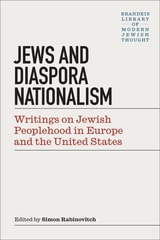
cover of Jews and Diaspora Nationalism: Writings on Jewish Peoplehood in Europe and the United States

Jews and Diaspora Nationalism

Writings on Jewish Peoplehood in Europe and the United States

Edited by Simon Rabinovitch

Brandeis University Press, 2012
The question of how to preserve, construct or transform Jewish peoplehood consumed Jewish intellectuals in the late nineteenth and early twentieth centuries. Despite a rich array of writing from Jewish nationalists, liberals, and socialists about the vitality of Jewish existence in the diaspora, the key works have never been collected in a single volume, and few reliable English translations exist. This anthology brings together a variety of thinkers who offered competing visions of peoplehood within the established and developing Jewish diaspora centers of Europe and America. Writing in Russian, Yiddish, Hebrew, French, and English, these Jewish intellectuals sought to recast Jewish existence, whether within multiethnic empires, liberal democracies, or socialist forms of government, in national terms. Volume editor Simon Rabinovitch provides an introductory essay, as well as short introductions and annotations to each document that contextualize and make accessible this wealth of primary sources for scholars and students.
[more]
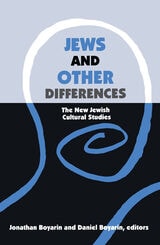
cover of Jews and Other Differences: The New Jewish Cultural Studies

Jews and Other Differences

The New Jewish Cultural Studies

Jonathan Boyarin

University of Minnesota Press, 1997
[more]
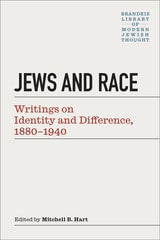
cover of Jews and Race: Writings on Identity and Difference, 1880–1940

Jews and Race

Writings on Identity and Difference, 1880–1940

Edited by Mitchell B. Hart

Brandeis University Press, 2011

Many people think of Jews as victims of a particular sort of racism, not as active participants in the development of racial thinking in the nineteenth and twentieth centuries. Yet many Jews did take up racial discourse and used it to analyze Judaism, Jewish history, and the contemporary condition of world Jewry. Race discourse generated by Jews was in part apologetic, a response to racial antisemitism; however, it also served other political and ideological needs. Focusing primarily on works written at the height of the racial hygiene and eugenics movements in Europe and North America, this diverse anthology shows how Jewish scholars and popular writers in Europe, North America, and Palestine developed racial interpretations of Judaism and Jewish history, thereby raising fascinating and thorny issues about the nature and history of racial discourse in Europe and America. Designed for class adoption, the volume contains annotations and an introduction by the editor.
[more]
cover of Job Loss, Identity, and Mental Health

Job Loss, Identity, and Mental Health

Norris, Dawn R

Rutgers University Press, 2016
Our jobs are often a big part of our identities, and when we are fired, we can feel confused, hurt, and powerless—at sea in terms of who we are. Drawing on extensive, real-life interviews, Job Loss, Identity, and Mental Health shines a light on the experiences of unemployed, middle-class professional men and women, showing how job loss can affect both identity and mental health.
 
Sociologist Dawn R. Norris uses in-depth interviews to offer insight into the experience of losing a job—what it means for daily life, how the unemployed feel about it, and the process they go through as they try to deal with job loss and their new identities as unemployed people. Norris highlights several specific challenges to identity that can occur. For instance, the way other people interact with the unemployed either helps them feel sure about who they are, or leads them to question their identities. Another identity threat happens when the unemployed no longer feel they are the same person they used to be. Norris also examines the importance of the subjective meaning people give to statuses, along with the strong influence of society’s expectations. For example, men in Norris’s study often used the stereotype of the “male breadwinner” to define who they were. Job Loss, Identity, and Mental Health describes various strategies to cope with identity loss, including “shifting” away from a work-related identity and instead emphasizing a nonwork identity (such as “a parent”), or conversely “sustaining” a work-related identity even though he or she is actually unemployed. Finally, Norris explores the social factors—often out of the control of unemployed people—that make these strategies possible or impossible.
 
A compelling portrait of a little-studied aspect of the Great Recession, Job Loss, Identity, and Mental Health is filled with insight into the identity crises that unemployment can trigger, as well as strategies to help the unemployed maintain their mental strength.
 
[more]
cover of Judaism Musical and Unmusical

Judaism Musical and Unmusical

Michael P. Steinberg

University of Chicago Press, 2008

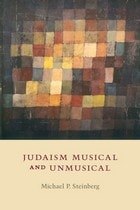
Modernity gave rise to a Jewish consciousness that has increasingly distanced itself from the sacred in favor of worldliness and secularity. Judaism Musical and Unmusical traces the formulation of this secular Jewishness from its Enlightenment roots through the twentieth century to explore the infinite variations of modern Jewish experience in Central Europe and beyond.

Engaging the work of such figures as Sigmund Freud, Walter Benjamin, Hannah Arendt, Charlotte Salomon, Arnaldo Momigliano, Leonard Bernstein, and Daniel Libeskind, Michael Steinberg shows how modern Jews advanced cosmopolitanism and multiplicity by helping to loosen—whether by choice or by necessity—the ties that bind any culture to accounts of its origins. In the process, Steinberg composes a mosaic of texts and events, often distant from one another in time and place, that speak to his theme of musicality. As both a literal value and a metaphorical one, musicality opens the possibility of a fusion of aesthetics and analysis—a coupling analogous to European modernity’s twin concerns of art and politics.
[more]
cover of Just Between Us: An Ethnography of Male Identity and Intimacy in Rural Communities of Northern Mexico

Just Between Us

An Ethnography of Male Identity and Intimacy in Rural Communities of Northern Mexico

Guillermo Núñez Noriega

University of Arizona Press, 2014

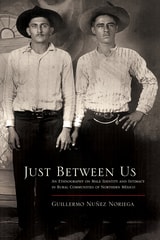
A photograph of two men, cowboy-hatted and -booted and discreetly holding hands, is the departure point in a groundbreaking study on masculinity and homosexuality in Mexico. Just Between Us, an ethnography of intimacy and affection between men, explores the concept of masculine identity and homoeroticism, expressing the difficulties men face in maintaining their masculinity while expressing intimacy and affection.

Using fieldwork from rural Sonora, Mexico, Guillermo Núñez Noriega posits that men accept this intimacy outside gender categories and stereotypes, despite the traditional patriarchal society. This work contests homophobia and the heterosexual ideal of men and attempts to break down the barriers between genders.

The photograph Núñez Noriega uses to explore the shifting attitudes and perceptions of sexuality and gender provokes more questions than answers. Recognizing the societal regulations at play, the author demonstrates the existence in contemporary Mexico of an invisible regime of power that constructs and regulates the field of possibilities for men’s social actions, especially acts of friendship, affection, and eroticism with other men. The work investigates “modes of speaking” about being a man, on being gay, on the implicit meanings of the words homosexual, masculine, trade, fairy, and others—words that construct possibilities for intimacy, particularly affective and erotic intimacy among men.

Multiple variants of homoeroticism fall outside the dominant model, Núñez Noriega argues, a finding that offers many lessons on men and masculine identities. This book challenges patriarchal definitions of sex, gender, and identity; it promotes the unlearning of dominant conventions of masculinity to allow new ways of being.
 
[more]