Results by title
763 books match the query 'Immigration & Emigration' and 3 start with j
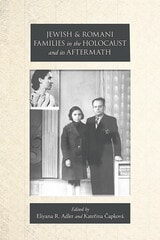
Jewish and Romani Families in the Holocaust and its Aftermath
Eliyana R. Adler
Rutgers University Press, 2021
Diaries, testimonies and memoirs of the Holocaust often include at least as much on the family as on the individual. Victims of the Nazi regime experienced oppression and made decisions embedded within families. Even after the war, sole survivors often described their losses and rebuilt their lives with a distinct focus on family. Yet this perspective is lacking in academic analyses.
In this work, scholars from the United States, Israel, and across Europe bring a variety of backgrounds and disciplines to their study of the Holocaust and its aftermath from the family perspective. Drawing on research from Belarus to Great Britain, and examining both Jewish and Romani families, they demonstrate the importance of recognizing how people continued to function within family units—broadly defined—throughout the war and afterward.
In this work, scholars from the United States, Israel, and across Europe bring a variety of backgrounds and disciplines to their study of the Holocaust and its aftermath from the family perspective. Drawing on research from Belarus to Great Britain, and examining both Jewish and Romani families, they demonstrate the importance of recognizing how people continued to function within family units—broadly defined—throughout the war and afterward.
[more]
Journey without End
Migration from the Global South through the AmericasRob Curran and Andrew Nelson
Vanderbilt University Press, 2022
Journey without End chronicles the years-long journey of "extracontinentales"—African and South Asian migrants moving through Latin America toward the United States. Based on five years of collaborative research between a journalist and an anthropologist, this book makes an engrossing, sometimes surreal, narrative-driven critique of how state-level immigration policy fails extracontinental migrants.
The book begins with Kidane, an Eritrean migrant who has left his pregnant wife behind to make the four-year trip to North America; it then picks up the natural disaster–riddled voyage of Roshan and Kamala Dhakal from Nepal to Ecuador; and it continues to the trials of Cameroonian exile Jane Mtebe, who becomes trapped in a bizarre beachside resort town on the edge of the Darién Gap—the gateway from South to Central America.
Journey without End follows these migrants as their fitful voyages put them in a semi-permanent state of legal and existential liminality. Mercurial policy creates profit opportunities that transform migration bottlenecks—Quito's tourist district, a Colombian beachside resort, Panama's Darién Gap, and a Mexican border town—into spontaneous migration-oriented spaces rife with racial, gender, and class exploitation. Throughout this struggle, migrant solidarity allows for occasional glimpses of subaltern cosmopolitanism and the possibility of mobile futures.
[more]