Results by title
220 books match the query 'Israel' and 6 start with j
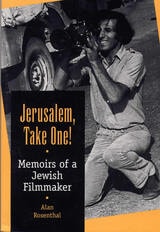
Jerusalem, Take One!
Memoirs of a Jewish FilmmakerAlan Rosenthal
Southern Illinois University Press, 2000
Jerusalem, Take One! Memoirs of a Jewish Filmmaker is a behind-the-scenes look at the life of documentary filmmaker Alan Rosenthal, the maker of over sixty films including Day of Peace, Out of the Ashes, A Nation Is Born, and On the Brink of Peace. As a witness to so much recent Israeli history through a camera’s viewfinder, Rosenthal himself makes as much of an interesting subject as the events he documents.
Born in London in 1936, Rosenthal studied law at Oxford before beginning his work in television directing in Israel and the United States. By the 1960s he was an established young filmmaker who had participated in the filming of the Eichmann trial in Jerusalem in 1961. He returned in 1968, initially for just one year, as part of a team invited by the Israeli government to set up the first television network; that year turned into the thirty-plus years that inspired this book.
The Eichmann trial, the development of Israel Television, the Oslo agreement, the search for the menorah from the Second Temple, the history of Zionism on the television screen, and the Yom Kippur War and Project Renewal are but a few of the recent moments in Israeli history that Rosenthal and his camera have witnessed. As he recalls these events with humor and wit, Rosenthal’s words recapture the emotions and feel of those times as vividly as his lens recorded their passing.
This is a memoir, not a history textbook, and Rosenthal himself is the true subject of the book’s most intensely personal and introspective moments, stories of growth and learning, of England and family, of love and loss, of ideological disappointment and renewed hope. Rosenthal’s tale is one of progress toward the man he wishes to be, the films he feels he must make, and the cultural identity he seeks to develop for himself and all Jewish people.
Jewish Claims Against East Germany
Angelika Timm
Central European University Press, 1998
This is the first comprehensive history of Jewish negotiations with East Germany regarding restitution and reparations for Nazi war crimes. Angelika Timm analyzes the politics of old and new anti-Semitism and the context in which they grew under the officially propagated ideology of antifascism.
Investigating the mass of unpublished, newly available archival data from the United States, Israel, and the former German Democratic Republic, and more than forty personal interviews, Timm fills a critical gap in the scholarship on postwar Germany. She analyzes the role of the Holocaust and the image of Jews in the historical consciousness and political culture of East Germany and chronicles the efforts of Jewish organizations, especially the Conference on Jewish Material Claims Against Germany, to negotiate reparations with the East German state. The unique relationship between ideology and Realpolitik defined the manner in which East Germany confronted the crimes of its past and allowed anti-Semitism to reemerge.

Jewish Fundamentalism in Israel
Israel Shahak
Pluto Press, 2004
This is a new edition of a classic and highly controversial book that examines the history and consequences of Jewish Fundamentalism in Israel. Fully updated, with new chapters and a new introduction by Norton Mezvinsky, it is essential reading for anyone who wants a full understanding of the way religious extremism has affected the political development of the modern Israeli state.
Acclaimed writer and human rights campaigner Israel Shahak was, up util his death in 2001, one of the most respected of Israel’s peace activists – he was, in the words of Gore Vidal, ‘the latest – if not the last – of the great prophets.’ Written by Shahak together with American scholar Norton Mezvinsky, this books shows how Jewish fundamentalism in Israel, as shown in the activities of religious settlers, is of great political importance.
The authors trace the history and development of Jewish fundamentalism. They place the assassination of Prime Minister Rabin in the context of what they see as a tradition of punishments and killings of those Jews perceived to be heretics. They conclude that Jewish fundamentalism is essentially hostile to democracy.
Jewish History, Jewish Religion
The Weight of Three Thousand YearsIsrael Shahak
Pluto Press, 2008
Israel Shahak was a remarkable man. Born in the Warsaw ghetto and a survivor of Belsen, Shahak arrived in Israel in 1945. Brought up under Jewish Orthodoxy and Hebrew culture, he consistently opposed the expansion of the borders of Israel from 1967.
In this extraordinary and highly acclaimed book, Shahak embarks on a provocative study of the extent to which the secular state of Israel has been shaped by religious orthodoxies of an invidious and potentially lethal nature. Drawing on the Talmud and rabbinical laws, Shahak argues that the roots of Jewish chauvinism and religious fanaticism must be understood before it is too late.
Written from a humanitarian viewpoint by a Jewish scholar, this is a rare and highly controversial criticism of Israel that will both excite and disturb readers worldwide.
Jewish Women in Pre-State Israel
Life History, Politics, and CultureEdited by Ruth Kark, Margalit Shilo, and Galit Hasan-Rokem
Brandeis University Press, 2009

Jewish-Catholic Engagements on Israel
Holy Land, Political Territory, or Theological Promise?Gavin D'Costa
Catholic University of America Press, 2025