58 books match the query 'Jesus, the Gospels & Acts' and 12 start with j
cover of Jairus’s Daughter and the Female Body in Mark

Jairus’s Daughter and the Female Body in Mark

Janine E. Luttick

SBL Press, 2023

Jairus’s Daughter and the Female Body in Mark demonstrates that ubiquitous and significant depictions of children in the literature and material culture of the first century CE shaped the mindsets of the Gospel of Mark’s original audience. Through a detailed analysis of the story of Jairus’s daughter in Mark 5 and of the archaeological remains depicting female children, Janine E. Luttick reveals how ancient hearers of this story encountered an image of a female child that communicated ideas of hope to Jesus’s followers and in turn how readers today can understand the authority of Jesus, the domestic structures of early Christianity, and the suffering and loss experienced by some early Christians.
[more]
cover of Jesus Becoming Jesus, Volume 2: A Theological Interpretation of the Gospel of John: Prologue and the Book of Signs

Jesus Becoming Jesus, Volume 2

A Theological Interpretation of the Gospel of John: Prologue and the Book of Signs

Thomas G. Weinandy

Catholic University of America Press, 2021
Jesus Becoming Jesus, Volume 2: A Theological Interpretation of the Gospel of John: Prologue and the Book of Signs follows upon the first volume of this series entitled Jesus Becoming Jesus. The first volume was a theological interpretation of the Gospels of Matthew, Mark and Luke. Unlike many conventional biblical commentaries, Weinandy concentrates on the theological content contained within John’s Gospel. He does this in the light of the Church’s doctrinal and theological tradition, particularly in keeping with the Second Vatican Council’s Dogmatic Constitution, Dei Verbum. This is accomplished through a close reading of John’s Gospel, theologically interpreting each chapter of the Gospel sequentially. In so doing he also takes into account the Johannine corpus as a whole. He also relates John’s Gospel to relevant material found within the Synoptic Gospels, the Pauline Corpus and other New Testament writings. This original theological interpretation focuses primarily on the intertwining theological themes contained within John’s Gospel, specifically within the Prologue and the Book of Signs – light and darkness, the seven miracle-signs, the sacraments of baptism and the Eucharist, the seven “I Am” sayings, the contentious dialogues with the Jews, Jesus’ relationship to his Father as the Father’s incarnate Word and Son, etc. Within all of these interlocking themes one finds the importance of Jesus’ saving actions – the salvific works of his Father. The overarching theme of this book, as the title suggests, is that Jesus, being named Jesus, throughout his public ministry is enacting his name and so becoming who he is – YHWH-Saves. Weinandy offers a singular, vibrant, and luminous reading of John’s Gospel; one that reveals the Evangelist’s theological depth and doctrinal sophistication. In so doing, Weinandy makes manifest the particular beauty of the Gospel According to John.
[more]
cover of Jesus Being Jesus: A Theological Interpretation of the Acts of the Apostles, Volume 2: Chapters 15-28

Jesus Being Jesus

A Theological Interpretation of the Acts of the Apostles, Volume 2: Chapters 15-28

Thomas G. Weinandy

Catholic University of America Press, 2026
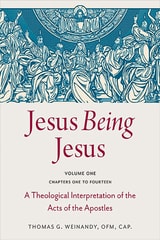
Luke was a Gentile and physician. Though not one of Jesus’ initial Jewish disciples, Luke was a traveling companion of Paul. As with the Old Testament and the Gospels, Luke provides the theological and ecclesial significance of the historical events he is narrating. In so doing, he accentuates what the risen and ascended Jesus is doing through the Holy Spirit by means of the nascent church, primarily through Peter and Paul. Although the book is entitled the Acts of the Apostles, the Holy Spirit is the primary actor throughout its entirety. Luke is traditionally believed to be the author of both the third Gospel as well as the Acts of the Apostles. As Luke, in his Gospel, first wrote “an orderly account for you, most excellent Theophilus, concerning the truth of the gospel,” so he now writes what has taken place after Jesus’ departure. Thus, the Acts of the Apostles is a continuation of a historical narrative. The Gospel contains what Jesus historically said and did until his Ascension into Heaven. Acts is the historical narrative of what followed upon Jesus’ ascension and the pouring out of the Holy Spirit at Pentecost that gave birth of the Church, and the first preaching of the Good News. If in Luke’s gospel account one finds Jesus becoming Jesus through his saving actions which culminate in his death and resurrection, in the Acts of the Apostles, one finds the risen Jesus being Jesus through the preaching and actions of the apostolic church. Jesus continues to enact his name, YHWH-Saves. In this second volume on Acts, such saving words and actions are particularly found within Paul’s preaching of the gospel in course of his missionary journeys.
[more]
cover of Jesus Being Jesus: A Theological Interpretation of the Acts of the Apostles: Volume 1: Chapters 1-14

Jesus Being Jesus

A Theological Interpretation of the Acts of the Apostles: Volume 1: Chapters 1-14

Thomas G. Weinandy

Catholic University of America Press, 2026

Luke was a Gentile and physician. Though not one of Jesus’ initial Jewish dis­ciples, Luke was a traveling companion of Paul. As with the Old Testament and the Gospels, Luke provides the theological and ecclesial significance of the historical events he is narrating. In so doing, he accentuates what the risen and ascended Jesus is doing through the Holy Spirit by means of the na­scent church, primarily through Peter and Paul. Although the book is entitled the Acts of the Apostles, the Holy Spirit is the primary actor throughout its entirety. Luke is traditionally believed to be the author of both the third Gospel as well as the Acts of the Apostles. As Luke, in his Gospel, first wrote “an or­derly account for you, most excellent Theophilus, concerning the truth of the gospel,” so he now writes what has taken place after Jesus’ departure. Thus, the Acts of the Apostles is a continuation of a historical narrative. The Gospel contains what Jesus historically said and did until his Ascension into Heaven. Acts is the historical narrative of what followed upon Jesus’ ascen­sion and the pouring out of the Holy Spirit at Pentecost that gave birth to the Church, and the first preaching of the Good News. If in Luke’s gospel account one finds Jesus becoming Jesus through his sav­ing actions which culminate in his death and resurrection, in the Acts of the Apostles, one finds the risen Jesus being Jesus through the preaching and actions of the apostolic church. Jesus continues to enact his name, YH­WH-Saves. Such saving words and actions are particularly within the evan­gelistic ministry of Peter and Paul.
[more]
cover of Jesus the Central Jew: His Times and His People

Jesus the Central Jew

His Times and His People

André LaCocque

SBL Press, 2015

Not a Jew marginally, but centrally

In this book, LaCocque presents the case that Jesus was totally and unquestionably a Jew. He lived as a Jew, thought as a Jew, debated as a Jew, acted as a Jew and died as a Jew. He had no intention of creating a new religion; rather, he was a reformer of the Judaism of his day. True, his critique went far beyond an intellectual subversion. In fact, Jesus progressively thought of himself as the “Son of Man” inaugurating the advent of the Kingdom of God on earth.

Features:

  • Focused attention given to the historical Jesus and not Christianity or Christology
  • Addresses restricted sources, namely, the Synoptic Gospels
  • Close examination of Jesus’s way of thinking, teaching, and behaving

[more]
cover of Jesus, Son of Mary, in Muslim Thought

Jesus, Son of Mary, in Muslim Thought

S. R. Burge

SBL Press, 2026
Although Jesus is not considered the Son of God in Islam, he is still considered to be a prophet, a bringer of Scripture, a teacher and wise man, and one of the figures who will return before the last day, heralding the end of time. In this collection of essays, scholars explore the life of Jesus in Muslim sources and the variety of ways that he is represented and discussed in different genres of Muslim writing. Contributors include Halla Attallah, Helen Blatherwick, S. R. Burge, Ryann Elizabeth Craig, Maha El Kaisy-Friemuth, Abdulla Galadari, Fatih Harpci, Fitzroy Morrissey, and Rebecca Williams. Accessibly written for specialists and nonspecialists alike, this is an essential collection for those interested in a deeper understanding of the figure of Jesus in Islam.
[more]
cover of John and Judaism: A Contested Relationship in Context

John and Judaism

A Contested Relationship in Context

R. Alan Culpepper

SBL Press, 2017

A window into early Judaism and Christianity

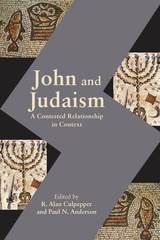
The Gospel of John was written during the period of the emergence of Christianity and its separation from Judaism and bears witness to their contested relationship. This volume contains eighteen cutting-edge essays written by an international group of scholars who interpret for students and general readers what the book tells us about first-century Judaism, the separation of the church from Judaism, and how John's anti-Jewish references are being interpreted today.

Features:

  • A debate over the process that led to the separation of the church from Judaism, and John's place in that process
  • A review of recent interpretations of John's anti-Jewish references
  • An assessment of the current status of Jewish Christian relations
[more]
cover of John, Jesus, and History, Volume 1: Critical Appraisals of Critical Views

John, Jesus, and History, Volume 1

Critical Appraisals of Critical Views

Paul N. Anderson

SBL Press, 2007

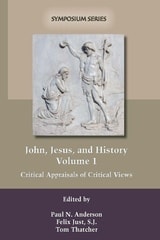
Over the last two centuries, many scholars have considered the Gospel of John off-limits for all quests for the historical Jesus. That stance, however, creates a new set of problems that need to be addressed thoughtfully. The essays in this book, reflecting the ongoing deliberations of an international group of Johannine and Jesus scholars, critically assess two primary assumptions of the prevalent view: the dehistoricization of John and the de-Johannification of Jesus. The approaches taken here are diverse, including cognitive-critical developments of Johannine memory, distinctive characteristics of the Johannine witness, new historicism, Johannine-Synoptic relations, and fresh analyses of Johannine traditional development. In addition to offering state-of-the-art reviews of Johannine studies and Jesus studies, this volume draws together an emerging consensus that sees the Gospel of John as an autonomous tradition with its own perspective, in dialogue with other traditions. Through this challenging of critical and traditional assumptions alike, new approaches to John’s age-old riddles emerge, and the ground is cleared for new and creative ways forward.
[more]
cover of John, Jesus, and History, Volume 2: Aspects of Historicity in the Fourth Gospel

John, Jesus, and History, Volume 2

Aspects of Historicity in the Fourth Gospel

Paul N. Anderson

SBL Press, 2009

This groundbreaking volume draws together an international group of leading biblical scholars to consider one of the most controversial religious topics in the modern era: Is the Gospel of John—the most theological and distinctive among the four canonical Gospels—historical or not? If not, why does John alone among the Gospels claim eyewitness connections to Jesus? If so, why is so much of John’s material unique to John? Using various methodologies and addressing key historical issues in John, these essays advance the critical inquiry into Gospel historiography and John’s place within it, leading to an impressive consensus and convergences along the way. The contributors are Paul N. Anderson; Mark Appold; Richard Bauckham; Helen K. Bond; Richard A. Burridge; James H. Charlesworth; Jaime Clark-Soles; Mary Coloe; R. Alan Culpepper; Craig A. Evans; Sean Freyne; Jeffrey Paul Garcia; Brian D. Johnson; Peter J. Judge; Felix Just, S.J.; Craig S. Keener; Edward W. Klink III; Craig R. Koester; Michael Labahn; Mark A. Matson; James F. McGrath; Susan Miller; Gail R. O’Day; Bas van Os; Tom Thatcher; Derek M. H. Tovey; Urban C. von Wahlde; and Ben Witherington III.
[more]
cover of John, Jesus, and History, Volume 3: Glimpses of Jesus Through the Johannine Lens

John, Jesus, and History, Volume 3

Glimpses of Jesus Through the Johannine Lens

Paul N. Anderson

SBL Press, 2016

A critical analysis of the historicity of the Gospel of John

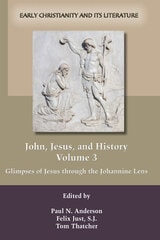
Since it began in 2002, the John, Jesus, and History Project has assessed critically the modern disparaging of John's historicity and has found this bias wanting. In this third volume, an international group of experts demonstrate over two dozen ways in which John contributes to an enhanced historical understanding of Jesus and his ministry. This volume does not simply argue for a more inclusive quest for Jesus—one that embraces John instead of programmatically excluding it. It shows that such a quest has already indeed begun. Contributors include Paul N. Anderson, Jo-Ann A. Brant, Peder Borgen, Gary M. Burge, Warren Carter, R. Alan Culpepper, James D. G. Dunn, Robert T. Fortna, Jörg Frey, Steven A. Graham, Colin J. Humphreys, Craig Keener, Andreas Köstenberger, Tim Ling, William Loader, Linda McKinnish Bridges, James S. McLaren, Annette Merz, Wendy E. S. North, Benjamin E. Reynolds, Udo Schnelle, Donald Senior, C.P., Tom Thatcher, Michael Theobald, Jan van der Watt, Robert Webb, Stephen Witetscheck, and Jean Zumstein.

Features

  • A state-of-the-art analysis of John’s contributions to the quest for the historical Jesus, including evaluative responses by leading Jesus scholars
  • •An overview of paradigm shifts in Jesus scholarship and recent approaches to the Johannine riddles
  • Detailed charts that illuminates John's similarities and differences form the Synoptic Gospels as well as the gospel's contributions to the historical Jesus research
[more]
cover of John, Jesus, and History, Volume 4: Jesus Remembered in the Johannine Situation

John, Jesus, and History, Volume 4

Jesus Remembered in the Johannine Situation

Paul N. Anderson

SBL Press, 2024

John, Jesus, and History, Volume 4: Jesus Remembered in the Johannine Situation addresses the narrative development of the Johannine corpus over as many as seven decades. Contributors connect how Jesus is presented in the Fourth Gospel to how the memory of his ministry is developed in Palestine during the earliest period (30–70 CE), in Asia Minor in the later first century (70–100 CE), and in the main and alternative streams of post-Johannine early Christianity (100 CE and later). Contributors include Paul N. Anderson, Harold W. Attridge, Giovanni Bazzana, Jonathan Bernier, Sherri Brown, Rex D. Butler, Andrew J. Byers, Stephen C. Carlson, Warren Carter, Amber M. Dillon, Jonathan A. Draper, Musa W. Dube, Charles E. Hill, Karen L. King, Peter T. Lanfer, Kasper Bro Larsen, Ian N. Mills, Alicia D. Myers, Reinhard Pummer, Tuomas Rasimus, David Rensberger, Clare K. Rothschild, Geoffrey Smith, Travis D. Trost, Meredith J. C. Warren, Kenneth L. Waters Sr., and Lorne R. Zelyck. The collection pushes Johannine, Jesus, and early Christian history studies in new directions, raising possibilities for future research.
[more]
cover of John, Jesus, and History, Volume 5: Jesus Remembered within the Johannine Tradition

John, Jesus, and History, Volume 5

Jesus Remembered within the Johannine Tradition

Paul N. Anderson

SBL Press, 2026

Essays in this collection demonstrate that the Johannine account of Jesus deserves to be seen as a self-standing tradition rather than a collection of non-Johannine sources and the evangelist’s theologized perspective. Paul N. Anderson, N. Clayton Croy, Rachel L. Danley, James D. G. Dunn, Nicholas Elder, Douglas Estes, Charles A. Gieschen, Jeannine M. Hanger, Holly Hearon, Richard Horsley, Felix Just, S.J., Ahreum Kim, Amy Whisenand, Francisco Lozada Jr., William R. G. Loader, James F. McGrath, Christopher W. Skinner, Tom Thatcher, Marianne Meye Thompson, and Michael Zolondek demonstrate how the memory of Jesus in the Gospel of John developed from orality to literacy, perhaps in more than one edition. While John’s Christ hymn and other material were likely added later, contributors assert that this does not preclude that earlier memories were referenced within developing understandings of Jesus of Nazareth. The result is a unique Johannine tradition bridging firsthand reflections on Jesus’s ministry with the later needs of early Christianity.
[more]