Results by title
496 books match the query 'Jewish' and 35 start with j
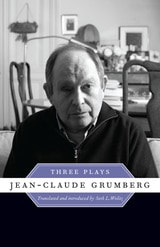
Jean-Claude Grumberg
Three PlaysBy Jean-Claude Grumberg and Seth Wolitz
University of Texas Press, 2014
Winner of seven Molières, the Pulitzer Prize of France, Jean-Claude Grumberg is one of France’s leading dramatists and a distinguished voice of modern European Jewry after the Shoah. His success in portraying contemporary Parisian Jews on the stage represents a new development in European theater and a new aesthetic expression of European Jewish experience and sensibility of the Holocaust and its aftermath, a perspective quite different from either the American or the Israeli one. Grumberg’s Jews are French to their fingertips, yet they have been made more consciously Jewish by the war and the difficulties of reintegrating into a society in which too many neighbors denounced them or ignored their pleas to save their children. Affirming the new status of Jewish culture, Grumberg’s plays insist on the recognition of Jewish identity and uniqueness within the majority societies of Europe.
This volume offers the first English translation of three of Grumberg’s prize-winning plays: The Workplace (L’Atelier, 1979), On the Way to the Promised Land (Vers toi Terre promise, 2006) and Mama’s Coming Back, Poor Orphan (Maman revient, pauvre orphelin, 1994). Presented in the order of the history they record and steeped in Grumberg’s personal experience and insights into contemporary Parisian life, these plays serve as documentary witnesses that begin with the immediate postwar reality and continue up to the end of the twentieth century. Seth Wolitz provides notes on the plays’ themes, structures, characters, and settings, along with an introduction that discusses Grumberg’s place within the emergence of French-Jewish drama and a translation of an interview with the playwright himself.
Jew
Baker, Cynthia M
Rutgers University Press, 2017
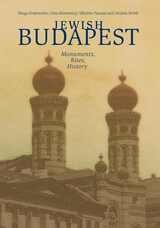
Jewish Budapest
Monuments, Rites, HistoryGéza Komoróczy
Central European University Press, 1999
Jewish Claims Against East Germany
Angelika Timm
Central European University Press, 1998
This is the first comprehensive history of Jewish negotiations with East Germany regarding restitution and reparations for Nazi war crimes. Angelika Timm analyzes the politics of old and new anti-Semitism and the context in which they grew under the officially propagated ideology of antifascism.
Investigating the mass of unpublished, newly available archival data from the United States, Israel, and the former German Democratic Republic, and more than forty personal interviews, Timm fills a critical gap in the scholarship on postwar Germany. She analyzes the role of the Holocaust and the image of Jews in the historical consciousness and political culture of East Germany and chronicles the efforts of Jewish organizations, especially the Conference on Jewish Material Claims Against Germany, to negotiate reparations with the East German state. The unique relationship between ideology and Realpolitik defined the manner in which East Germany confronted the crimes of its past and allowed anti-Semitism to reemerge.
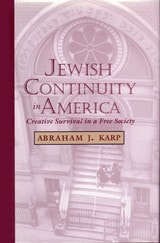
Jewish Continuity in America
Creative Survival in a Free SocietyAbraham J. Karp
University of Alabama Press, 1998
Presents an overview of a life's work by a preeminent scholar and brings new insight to the challenge of American Jewish continuity
Jews have historically lived within a paradox of faith and fear: faith that they are an eternal people and fear that their generation may be the last. In the United States, the Jewish community has faced to a heightened degree the enduring question of identity and assimilation: How does the Jewish community in this free, open, pluralistic society discover or create factors-both ideological and existential-that make group survival beneficial to the larger society and rewarding to the individual Jew?
Abraham J. Karp's Jewish Continuity in America focuses on the three major sources of American Judaism's continuing vitality: the synagogue, the rabbinate, and Jewish religious pluralism. Particularly illuminating is Karp's examination of the coexistence and unity-in-diversity of American religious Jewry's three divisions-Orthodox, Reform, and Conservative-and of how this Jewish religious pluralism fits into the larger picture of American religious pluralism.
Informing the larger enterprise through sharp and full delineation of discrete endeavors, the essays collected in Jewish Continuity in America-some already acknowledged as classics, some appearing here for the first time-describe creative individual and communal responses to the challenge of Jewish survival. As the title suggests, this book argues that continuity in a free and open society demands a high order of creativity, a creativity that, to be viable, must be anchored in institutions wholly pledged to continuity.
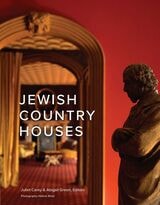
Jewish Country Houses
Edited by Juliet Carey and Abigail Green
Brandeis University Press, 2024
Country houses are powerful symbols of national identity, evoking the glamorous world of the landowning aristocracy. Jewish country houses—properties that were owned, built, or renewed by Jews—tell a more complex story of prejudice and integration, difference and connection. Many had spectacular art collections and gardens. Some were stages for lavish entertaining, while others inspired the European avant-garde. A few are now museums of international importance, many more are hidden treasures, and all were beloved homes that bear witness to the remarkable achievements of newly emancipated Jews across Europe—and to a dream of belonging that mostly came to a brutal end with the Holocaust.
Lavishly illustrated with historical images and a new body of work by the celebrated photographer Hélène Binet, this book is the first to tell the story of Jewish country houses, from the playful historicism of the National Trust’s Waddesdon Manor in Buckinghamshire to the modernist masterpiece that is the Villa Tugendhat in the Czech city of Brno—and across the pond to the United States, where American Jews infused the European country house tradition with their own distinctive concerns and experiences. This book emerges from a four-year research project funded by the UK Arts and Humanities Research Council that aims to establish Jewish country houses as a focus for research, a site of European memory, and a significant aspect of European Jewish heritage and material culture.
Jewish Identities in the American West
Relational PerspectivesEdited by Ellen Eisenberg
Brandeis University Press, 2022
Since the onset of New Western History in the 1980s, the complexity of race and ethnicity as it developed in the American West has increasingly been recognized by scholars and the wider public alike. Ethnic studies scholars have developed new perspectives on racial formation in the West that complicate older notions that often relied on binary descriptions, such as Black/white racialization. In the past few decades, these studies have relied on relational approaches that focus on how race is constructed, by both examining interactions with the white dominant group, and by exploring the multiple connections with other racial/ethnic groups in society. Historians are discovering new stories of racial construction, and revising older accounts, to integrate these new perspectives into the formation of racial and ethnic identities. This collection of essays on Jews in the American West advances this field in multiple ways. With essays that cover the period from the mid-nineteenth century to the present, these authors present a collective portrait of change over time that allows us to view the shifting nature of Jewish identity in the West, as well as the evolving frameworks for racial construction. Thorough and thought-provoking, Jewish Identities in the American West takes readers on a journey of racial and ethnic identity in the American West.
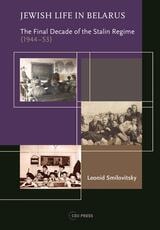
Jewish Life in Belarus
The Final Decade of the Stalin Regime, 1944-1953Leonid Smilovitsky
Central European University Press, 2014
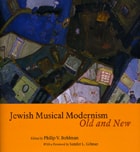
Jewish Musical Modernism, Old and New
Edited by Philip V. Bohlman
University of Chicago Press, 2009
Tackling the myriad issues raised by Sander Gilman’s provocative opening salvo—”Are Jews Musical?”—this volume’s distinguished contributors present a series of essays that trace the intersections of Jewish history and music from the late nineteenth century to the present.
Covering the sacred and the secular, the European and the non-European, and all the arenas where these realms converge, these essays recast the established history of Jewish culture and its influences on modernity. Mitchell Ash explores the relationship of Jewish scientists to modernist artists and musicians, while Edwin Seroussi looks at the creation of Jewish sacred music in nineteenth-century Vienna. Discussing Jewish musicologists in Austria and Germany, Pamela Potter details their contributions to the “science of music” as a modern phenomenon. Kay Kaufman Shelemay investigates European influence in the music of an Ethiopian Jewish community, and Michael P. Steinberg traces the life and works of Charlotte Salomon, whose paintings staged the destruction of the Holocaust. Bolstered by Philip V. Bohlman’s wide-ranging introduction and epilogue, and featuring lush color illustrations and a complementary CD of the period’s music, this volume is a lavish tribute to Jewish contributions to modernity.
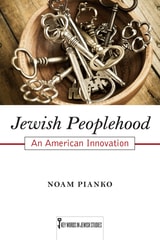
Jewish Peoplehood
An American InnovationPianko, Noam
Rutgers University Press, 2015
Although fewer American Jews today describe themselves as religious, they overwhelmingly report a strong sense of belonging to the Jewish people. Indeed, Jewish peoplehood has eclipsed religion—as well as ethnicity and nationality—as the essence of what binds Jews around the globe to one another. In Jewish Peoplehood, Noam Pianko highlights the current significance and future relevance of “peoplehood” by tracing the rise, transformation, and return of this novel term.
Jewish Prince in Moslem Spain
Selected Poems of Samuel Ibn NagrelaSamuel Ibn Nagrela
University of Alabama Press, 2005
Of all the Hebrew poets of the 'Golden Age' in Spain, Samuel Ibn Nagrela (993-1056 A.D.) remains perhaps the most fascinating personality. A leading statesman in the kingdom of Granada, he was as successful in court as on the battlefield, maintaining a position of power for several decades while walking a political tightrope. Endowed with great literary talents, he opened up new paths in Hebrew poetry, and his mastery of its metrical intricacies was as consummate as his political and military skill.
Jewish Resistance Against the Nazis
Patrick Henry
Catholic University of America Press, 2014
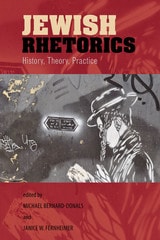
Jewish Rhetorics
History, Theory, PracticeEdited by Michael Bernard-Donals and Janice W. Fernheimer
Brandeis University Press, 2014
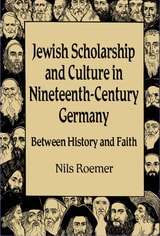
Jewish Scholarship and Culture in Nineteenth-Century Germany
Between History and FaithNils Roemer
University of Wisconsin Press, 2005
German Jews were fully assimilated and secularized in the nineteenth century—or so it is commonly assumed. In Jewish Scholarship and Culture in the Nineteenth Century, Nils Roemer challenges this assumption, finding that religious sentiments, concepts, and rhetoric found expression through a newly emerging theological historicism at the center of modern German Jewish culture.
Modern German Jewish identity developed during the struggle for emancipation, debates about religious and cultural renewal, and battles against anti-Semitism. A key component of this identity was historical memory, which Jewish scholars had begun to infuse with theological perspectives beginning in the 1850s. After German reunification in the early 1870s, Jewish intellectuals reevaluated their enthusiastic embrace of liberalism and secularism. Without abandoning the ideal of tolerance, they asserted a right to cultural religious difference for themselves--an ideal they held to even more tightly in the face of growing anti-Semitism. This newly re-theologized Jewish history, Roemer argues, helped German Jews fend off anti-Semitic attacks by strengthening their own sense of their culture and tradition.
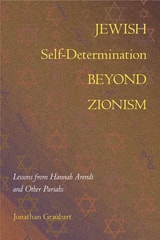
Jewish Self-Determination beyond Zionism
Lessons from Hannah Arendt and Other PariahsJonathan Graubart
Temple University Press, 2023
Jewish Self-Determination beyond Zionism also engages a Humanist Zionist vision to confront the Zionist movement’s foundational sins and demands a full reckoning with the Palestinians. Graubart focuses on two of Humanist Zionism’s most insightful thinkers, Martin Buber and Hannah Arendt, putting them “in conversation” with each other, and synthesizing their collective insights and critical Jewish perspectives alongside the ideas of Noam Chomsky, Judith Butler, Ella Shohat, Edward Said, and other philosophers and academics. Jewish Self-Determination beyond Zionism concludes that an updated, binational program is the best path forward.
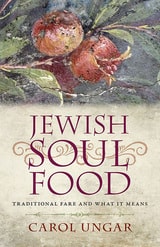
Jewish Soul Food
Traditional Fare and What It MeansCarol Ungar
Brandeis University Press, 2015
Jewish Women in Fin de Siècle Vienna
By Alison Rose
University of Texas Press, 2008
Despite much study of Viennese culture and Judaism between 1890 and 1914, little research has been done to examine the role of Jewish women in this milieu. Rescuing a lost legacy, Jewish Women in Fin de Siècle Vienna explores the myriad ways in which Jewish women contributed to the development of Viennese culture and participated widely in politics and cultural spheres.
Areas of exploration include the education and family lives of Viennese Jewish girls and varying degrees of involvement of Jewish women in philanthropy and prayer, university life, Zionism, psychoanalysis and medicine, literature, and culture. Incorporating general studies of Austrian women during this period, Alison Rose also presents significant findings regarding stereotypes of Jewish gender and sexuality and the politics of anti-Semitism, as well as the impact of German culture, feminist dialogues, and bourgeois self-images.
As members of two minority groups, Viennese Jewish women nonetheless used their involvement in various movements to come to terms with their dual identity during this period of profound social turmoil. Breaking new ground in the study of perceptions and realities within a pivotal segment of the Viennese population, Jewish Women in Fin de Siècle Vienna applies the lens of gender in important new ways.
Jewish Writing and the Deep Places of the Imagination
Mark Krupnick
University of Wisconsin Press, 2005
When he learned he had ALS and roughly two years to live, literary critic Mark Krupnick returned to the writers who had been his lifelong conversation partners and asked with renewed intensity: how do you live as a Jew, when, mostly, you live in your head? The evocative and sinuous essays collected here are the products of this inquiry. In his search for durable principles, Krupnick follows Lionel Trilling, Cynthia Ozick, Geoffrey Hartman, Philip Roth, Saul Bellow, and others into the elemental matters of life and death, sex and gender, power and vulnerability.
The editors—Krupnick’s wife, Jean K. Carney, and literary critic Mark Shechner—have also included earlier essays and introductions that link Krupnick’s work with the “deep places” of his own imagination.
Jewish and Islamic Philosophy
Crosspollinations in the Classic AgeLenn E. Goodman
Rutgers University Press, 1999
Jewish and Romani Families in the Holocaust and its Aftermath
Eliyana R. Adler
Rutgers University Press, 2021
In this work, scholars from the United States, Israel, and across Europe bring a variety of backgrounds and disciplines to their study of the Holocaust and its aftermath from the family perspective. Drawing on research from Belarus to Great Britain, and examining both Jewish and Romani families, they demonstrate the importance of recognizing how people continued to function within family units—broadly defined—throughout the war and afterward.
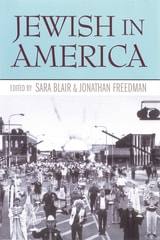
Jewish in America
Sara Blair and Jonathan Freedman, Editors
University of Michigan Press, 2004
-From the Introduction
This rare and original work of cultural studies offers uncommon and engaging perspectives-as well as provocative and humorous insights-on what it means to be Jewish in America.
Jewish in America features poetry, art, essays, and stories from an impressive and respected list of contributors, including among others Stephen Greenblatt, Richard Kostelanetz, Jacqueline Osherow, Robert Pinsky, Sharon Pomerantz, Nancy Reisman, Grace Schulman, Louis Simpson, Alisa Solomon, and Stephen J. Whitfield.
In addition to pieces by some of the country's leading writers, the book features a stunning gallery of original photographs that transport the viewer from the crowded Coney Island beaches of the 1940s to the landscapes of Oaxaca, Mexico in the 1990s.
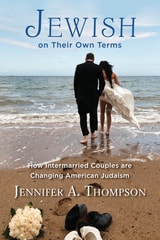
Jewish on Their Own Terms
How Intermarried Couples are Changing American JudaismThompson, Jennifer A
Rutgers University Press, 0
Over half of all American Jewish children are being raised by intermarried parents. This demographic group will have a tremendous impact on American Judaism as it is lived and practiced in the coming decades. To date, however, in both academic studies about Judaism and in the popular imagination, such children and their parents remain marginal.
Jennifer A. Thompson takes a different approach. In Jewish on Their Own Terms, she tells the stories of intermarried couples, the rabbis and other Jewish educators who work with them, and the conflicting public conversations about intermarriage among American Jews. Thompson notes that in the dominant Jewish cultural narrative, intermarriage symbolizes individualism and assimilation. Talking about intermarriage allows American Jews to discuss their anxieties about remaining distinctively Jewish despite their success in assimilating into American culture.
In contrast, Thompson uses ethnography to describe the compelling concerns of all of these parties and places their anxieties firmly within the context of American religious culture and morality. She explains how American and traditional Jewish gender roles converge to put non-Jewish women in charge of raising Jewish children. Interfaith couples are like other Americans in often harboring contradictory notions of individual autonomy, universal religious truths, and obligations to family and history.
Focusing on the lived experiences of these families, Jewish on Their OwnTerms provides a complex and insightful portrait of intermarried couples and the new forms of American Judaism that they are constructing.
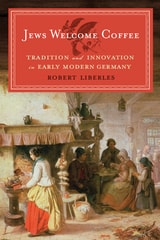
Jews Welcome Coffee
Tradition and Innovation in Early Modern GermanyRobert Liberles
Brandeis University Press, 2012
Jews and Diaspora Nationalism
Writings on Jewish Peoplehood in Europe and the United StatesEdited by Simon Rabinovitch
Brandeis University Press, 2012
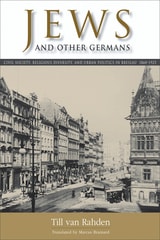
Jews and Other Germans
Civil Society, Religious Diversity, and Urban Politics in Breslau, 1860–1925Till van Rahden
University of Wisconsin Press, 2008
Closely analyzing the political, social, and cultural life in a major German city, van Rahden shows that Jews were a part of a broad urban community that encompassed diversity within unity, at once offering them a large measure of equality while permitting them to remain meaningfully Jewish. Jews and Other Germans also substantially revises the chronology of anti-Semitism in Germany, showing that Jews only began to experience exclusion from Breslau’s social world during World War I.
Yet van Rahden not only illuminates Breslau’s multicultural fabric; he also tells the story of this remarkable city as one of cultural and religious conflict and coexistence. Recounting the experiences of Jews, Protestants, and Catholics within a single narrative, he offers a critical intervention into scholarship on liberalism and civil society in nineteenth- and early twentieth-century Europe.
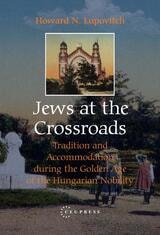
Jews at the Crossroads
Tradition and Accomodation during the Golden Age of the Hungarian NobilityHoward N. Lupovitch
Central European University Press, 2007
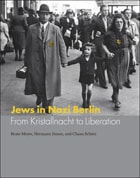
Jews in Nazi Berlin
From Kristallnacht to LiberationEdited by Beate Meyer, Hermann Simon, and Chana Schütz
University of Chicago Press, 2009
Though many of the details of Jewish life under Hitler are familiar, historical accounts rarely afford us a real sense of what it was like for Jews and their families to live in the shadow of Nazi Germany’s oppressive racial laws and growing violence. With Jews in Nazi Berlin, those individual lives—and the constant struggle they required—come fully into focus, and the result is an unprecedented and deeply moving portrait of a people.
Drawing on a remarkably rich archive that includes photographs, objects, official documents, and personal papers, the editors of Jews in Nazi Berlin have assembled a multifaceted picture of Jewish daily life in the Nazi capital during the height of the regime’s power. The book’s essays and images are divided into thematic sections, each representing a different aspect of the experience of Jews in Berlin, covering such topics as emigration, the yellow star, Zionism, deportation, betrayal, survival, and more. To supplement—and, importantly, to humanize—the comprehensive documentary evidence, the editors draw on an extensive series of interviews with survivors of the Nazi persecution, who present gripping first-person accounts of the innovation, subterfuge, resilience, and luck required to negotiate the increasing brutality of the regime.
A stunning reconstruction of a storied community as it faced destruction, Jews in Nazi Berlin renders that loss with a startling immediacy that will make it an essential part of our continuing attempts to understand World War II and the Holocaust.
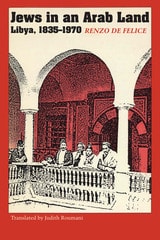
Jews in an Arab Land
Libya, 1835–1970By Renzo De Felice; translated by Judith Roumani; foreword by Rafello Fellah
University of Texas Press, 1985
Internationally renowned scholar Renzo De Felice’s pioneering study of the Jews of Libya is, in many ways, a microcosm of the major sources of conflict in the modern Middle East. This is the first English translation of Ebrei in un paese arabo, originally published by Il Mulino, Bologna, in 1978.
The author’s broad-ranging and meticulous research has enabled him to reconstruct the contemporary history of the Jews in Libya with an incredible richness of detail, bringing into vivid relief the social, religious, cultural, and political lives of a people caught between centuries of tradition and a series of governments bent on plunging them headfirst into the modern world. This story—fraught with the passion, drama, tragicomedy, and conflict of a society in transition—will be an invaluable resource for scholars in Middle Eastern studies, Jewish studies, and contemporary European history. The wealth of documentation, much of it previously unknown or unpublished, makes this a particularly useful book.
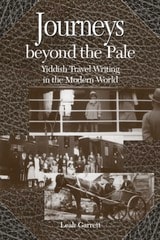
Journeys beyond the Pale
Yiddish Travel Writing in the Modern WorldLeah V. Garrett
University of Wisconsin Press, 2003
Journeys beyond the Pale is the first book to examine how Yiddish writers, from Mendele Moycher Sforim to Der Nister to the famed Sholem Aleichem, used motifs of travel to express their complicated relationship with modernization. The story of the Jews of the Pale of settlement encompasses current-day Russia, the Ukraine, Belarus, and Poland.
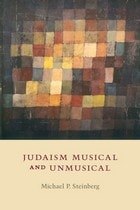
Judaism Musical and Unmusical
Michael P. Steinberg
University of Chicago Press, 2008
Engaging the work of such figures as Sigmund Freud, Walter Benjamin, Hannah Arendt, Charlotte Salomon, Arnaldo Momigliano, Leonard Bernstein, and Daniel Libeskind, Michael Steinberg shows how modern Jews advanced cosmopolitanism and multiplicity by helping to loosen—whether by choice or by necessity—the ties that bind any culture to accounts of its origins. In the process, Steinberg composes a mosaic of texts and events, often distant from one another in time and place, that speak to his theme of musicality. As both a literal value and a metaphorical one, musicality opens the possibility of a fusion of aesthetics and analysis—a coupling analogous to European modernity’s twin concerns of art and politics.
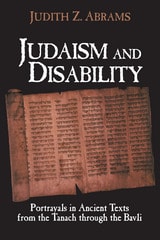
Judaism and Disability
Portrayals in Ancient Texts from the Tanach through the BavliJudith Z. Abrams
Gallaudet University Press, 1998
In Judaism and Disability, the archaic portrayals of mentally ill, mentally retarded, physically affected, deaf, blind, and other disabled people reflect the sharp contrast they presented compared to the unchanging Judaic ideal of the “perfect priest.” All of these sources describe this perfection as embodied in a person who is male, free, unblemished, with da’at (cognition that can be communicated), preferably learned, and a priest. The failure to have da’at stigmatized disabled individuals, who were also compromised by the treatment they received from nondisabled people, who were directing and constraining.
As the Judaic ideal transformed from the bodily perfection of the priest in the cult to intellectual prowess in the Diaspora, a parallel change of attitudes toward disabled persons gradually occurred. The reduced emphasis upon physical perfection as a prerequisite for a relationship with God eventually enabled the enfranchisement of some disabled people and other minorities. Scholars, students, and other readers will find the engrossing process disclosed in Judaism and Disability one that they can apply to a variety of other disciplines.
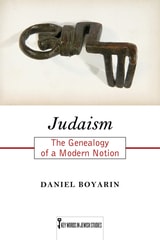
Judaism
The Genealogy of a Modern NotionBoyarin, Daniel
Rutgers University Press, 2019
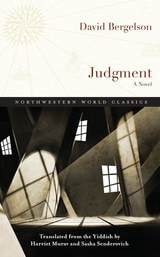
Judgment
A NovelDavid Bergelson, Translated from the Yiddish by Harriet Murav and Sasha Senderovich
Northwestern University Press, 2017
Originally published in 1929 and set in 1920 during the Russian civil war, Judgment traces the death of the shtetl and the birth of the “new, harsher world” created by the 1917 revolution. Jews and non-Jews smuggle people, goods, and anti-Bolshevik literature back and forth across the new political border. Filipov acts as the arbiter of "judgment" to prisoners in a Bolshevik outpost, who include Spivak, a counterrevolutionary; Lemberger, a pious and wealthy Jew; a seductive woman referred to as "the blonde"; and a memorable cast of smugglers and criminals.
Ordinary people, depicted in a grotesque and modernist style—comparable to Isaac Babel’s Red Cavalry—confront the overwhelming forces of history, whose ultimate outcome remains unknown.
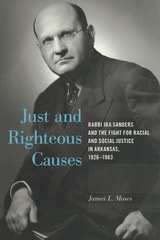
Just and Righteous Causes
Rabbi Ira Sanders and the Fight for Racial and Social Justice in Arkansas, 1926-1963James L. Moses
University of Arkansas Press, 2018
Winner, 2019 Booker Worthen Prize from the Central Arkansas Library System.
A dedicated advocate for social justice long before the term entered everyday usage, Rabbi Ira Sanders began striving against the Jim Crow system soon after he arrived in Little Rock from New York in 1926. Sanders, who led Little Rock’s Temple B’nai Israel for nearly forty years, was a trained social worker as well as a rabbi and his career as a dynamic religious and community leader in Little Rock spanned the traumas of the Great Depression, World War II and the Holocaust, and the social and racial struggles of the 1950s and 1960s.
Just and Righteous Causes—a full biographical study of this bold social-activist rabbi—examines how Sanders expertly navigated the intersections of race, religion, and gender to advocate for a more just society. It joins a growing body of literature about the lives and histories of Southern rabbis, deftly balancing scholarly and narrative tones to provide a personal look into the complicated position of the Southern rabbi and the Jewish community throughout the political struggles of the twentieth-century South.

Justyna's Narrative
Gusta Davidson Draenger
University of Massachusetts Press, 1996
Written during World War II, Justyna's Narrative is a compelling account of the Krakow Jewish resistance. From February through April 1943, Gusta Davidson Draenger (aka “Justyna”) composed the narrative on scraps of paper smuggled into her prison cell. Between sessions of torture and interrogation at the hands of the Gestapo, she recorded the activities and spiritual aspirations of the clandestine group of young Jewish idealists who forged documents, acquired weapons, and committed acts of defiance against the Nazis.