Results by title
645 books match the query 'Judaism' and 45 start with j
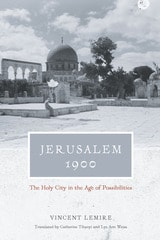
Jerusalem 1900
The Holy City in the Age of PossibilitiesVincent Lemire
University of Chicago Press, 2017
In this masterly history, Lemire uses newly opened archives to explore how Jerusalem’s elite residents of differing faiths cooperated through an intercommunity municipal council they created in the mid-1860s to administer the affairs of all inhabitants and improve their shared city. These residents embraced a spirit of modern urbanism and cultivated a civic identity that transcended religion and reflected the relatively secular and cosmopolitan way of life of Jerusalem at the time. These few years would turn out to be a tipping point in the city’s history—a pivotal moment when the horizon of possibility was still open, before the council broke up in 1934, under British rule, into separate Jewish and Arab factions. Uncovering this often overlooked diplomatic period, Lemire reveals that the struggle over Jerusalem was not historically inevitable—and therefore is not necessarily intractable. Jerusalem 1900 sheds light on how the Holy City once functioned peacefully and illustrates how it might one day do so again.
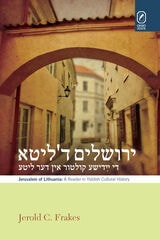
Jerusalem of Lithuania
A Reader in Yiddish Cultural HistoryJerold C. Frakes
The Ohio State University Press, 2011
Yerusholayim d’lite: di yidishe kultur in der lite (Jerusalem of Lithuania: A Reader in Yiddish Cultural History) by Jerold C. Frakes contains cultural, literary, and historical readings in Yiddish that vividly chronicle the central role Vilnius (Lithuania) played in Jewish culture throughout the past five centuries. It includes many examples of Yiddish literature, historiography, sociology, and linguistics written by and about Litvaks and includes work by prominent Yiddish poets, novelists, raconteurs, journalists, and scholars. In addition, Frakes has supplemented the primary texts with many short essays that contextualize Yiddish cultural figures, movements, and historical events.
Jerusalem
Or on Religious Power and JudaismMoses Mendelssohn
Brandeis University Press, 1983
Jew
Baker, Cynthia M
Rutgers University Press, 2017
Jewish Allegory in Eighteenth-Century Christian Imagination
Rebecca K. Esterson
SBL Press, 2023
Rebecca K. Esterson explores how Christian methods of biblical interpretation shifted during the eighteenth century, producing a rhetorical rejection of allegory while embracing literalism. Under the influence of Enlightenment concepts of human reason and advances in the experimental sciences, Christian interpreters began casting Jewish biblical interpretation as allegorical, while presenting Christian interpretation as literal. This shift in self-understanding allowed Christians to portray their own interpretations as scientifically, philosophically, and historically superior, resulting in a new way of othering the Jewish people. This study of biblical exegesis, theology, philosophy, and the arts in English, Swedish, and German contexts is an essential resource for scholars interested in biblical reception history and the history of Jewish-Christian relations.
Jewish Biblical Exegesis from Islamic Lands
The Medieval PeriodMeira Polliack
SBL Press, 2019
An accessible point of entry into the rich medieval religious landscape of Jewish biblical exegesis s
Medieval Judeo-Arabic translations of the Hebrew Bible and their commentaries provide a rich source for understanding a formative period in the intellectual, literary, and cultural history and heritage of Jews in Islamic lands. The carefully selected texts in this volume offer intriguing insight into Arabic translations and commentaries by Rabbanite and Karaite Jewish exegetes from the tenth to the twelfth centuries CE, arranged according to the three divisions of the Torah, the Former and Latter Prophets, and the Writings. Each text is embedded within an essay discussing its exegetical context, reception, and contribution.
Features:
- Focus on underrepresented medieval Jewish commentators of the Eastern world
- A list of additional resources, including major Judeo-Arabic commentators in the medieval period
- Previously unpublished texts from the Cairo Geniza
Jewish Childhood in Kraków
A Microhistory of the HolocaustJoanna Sliwa
Rutgers University Press, 2021
Jewish Childhood in Kraków is the first book to tell the history of Kraków in the second World War through the lens of Jewish children’s experiences. Here, children assume center stage as historical actors whose recollections and experiences deserve to be told, analyzed, and treated seriously.
Sliwa scours archives to tell their story, gleaning evidence from the records of the German authorities, Polish neighbors, Jewish community and family, and the children themselves to explore the Holocaust in German-occupied Poland and in Kraków in particular. A microhistory of a place, a people, and daily life, this book plumbs the decisions and behaviors of ordinary people in extraordinary times.
Offering a window onto human relations and ethnic tensions in times of rampant violence, Jewish Childhood in Kraków is an effort both to understand the past and to reflect on the position of young people during humanitarian crises.
Jewish Continuity in America
Creative Survival in a Free SocietyAbraham J. Karp
University of Alabama Press, 1998
Presents an overview of a life's work by a preeminent scholar and brings new insight to the challenge of American Jewish continuity
Jews have historically lived within a paradox of faith and fear: faith that they are an eternal people and fear that their generation may be the last. In the United States, the Jewish community has faced to a heightened degree the enduring question of identity and assimilation: How does the Jewish community in this free, open, pluralistic society discover or create factors-both ideological and existential-that make group survival beneficial to the larger society and rewarding to the individual Jew?
Abraham J. Karp's Jewish Continuity in America focuses on the three major sources of American Judaism's continuing vitality: the synagogue, the rabbinate, and Jewish religious pluralism. Particularly illuminating is Karp's examination of the coexistence and unity-in-diversity of American religious Jewry's three divisions-Orthodox, Reform, and Conservative-and of how this Jewish religious pluralism fits into the larger picture of American religious pluralism.
Informing the larger enterprise through sharp and full delineation of discrete endeavors, the essays collected in Jewish Continuity in America-some already acknowledged as classics, some appearing here for the first time-describe creative individual and communal responses to the challenge of Jewish survival. As the title suggests, this book argues that continuity in a free and open society demands a high order of creativity, a creativity that, to be viable, must be anchored in institutions wholly pledged to continuity.
Jewish Education
Ari Y Kelman
Rutgers University Press, 2024
At the heart of Jewish Education is an innovative alphabetical primer of Jewish educational values, qualities, frameworks, catalysts, and technologies which explore the historical ways in which Jewish communities have produced and transmitted knowledge. The book examines the tension between Jewish education and Jewish Studies to argue that shifting the locus of inquiry from “what people ought to know” to “how do people learn” can provide an understanding of Jewish education that both draws on historical precedent and points to the future of Jewish knowledge.
Jewish Fictional Letters from Hellenistic Egypt
The Epistle of Aristeas and Related LiteratureL. Michael White
SBL Press, 2017
The first Greek text of the Epistle of Aristeas published in more than a century
The Greek text Epistle of Aristeas is a Jewish work of the late Hellenistic period that recounts the origins of the Septuagint. Long recognized as a literary fiction, the Epistle of Aristeas has been variously dated from the third century BCE to the first century CE. As a result, its epistolary features, and especially those in which the putative author, Aristeas, addresses his brother and correspondent, Philocrates, have largely been ignored. In light of more recent scholarship on epistolary literature in the Greco-Roman world, however, this volume presents for the first time a complete Greek text and English Translation with introduction, notes, and commentary of the Epistle of Aristeas with key testimonia from Philo, Josephus, and Eusebius, as well as other related examples of Jewish fictional letters from the Apocrypha and Pseudepigrapha.
Features
- Relevant excerpts from Eupolemus, 2 Maccabees, 3 Maccabees, and the Greek Additions to Esther with translations and introductions
- A critical introduction to ancient Greek letter-writing
- An outline of epistolary features in the text
Jewish Life in Muslim Libya
Rivals and RelativesHarvey E. Goldberg
University of Chicago Press, 1990
Harvey E. Goldberg shows that the cultural and religious worlds of the Jewish and Muslim communities in Libya were deeply intertwined in daily life and largely remained so despite political and social changes under successive Ottoman and Italian rule. He documents the intricate symbolic linkages of Jews and Muslims in different periods and in a variety of settings. His accounts of traditional Jewish weddings, of mock fights between Jewish teams that took place in early nineteenth-century Tripoli, and of the profession of street peddling demonstrate that, despite age-old images of Jews as outsiders or infidels, Jews were also an essential and familiar part of the local Islamic society.
Goldberg's narrative continues through the British Military Administration in Libya, a period which saw growing Libyan nationalism and, in 1945, three days of riots in which more than 130 Jews were killed. Goldberg reflects on how these events both expressed and exacerbated a rupture in the social fabric linking Muslims and Jews, setting the scene for the mass emigration of Libyan Jews from their homeland.
Jewish Musical Modernism, Old and New
Edited by Philip V. Bohlman
University of Chicago Press, 2009
Tackling the myriad issues raised by Sander Gilman’s provocative opening salvo—”Are Jews Musical?”—this volume’s distinguished contributors present a series of essays that trace the intersections of Jewish history and music from the late nineteenth century to the present.
Covering the sacred and the secular, the European and the non-European, and all the arenas where these realms converge, these essays recast the established history of Jewish culture and its influences on modernity. Mitchell Ash explores the relationship of Jewish scientists to modernist artists and musicians, while Edwin Seroussi looks at the creation of Jewish sacred music in nineteenth-century Vienna. Discussing Jewish musicologists in Austria and Germany, Pamela Potter details their contributions to the “science of music” as a modern phenomenon. Kay Kaufman Shelemay investigates European influence in the music of an Ethiopian Jewish community, and Michael P. Steinberg traces the life and works of Charlotte Salomon, whose paintings staged the destruction of the Holocaust. Bolstered by Philip V. Bohlman’s wide-ranging introduction and epilogue, and featuring lush color illustrations and a complementary CD of the period’s music, this volume is a lavish tribute to Jewish contributions to modernity.
Jewish Peoplehood
An American InnovationPianko, Noam
Rutgers University Press, 2015
Although fewer American Jews today describe themselves as religious, they overwhelmingly report a strong sense of belonging to the Jewish people. Indeed, Jewish peoplehood has eclipsed religion—as well as ethnicity and nationality—as the essence of what binds Jews around the globe to one another. In Jewish Peoplehood, Noam Pianko highlights the current significance and future relevance of “peoplehood” by tracing the rise, transformation, and return of this novel term.
Jewish Philosophical Politics in Germany, 1789–1848
Sven-Erik Rose
Brandeis University Press, 2014
Jewish Poet and Intellectual in Seventeenth-Century Venice
The Works of Sarra Copia Sulam in Verse and Prose Along with Writings of Her Contemporaries in Her Praise, Condemnation, or DefenseSarra Copia Sulam
University of Chicago Press, 2009
The first Jewish woman to leave her mark as a writer and intellectual, Sarra Copia Sulam (1600?–41) was doubly tainted in the eyes of early modern society by her religion and her gender. This remarkable woman, who until now has been relatively neglected by modern scholarship, was a unique figure in Italian cultural life, opening her home, in the Venetian ghetto, to Jews and Christians alike as a literary salon.
For this bilingual edition, Don Harrán has collected all of Sulam’s previously scattered writings—letters, sonnets, a Manifesto—into a single volume. Harrán has also assembled all extant correspondence and poetry that was addressed to Sulam, as well as all known contemporary references to her, making them available to Anglophone readers for the first time. Featuring rich biographical and historical notes that place Sulam in her cultural context, this volume will provide readers with insight into the thought and creativity of a woman who dared to express herself in the male-dominated, overwhelmingly Catholic Venice of her time.
Jewish Prince in Moslem Spain
Selected Poems of Samuel Ibn NagrelaSamuel Ibn Nagrela
University of Alabama Press, 2005
Of all the Hebrew poets of the 'Golden Age' in Spain, Samuel Ibn Nagrela (993-1056 A.D.) remains perhaps the most fascinating personality. A leading statesman in the kingdom of Granada, he was as successful in court as on the battlefield, maintaining a position of power for several decades while walking a political tightrope. Endowed with great literary talents, he opened up new paths in Hebrew poetry, and his mastery of its metrical intricacies was as consummate as his political and military skill.
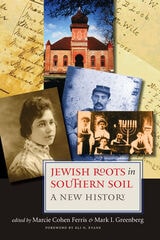
Jewish Roots in Southern Soil
A New HistoryEdited by Marcie Ferris and Mark I. Greenberg
Brandeis University Press, 2006
Jewish Scholarship and Culture in Nineteenth-Century Germany
Between History and FaithNils Roemer
University of Wisconsin Press, 2005
German Jews were fully assimilated and secularized in the nineteenth century—or so it is commonly assumed. In Jewish Scholarship and Culture in the Nineteenth Century, Nils Roemer challenges this assumption, finding that religious sentiments, concepts, and rhetoric found expression through a newly emerging theological historicism at the center of modern German Jewish culture.
Modern German Jewish identity developed during the struggle for emancipation, debates about religious and cultural renewal, and battles against anti-Semitism. A key component of this identity was historical memory, which Jewish scholars had begun to infuse with theological perspectives beginning in the 1850s. After German reunification in the early 1870s, Jewish intellectuals reevaluated their enthusiastic embrace of liberalism and secularism. Without abandoning the ideal of tolerance, they asserted a right to cultural religious difference for themselves--an ideal they held to even more tightly in the face of growing anti-Semitism. This newly re-theologized Jewish history, Roemer argues, helped German Jews fend off anti-Semitic attacks by strengthening their own sense of their culture and tradition.
Jewish Soul Food
Traditional Fare and What It MeansCarol Ungar
Brandeis University Press, 2015
Jewish Studies
A Theoretical IntroductionBush, Andrew
Rutgers University Press, 2011
Jewish Studies, the first volume in a groundbreaking new series, Key Words in Jewish Studies, introduces the basic approach of the series by organizing discussion around key concepts in the field that have emerged over the last two centuries: history and science, race and religion, self and community, identity and memory. The book is oriented by contemporary critical theory, especially feminist and postcolonial studies, and the multidisciplinary approaches of cultural studies.
By looking backward and forward—and across continents and disciplines—to unearth the evolution of the scholarly study of Jews, Andrew Bush provides a comprehensive introduction to the development of Jewish studies from the turn of the nineteenth century to the present. In the course of engaging scholarship on periods from the classical to the contemporary and from the disciplines of history, philosophy, sociology, anthropology, psychology, and literary studies, Bush questions male-dominated and Ashkenazi-centric visions of the field. He concludes with an experimental exposition of a new Jewish studies for a time where attention to difference has overtaken the security of canons and commonalities.
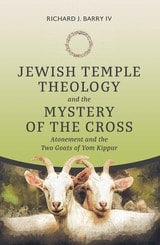
Jewish Temple Theology and the Mystery of the Cross
Atonement and the Two Goats of Yom KippurRichard J. Barry IV
Catholic University of America Press, 2023
Jewish Tradition and the Challenge of Darwinism
Edited by Geoffrey Cantor and Marc Swetlitz
University of Chicago Press, 2006
Darwin’s theory of evolution transformed the life sciences and made profound claims about human origins and the human condition, topics often viewed as the prerogative of religion. As a result, evolution has provoked a wide variety of religious responses, ranging from angry rejection to enthusiastic acceptance. While Christian responses to evolution have been studied extensively, little scholarly attention has been paid to Jewish reactions. Jewish Tradition and the Challenge of Darwinism is the first extended meditation on the Jewish engagement with this crucial and controversial theory.
The contributors to Jewish Tradition and the Challenge of Darwinism—from several academic disciplines and two branches of the rabbinate—present case studies showing how Jewish discussions of evolution have been shaped by the intersections of faith, science, philosophy, and ideology in specific historical contexts. Furthermore, they examine how evolutionary theory has been deployed when characterizing Jews as a race, both by Zionists and by anti-Semites. Jewish Tradition and the Challenge of Darwinism addresses historical and contemporary, as well as progressive and Orthodox, responses to evolution in America, Europe, and Israel, ultimately extending the history of Darwinism into new religious domains.
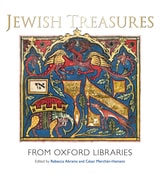
Jewish Treasures from Oxford Libraries
Edited by Rebecca Abrams & César Merchán-Hamann
Bodleian Library Publishing, 2020
Saved for posterity by religious scholarship, intellectual rivalry, and political ambition, these extraordinary collections also detail the consumption and circulation of knowledge across the centuries, forming a social and cultural history of objects moved across borders from person to person. Together, they offer a fascinating journey through Jewish intellectual and social history.
Jewish Universalisms
Mendelssohn, Cohen, and Humanity’s Highest GoodJeremy Fogel
Brandeis University Press, 2023
Any version of universalism relevant to a more attentive, pluralistic, and postcolonial outlook would balance the urgent current need for a universalistic perspective with the desire to maintain the richness of human diversity. The modern Jewish philosophers who sought to partake in the Enlightenment’s universalistic vision while maintaining their distinct identities as members of a religious minority within Europe offer insightful answers.
Jewish Universalisms analyzes how two major figures, Moses Mendelssohn and Hermann Cohen, dealt with the perceived tension between the universal values characteristic of the Enlightenment and aspects of Judaism often depicted as particularistic and parochial. Jeremy Fogel joins this lively debate in modern Jewish philosophy, offering a comparative examination of these thinkers and analyzing their worldviews from an innovative axiological perspective. Fogel writes that to gain a precise understanding of how Mendelssohn and Cohen argued for the concordance of Judaism and universalism, one must first seek out what they delineated as ultimately valuable. Then one can work out how that highest good, and the method of valuation it sustains, are universal.
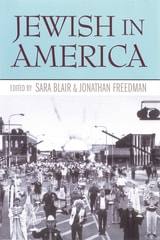
Jewish in America
Sara Blair and Jonathan Freedman, Editors
University of Michigan Press, 2004
-From the Introduction
This rare and original work of cultural studies offers uncommon and engaging perspectives-as well as provocative and humorous insights-on what it means to be Jewish in America.
Jewish in America features poetry, art, essays, and stories from an impressive and respected list of contributors, including among others Stephen Greenblatt, Richard Kostelanetz, Jacqueline Osherow, Robert Pinsky, Sharon Pomerantz, Nancy Reisman, Grace Schulman, Louis Simpson, Alisa Solomon, and Stephen J. Whitfield.
In addition to pieces by some of the country's leading writers, the book features a stunning gallery of original photographs that transport the viewer from the crowded Coney Island beaches of the 1940s to the landscapes of Oaxaca, Mexico in the 1990s.
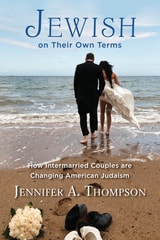
Jewish on Their Own Terms
How Intermarried Couples are Changing American JudaismThompson, Jennifer A
Rutgers University Press, 0
Over half of all American Jewish children are being raised by intermarried parents. This demographic group will have a tremendous impact on American Judaism as it is lived and practiced in the coming decades. To date, however, in both academic studies about Judaism and in the popular imagination, such children and their parents remain marginal.
Jennifer A. Thompson takes a different approach. In Jewish on Their Own Terms, she tells the stories of intermarried couples, the rabbis and other Jewish educators who work with them, and the conflicting public conversations about intermarriage among American Jews. Thompson notes that in the dominant Jewish cultural narrative, intermarriage symbolizes individualism and assimilation. Talking about intermarriage allows American Jews to discuss their anxieties about remaining distinctively Jewish despite their success in assimilating into American culture.
In contrast, Thompson uses ethnography to describe the compelling concerns of all of these parties and places their anxieties firmly within the context of American religious culture and morality. She explains how American and traditional Jewish gender roles converge to put non-Jewish women in charge of raising Jewish children. Interfaith couples are like other Americans in often harboring contradictory notions of individual autonomy, universal religious truths, and obligations to family and history.
Focusing on the lived experiences of these families, Jewish on Their OwnTerms provides a complex and insightful portrait of intermarried couples and the new forms of American Judaism that they are constructing.

Jewish-American Artists and the Holocaust
Baigell, Matthew
Rutgers University Press, 1997
Jewish themes in American art were not very visible until the last two decades, although many famous twentieth-century artists and critics were and are Jewish. Few artists responded openly to the Holocaust until the 1960s, when it finally began to act as a galvanizing force, allowing Jewish-American artists to express their Jewish identity in their work. Baigell describes how artists initially deflected their responses into abstract forms or by invoking biblical and traditional figures and then in more recent decades confronted directly Holocaust imagery and memory. He traces the development of artistic work from the late 1930s to the present in a moving study of a long overlooked topic in the history of American art.
Jewish-Catholic Engagements on Israel
Holy Land, Political Territory, or Theological Promise?Gavin D'Costa
Catholic University of America Press, 2025

Jews and Gender
Responses to Otto WeiningerNancy Harrowitz
Temple University Press, 1994
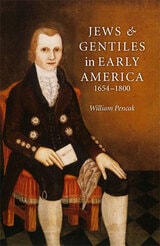
Jews and Gentiles in Early America
1654-1800William Pencak
University of Michigan Press, 2005
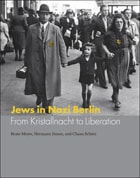
Jews in Nazi Berlin
From Kristallnacht to LiberationEdited by Beate Meyer, Hermann Simon, and Chana Schütz
University of Chicago Press, 2009
Though many of the details of Jewish life under Hitler are familiar, historical accounts rarely afford us a real sense of what it was like for Jews and their families to live in the shadow of Nazi Germany’s oppressive racial laws and growing violence. With Jews in Nazi Berlin, those individual lives—and the constant struggle they required—come fully into focus, and the result is an unprecedented and deeply moving portrait of a people.
Drawing on a remarkably rich archive that includes photographs, objects, official documents, and personal papers, the editors of Jews in Nazi Berlin have assembled a multifaceted picture of Jewish daily life in the Nazi capital during the height of the regime’s power. The book’s essays and images are divided into thematic sections, each representing a different aspect of the experience of Jews in Berlin, covering such topics as emigration, the yellow star, Zionism, deportation, betrayal, survival, and more. To supplement—and, importantly, to humanize—the comprehensive documentary evidence, the editors draw on an extensive series of interviews with survivors of the Nazi persecution, who present gripping first-person accounts of the innovation, subterfuge, resilience, and luck required to negotiate the increasing brutality of the regime.
A stunning reconstruction of a storied community as it faced destruction, Jews in Nazi Berlin renders that loss with a startling immediacy that will make it an essential part of our continuing attempts to understand World War II and the Holocaust.
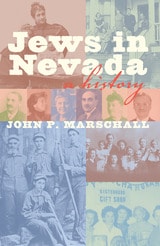
Jews in Nevada
A HistoryJohn P. Marschall
University of Nevada Press, 2011
Jews have always been one of Nevada’s most active and influential ethnic minorities. They were among the state’s earliest Euro-American settlers, and from the beginning they have been involved in every area of the state’s life as businessmen, agrarians, scholars, educators, artists, politicians, and civic, professional, and religious leaders. Jews in Nevada is an engaging, multilayered chronicle of their lives and contributions to the state. Here are absorbing accounts of individuals and families who helped to settle and develop the state, as well as thoughtful analyses of larger issues, such as the reasons Jews came to Nevada in the first place, how they created homes and interacted with non-Jews, and how they preserved their religious and cultural traditions as a small minority in a sparsely populated region.
Jews in the Center
Conservative Synagogues and Their MembersWertheimer, Jack
Rutgers University Press, 2002
Why do well-educated, highly Americanized, and financially secure Jews join a synagogue and participate in its religious life? This study of Conservative Jews examines the largest movement of synagogue-affiliated Jews in the United States, a group that outnumbers the combined membership of Reform and Orthodox congregations and a population that adheres to a centrist version of Judaism. The scholars who contribute to this study ask a series of provocative questions: How do these Jews negotiate the tensions between the traditional values of their religion and modern sensibilities? What meaning do they find in synagogue participation? How crucial are rabbis in the "success" of congregations?
Written by a team of scholars employing the tools of demography, ethnography, sociology, history, and comparative religious studies, Jews in the Center offers the most comprehensive view of any religious movement within American Judaism----and indeed, one of the most detailed studies of any denomination in American religious life.
Jews in the Center seeks to understand how synagogues function as congregations and to what extent they allow for individual self-expression. By focusing on a mainstream population, this book sheds light on religious people who generally receive the least attention----the broad center who neither retreat from society nor blur all boundaries between their religion and modern American culture.
Jews in the Center
Conservative Synagogues and Their MembersWertheimer, Jack
Rutgers University Press, 2000
Why do well-educated, highly Americanized, and financially secure Jews join a synagogue and participate in its religious life? This study of Conservative Jews examines the largest movement of synagogue-affiliated Jews in the United States, a group that outnumbers the combined membership of Reform and Orthodox congregations and a population that adheres to a centrist version of Judaism. The scholars who contribute to this study ask a series of provocative questions: How do these Jews negotiate the tensions between the traditional values of their religion and modern sensibilities? What meaning do they find in synagogue participation? How crucial are rabbis in the "success" of congregations?
Written by a team of scholars employing the tools of demography, ethnography, sociology, history, and comparative religious studies, Jews in the Center offers the most comprehensive view of any religious movement within American Judaism----and indeed, one of the most detailed studies of any denomination in American religious life.
Jews in the Center seeks to understand how synagogues function as congregations and to what extent they allow for individual self-expression. By focusing on a mainstream population, this book sheds light on religious people who generally receive the least attention----the broad center who neither retreat from society nor blur all boundaries between their religion and modern American culture.
Jews, Christian Society, and Royal Power in Medieval Barcelona
Elka Klein
University of Michigan Press, 2006
Jews, Christian Society, and Royal Power in Medieval Barcelona traces the development of the Jewish community of Barcelona from 1050 to 1300. Elka Klein challenges the common perception that medieval Jews lived in relative isolation from the surrounding society, argues for the existence of significant cultural common ground between Jews and Christians, and proposes a new model for understanding Jewish communal autonomy and the relationship between Jews and their rulers.
Klein traces the development of the Jewish community of Barcelona in two contexts: the parallel development of the city of Barcelona and the changing relationship of the king to urban communities, Jewish and Christian. Until the later twelfth century, the Jewish community, like the Christian city of Barcelona, was left mostly to its own devices by the counts of Barcelona, who had neither the interest nor the power to interfere in internal affairs. Klein draws on both Hebrew and Latin sources to offer a picture of a communal elite whose power, mostly informal, derived from their influence within the community. This system changed in the later twelfth century as a result of the expansion of comitial-royal administration. Four Jewish families used their positions as bailiffs, accountants, and secretaries to consolidate power within their community. The rule of this courtier elite was short lived; two episodes of communal conflict in the early thirteenth century and increased royal activism led to the institution of a new regime of elected officials in 1241. The book concludes with an examination of the new elite and the implications of increased royal interference in internal affairs.
A central argument of Jews, Christian Society, and Royal Power in Medieval Barcelona is that it is necessary to distinguish between autonomy by default, resulting from the indifference of the ruler, who leaves a community to govern itself; and autonomy by design, guaranteed by selective royal interference. Against the view that royal interference undercut Jewish autonomy, Klein argues that autonomy by default left the community with insufficient power to enforce its decisions; because Catalan kings generally interfered in support of existing structures, autonomy by design in fact strengthened the community.
This book contributes to ongoing debates about the relationship between the cultures of the three religions in the Iberian peninsula. It joins a body of recent scholarship arguing that medieval European Jews and Christians shared considerable cultural common ground.
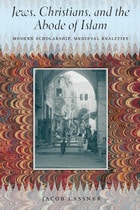
Jews, Christians, and the Abode of Islam
Modern Scholarship, Medieval RealitiesJacob Lassner
University of Chicago Press, 2012

Jews, Sports, and the Rites of Citizenship
Edited by Jack Kugelmass
University of Illinois Press, 2006
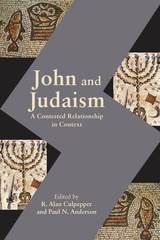
John and Judaism
A Contested Relationship in ContextR. Alan Culpepper
SBL Press, 2017
A window into early Judaism and Christianity
The Gospel of John was written during the period of the emergence of Christianity and its separation from Judaism and bears witness to their contested relationship. This volume contains eighteen cutting-edge essays written by an international group of scholars who interpret for students and general readers what the book tells us about first-century Judaism, the separation of the church from Judaism, and how John's anti-Jewish references are being interpreted today.
Features:
- A debate over the process that led to the separation of the church from Judaism, and John's place in that process
- A review of recent interpretations of John's anti-Jewish references
- An assessment of the current status of Jewish Christian relations
Judah in the Neo-Babylonian Period
The Archaeology of DesolationAvraham Faust
SBL Press, 2012
Judaism Despite Christianity
The 1916 Wartime Correspondence Between Eugen Rosenstock-Huessy and Franz RosenzweigEdited by Eugen Rosenstock-Huessy
University of Chicago Press, 2011
Judaism and Christianity in the Age of Constantine
History, Messiah, Israel, and the Initial ConfrontationJacob Neusner
University of Chicago Press, 1987
In a close analysis of texts by the Christian theologians Eusebius, Aphrahat, and Chrysostom on one hand, and of the central Jewish works the Talmud of the Land of Israel, the Genesis Rabbah, and the Leviticus Rabbah on the other, Neusner finds that both religious groups turned to the same corpus of Hebrew scripture to examine the same fundamental issues. Eusebius and Genesis Rabbah both address the issue of history, Chrysostom and the Talmud the issue of the Messiah, and Aphrahat and Leviticus Rabbah the issue of Israel. As Neusner demonstrates, the conclusions drawn shaped the dialogue between the two religions for the rest of their shared history in the West.
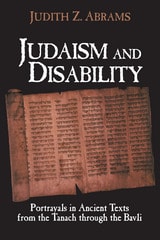
Judaism and Disability
Portrayals in Ancient Texts from the Tanach through the BavliJudith Z. Abrams
Gallaudet University Press, 1998
In Judaism and Disability, the archaic portrayals of mentally ill, mentally retarded, physically affected, deaf, blind, and other disabled people reflect the sharp contrast they presented compared to the unchanging Judaic ideal of the “perfect priest.” All of these sources describe this perfection as embodied in a person who is male, free, unblemished, with da’at (cognition that can be communicated), preferably learned, and a priest. The failure to have da’at stigmatized disabled individuals, who were also compromised by the treatment they received from nondisabled people, who were directing and constraining.
As the Judaic ideal transformed from the bodily perfection of the priest in the cult to intellectual prowess in the Diaspora, a parallel change of attitudes toward disabled persons gradually occurred. The reduced emphasis upon physical perfection as a prerequisite for a relationship with God eventually enabled the enfranchisement of some disabled people and other minorities. Scholars, students, and other readers will find the engrossing process disclosed in Judaism and Disability one that they can apply to a variety of other disciplines.
Judaism and Story
The Evidence of The Fathers According to Rabbi NathanJacob Neusner
University of Chicago Press, 1992
Judaism and Story documents a chapter of rabbinic tradition that explored the possibility of historical orientation by means of stories. As Neusner demonstrates, this experiment with narrative went beyond the borders of rabbinic preoccupation with rhetorical argumentation focused on the explication of the Torah. The sage story moved in the direction of biography, but without allowing biography to emerge. This development, in Neusner's account, parallels the movement from epistle to Gospel in early Christianity and thus has broad implications for the history of religions.
Judaism's Theological Voice
The Melody of the TalmudJacob Neusner
University of Chicago Press, 1995
In his attempt to answer these questions, Neusner sets forth the character and the form of the Torah as sung theology. Israel, the holy community, meets God in the synagogue, while at prayer, and in the yeshiva, when studying the Torah—at the moment in each setting when the Torah is received. In both circumstances people do not read but sing out its words. With the written part of the Torah sung in the synagogue, and the oral part declaimed in centers of sacred learning, music provides the medium for Judaism's theological voice.
Neusner identifies a reciprocal exchange between the holy community Israel and God: Israel sings to God when the Torah is studied, and God sings to Israel when the Torah is declaimed. Through the metaphor of music, Neusner offers an account of how he believes those faithful to the Torah meet God in the Torah, and how they should listen to the melody of God's self-revelation. The result is an original theological reflection that will interest all students of Judaism.
Judaism
The Genealogy of a Modern NotionBoyarin, Daniel
Rutgers University Press, 2019