Results by title
56 books match the query 'Jurisprudence' and 3 start with j
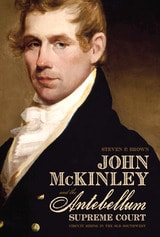
John McKinley and the Antebellum Supreme Court
Circuit Riding in the Old SouthwestSteven P. Brown
University of Alabama Press, 2012
A Southern voice on a national bench—McKinley’s legacy in antebellum law.
John McKinley and the Antebellum Supreme Court offers the first comprehensive biography of Justice John McKinley (1780–1852), a largely forgotten figure in American legal history who played a pivotal role during a formative period of the U.S. Supreme Court. Steven P. Brown rescues McKinley from historical obscurity, presenting a compelling portrait of a man deeply embedded in the political, legal, and financial life of the early 19th-century South.
Born in Kentucky and later settling in northern Alabama, McKinley served in both the U.S. Senate and House of Representatives before being appointed to the Supreme Court by President Martin Van Buren in 1837. His tenure on the bench coincided with the creation of the Ninth Circuit, a vast and challenging judicial territory encompassing Alabama, Arkansas, Louisiana, and Mississippi. Brown details McKinley’s arduous circuit-riding duties, which required extensive travel and exposed him to the legal complexities of a rapidly expanding frontier.
More than a biography, the book provides a penetrating analysis of antebellum legal culture, Alabama state politics, and the internal workings of the Supreme Court during a time of national transformation. Brown challenges the prevailing view of McKinley as a mediocre jurist, arguing instead that his contributions—particularly his dissents defending states’ rights—deserve renewed scholarly attention. With rich historical context and meticulous research, John McKinley and the Antebellum Supreme Court sheds light on the burdens of justice in a divided nation and the legacy of a justice whose career mirrored the tensions of his time.
Judicial Reputation
A Comparative TheoryNuno Garoupa and Tom Ginsburg
University of Chicago Press, 2015
In Judicial Reputation, Nuno Garoupa and Tom Ginsburg explain how reputation is not only an essential quality of the judiciary as a whole, but also of individual judges. Perceptions of judicial systems around the world range from widespread admiration to utter contempt, and as judges participate within these institutions some earn respect, while others are scorned. Judicial Reputation explores how judges respond to the reputational incentives provided by the different audiences they interact with—lawyers, politicians, the media, and the public itself—and how institutional structures mediate these interactions. The judicial structure is best understood not through the lens of legal culture or tradition, but through the economics of information and reputation. Transcending those conventional lenses, Garoupa and Ginsburg employ their long-standing research on the latter to examine the fascinating effects that governmental interactions, multicourt systems, extrajudicial work, and the international rule-of-law movement have had on the reputations of judges in this era.
Justice Outsourced
The Therapeutic Jurisprudence Implications of Judicial Decision-Making by Nonjudicial OfficersEdited by Michael L. Perlin and Kelly Frailing
Temple University Press, 2022
Nonjudicial officers (NJOs) permeate the criminal justice and the forensic mental health systems in hidden ways. But what are the impact and consequences of non-lawyers and non- “real judges” hearing cases? Across the nation, numerous cases are outsourced to administrative and other NJOs to decide issues ranging from family court cases involving custody disputes and foster care, to alcohol, substance abuse, as well as mental health and institutionalization issues. Moreover, NJOs may also deal with probation sentencing, conditions of confinement, release restrictions, and even capital punishment.
The editors and contributors to the indispensable Justice Outsourced examine the hidden role of these non-judicial officers in the courtroom and administrative settings, as well as the ethical and practical considerations of using NJOs. Written from the perspective of therapeutic jurisprudence by judges, criminologists, lawyers, law professors, psychologists, and sociologists, this volume provides a much-needed wake-up call that emphasizes why the removal of a judge weakens a defendant’s rights and dignity and corrupts the administration of justice. However, Justice Outsourced also suggests effective employments of NJOs, revealing the potential of therapeutic principles and procedures to enhance the practical knowledge supplied by nonjudicial decision-makers.