Results by title
486 books match the query 'LGBTQ+' and 7 start with j
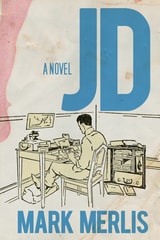
JD
A NovelMark Merlis
University of Wisconsin Press, 2015
When a would-be biographer approaches Ascher’s widow Martha, she delves for the first time into her husband’s papers and all the secrets that come tumbling out of them. She finds journals that begin as a wisecracking chronicle of life at the fringes of the New York literary scene, then recount Ascher’s sexual adventures in the pre-Stonewall gay underground and the social upheavals that led to his famous book “JD.” As Martha reads on, she finds herself in a long-distance conversation with her dead husband, fighting with him again about their rocky marriage and learning about the unseen tragedy in her own apartment that ended with the destruction of their son, Mickey. Mickey comes to life in the space between Jonathan and Martha’s conflicting portraits of him, while Martha and the biographer tangle over the continued relevance of Jonathan’s politics and his unfulfilled vision of a nation remade. Martha learns about herself, finally, through her confrontation with a man who will not let her go, even in death.
Mark Merlis’s JD is a brilliant and harrowing view of a half century of the American experiment, acted out on a small stage by three people who cannot find a way—neither sex nor touch nor words—to speak their love for one another.
Best Books of 2015: Fiction, Open Letters Monthly
Finalist, Gay Fiction, Lambda Literary Award
Finalist, Ferro-Grumley Award for LGBT Fiction, Publishing Triangle
Best books for public & secondary school libraries from university presses, American Library Association
“Many years after a ’60s New York writer's death, his widow confronts their tumultuous marriage and private identities through his journals. . . . JD’s most masterful element is its treatment of these two characters, both of whom spent their lives groping for contentment like one trying to find a light switch in a darkened room. A great writer offers not just tight prose but also insight, a series of probing questions that extend from the fictional world into the real one. JD asks who its characters were, and in doing so, forces the reader to confront the intricate and fascinating politics of identity.”—Shelf Awareness for Readers, *starred review
“A truly impressive work of literary fiction, JD documents author Mark Merlis as an extraordinary novelist able to deftly craft a complex plot and populate it with a roster of inherently fascinating characters and memorable events. The result is an entertaining and engaging read that will linger in the mind long after the book is finished. Very highly recommended for both community and academic library literary fiction collections.”—Midwest Book Review/Reviewer’s Bookwatch
“The fantastic JD (U. of Wisconsin), by acclaimed gay writer Mark Merlis (American Studies), is the writer's first novel in a dozen years. It's told in two voices. The first is that of the late gay writer Jonathan Ascher, and we hear from him through his journals. The second belongs to his widow Martha, who learns more about Jonathan than she ever imagined while reading the journals after agreeing to help a biographer of her late husband.”—Gregg Shapiro, Bay Area Reporter
JOAN
Jake Rose
University of Chicago Press, 2026
Longlisted for the 2026 National Book Award for Poetry. A narrative sequence of lyric poems reimagining Joan of Arc as a framework for queer identity, transformation, and poetic voice.
Collapsing biography and autobiography, the poetry of Jake Rose’s debut explores queer identity, grief, and desire through the historical framework of Joan of Arc’s life. Moving through rural landscapes of the speaker’s youth, contradictions of faith, consequences of desire, and fragmentations of trauma, JOAN is structured as an excavation of the speaker’s most intimate moments, combining poetry with historical quotations, visual collage, and a sequence of film stills. Through vivid lyric moments, the poems construct a speaker and world both intimate and charged—“I have to touch my farthest feeling,” “the sapphire dusk draping its lace arias”—with clarity and vibrant intensity. Refusing resolution, these poems dwell in rupture, reinvention, and fluid forms of gender that come to life outside of inherited boundaries. This collection speaks from the margins, searching for a body the self might inhabit and asking what it means to transform through language, gender, and desire.
JOAN is the winner of the Phoenix Emerging Poet Book Prize.
James Baldwin and the Heavenly City
Prophecy, Apocalypse, and DoubtChristopher Z. Hobson
Michigan State University Press, 2018
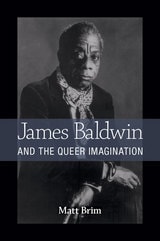
James Baldwin and the Queer Imagination
Matt Brim
University of Michigan Press, 2014

James Baldwin and the Queer Imagination
Matt Brim
University of Michigan Press, 2014
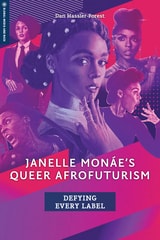
Janelle Monáe's Queer Afrofuturism
Defying Every LabelDan Hassler-Forest
Rutgers University Press, 2022
Janelle Monáe is all these things and more, making her one of the most fascinating artists to emerge in the twenty-first century. This provocative new study explores how Monáe’s work has connected different media platforms to strengthen and enhance new movements in art, theory, and politics. It considers not only Monáe’s groundbreaking albums The ArchAndroid, The Electric Lady, and Dirty Computer, but also Monáe’s work as an actress in such films as Hidden Figures and Antebellum, as well as her soundtrack appearances in socially-engaged projects ranging from I May Destroy You to Us. Examining Monáe as a cultural icon whose work is profoundly intersectional, this book maps how she is actively reshaping discourses around race, gender, sexuality, and capitalism. Tracing Monáe’s performances of joy, desire, pain, and hope across a wide range of media forms, it shows how she imagines Afrofuturist, posthumanist, and postcapitalist utopias, while remaining grounded in the realities of being a Black woman in a white-dominated industry. This is an exciting introduction to an audacious innovator whose work offers us fresh ways to talk about identity, desire, and power.
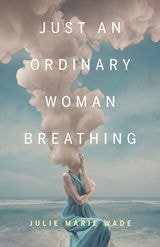
Just an Ordinary Woman Breathing
Julie Marie Wade
The Ohio State University Press, 2020
Finalist for the Publishing Triangle's Judy Grahn Award for Lesbian Nonfiction
You have a history, and a body. You are a history, and a body. Your body has (is) a history, too. As a girl, Julie Marie Wade was uninterested in makeup, boy-watching, and other trappings of conventional girlhood, much to her mother’s disappointment. Grace Kelly and Marilyn Monroe—movie stars immortalized as feminine ideals, even as they both died tragically and young—were lodestars that threw Wade’s own definition of beauty into relief as she stumbled into adulthood.
Now, in Just an Ordinary Woman Breathing, Wade traces the intimate story of coming of age in one particular body (as a lesbian, an only child, a Protestant attending Catholic school). She uses the language and tenets of music, math, religion, fairy tales, poetry, and art to reckon with the many facets of embodiment, sexuality, and love in our contemporary world. The diet industry, popular culture, and her own family all provide rich material for what is ultimately a lyrical and unflinching investigation into the questions that prickle deep within the human heart.