Results by title
372 books match the query 'Language' and 6 start with j
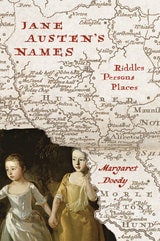
Jane Austen's Names
Riddles, Persons, PlacesMargaret Doody
University of Chicago Press, 2015
In Jane Austen’s works, a name is never just a name. In fact, the names Austen gives her characters and places are as rich in subtle meaning as her prose itself. Wiltshire, for example, the home county of Catherine Morland in Northanger Abbey, is a clue that this heroine is not as stupid as she seems: according to legend, cunning Wiltshire residents caught hiding contraband in a pond capitalized on a reputation for ignorance by claiming they were digging up a “big cheese”—the moon’s reflection on the water’s surface. It worked.
In Jane Austen’s Names, Margaret Doody offers a fascinating and comprehensive study of all the names of people and places—real and imaginary—in Austen’s fiction. Austen’s creative choice of names reveals not only her virtuosic talent for riddles and puns. Her names also pick up deep stories from English history, especially the various civil wars, and the blood-tinged differences that played out in the reign of Henry VIII, a period to which she often returns. Considering the major novels alongside unfinished works and juvenilia, Doody shows how Austen’s names signal class tensions as well as regional, ethnic, and religious differences. We gain a new understanding of Austen’s technique of creative anachronism, which plays with and against her skillfully deployed realism—in her books, the conflicts of the past swirl into the tensions of the present, transporting readers beyond the Regency.
Full of insight and surprises for even the most devoted Janeite, Jane Austen’s Names will revolutionize how we read Austen’s fiction.
[more]
Judicial Rhapsodies
Rhetoric and Fundamental Rights in the Supreme CourtDoug Coulson
Amherst College Press, 2023
All judges legitimize their decisions in writing, but US Supreme Court justices depend on public acceptance to a unique degree. Previous studies of judicial opinions have explored rhetorical strategies that produce legitimacy, but none have examined the laudatory, even operatic, forms of writing Supreme Court justices have used to justify fundamental rights decisions. Doug Coulson demonstrates that such “judicial rhapsodies” are not an aberration but a central feature of judicial discourse.
First examining the classical origins of divisions between law and rhetoric, Coulson tracks what he calls an epideictic register—highly affective forms of expression that utilize hyperbole, amplification, and vocabularies of praise—through a surprising number of landmark Supreme Court opinions. Judicial Rhapsodies recovers and revalues these instances as significant to establishing and maintaining shared perspectives that form the basis for common experience and cooperation.
“Judicial Rhapsodies is both compelling and important. Coulson brings his well-developed knowledge of rhetoric to bear on one of the most central (and most democratically fraught) means of governance in the United States: the Supreme Court opinion. He demonstrates that the epideictic, far from being a dispensable or detestable element of judicial rhetoric, is an essential feature of how the Court operates and seeks to persuade.” —Keith Bybee, Syracuse University
[more]
Just Words, Second Edition
Law, Language, and PowerJohn M. Conley and William M. O'Barr
University of Chicago Press, 2005
Is it "just words" when a lawyer cross-examines a rape victim in the hopes of getting her to admit an interest in her attacker? Is it "just words" when the Supreme Court hands down a decision or when business people draw up a contract? In tackling the question of how an abstract entity exerts concrete power, Just Words focuses on what has become the central issue in law and language research: what language reveals about the nature of legal power.
Conley and O'Barr show how the microdynamics of the legal process and the largest questions of justice can be fruitfully explored through the field of linguistics. Each chapter covers a language-based approach to a different area of the law, from the cross-examinations of victims and witnesses to the inequities of divorce mediation. Combining analysis of common legal events with a broad range of scholarship on language and law, Just Words seeks the reality of power in the everyday practice and application of the law. As the only study of its type, the book is the definitive treatment of the topic that will be welcomed by students and specialists alike.
Conley and O'Barr show how the microdynamics of the legal process and the largest questions of justice can be fruitfully explored through the field of linguistics. Each chapter covers a language-based approach to a different area of the law, from the cross-examinations of victims and witnesses to the inequities of divorce mediation. Combining analysis of common legal events with a broad range of scholarship on language and law, Just Words seeks the reality of power in the everyday practice and application of the law. As the only study of its type, the book is the definitive treatment of the topic that will be welcomed by students and specialists alike.
[more]
Just Words
Law, Language, and PowerJohn M. Conley and William M. O'Barr
University of Chicago Press, 1998
Is it "just words" when a lawyer cross-examines a rape victim in the hopes of getting her to admit an interest in her attacker? Is it "just words" when the Supreme Court hands down a decision or when business people draw up a contract? In tackling the question of how an abstract entity exerts concrete power, Just Words focuses on what has become the central issue in law and language research: what language reveals about the nature of legal power.
Conley and O'Barr show how the microdynamics of the legal process and the largest questions of justice can be fruitfully explored through the field of linguistics. Each chapter covers a language-based approach to a different area of the law, from the cross-examinations of victims and witnesses to the inequities of divorce mediation. Combining analysis of common legal events with a broad range of scholarship on language and law, Just Words seeks the reality of power in the everyday practice and application of the law. As the only study of its type, the book is the definitive treatment of the topic that will be welcomed by students and specialists alike.
Conley and O'Barr show how the microdynamics of the legal process and the largest questions of justice can be fruitfully explored through the field of linguistics. Each chapter covers a language-based approach to a different area of the law, from the cross-examinations of victims and witnesses to the inequities of divorce mediation. Combining analysis of common legal events with a broad range of scholarship on language and law, Just Words seeks the reality of power in the everyday practice and application of the law. As the only study of its type, the book is the definitive treatment of the topic that will be welcomed by students and specialists alike.
[more]
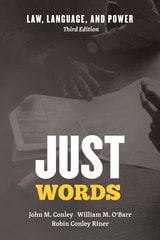
Just Words
Law, Language, and Power, Third EditionJohn M. Conley, William M. O'Barr, and Robin Conley Riner
University of Chicago Press, 2019
Is it “just words” when a lawyer cross-examines a rape victim in the hopes of getting her to admit an interest in her attacker? Is it “just words” when the Supreme Court hands down a decision or when business people draw up a contract? In tackling the question of how an abstract entity exerts concrete power, Just Words focuses on what has become the central issue in law and language research: what language reveals about the nature of legal power.
John M. Conley, William M. O'Barr, and Robin Conley Riner show how the microdynamics of the legal process and the largest questions of justice can be fruitfully explored through the field of linguistics. Each chapter covers a language-based approach to a different area of the law, from the cross-examinations of victims and witnesses to the inequities of divorce mediation. Combining analysis of common legal events with a broad range of scholarship on language and law, Just Words seeks the reality of power in the everyday practice and application of the law. As the only study of its type, the book is the definitive treatment of the topic and will be welcomed by students and specialists alike. This third edition brings this essential text up to date with new chapters on nonverbal, or “multimodal,” communication in legal settings and law, language, and race.
John M. Conley, William M. O'Barr, and Robin Conley Riner show how the microdynamics of the legal process and the largest questions of justice can be fruitfully explored through the field of linguistics. Each chapter covers a language-based approach to a different area of the law, from the cross-examinations of victims and witnesses to the inequities of divorce mediation. Combining analysis of common legal events with a broad range of scholarship on language and law, Just Words seeks the reality of power in the everyday practice and application of the law. As the only study of its type, the book is the definitive treatment of the topic and will be welcomed by students and specialists alike. This third edition brings this essential text up to date with new chapters on nonverbal, or “multimodal,” communication in legal settings and law, language, and race.
[more]
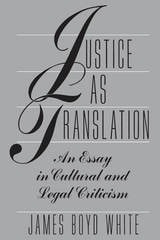
Justice as Translation
An Essay in Cultural and Legal CriticismJames Boyd White
University of Chicago Press, 1990
White extends his conception of United States law as a constitutive rhetoric shaping American legal culture that he proposed in When Words Lose Their Meaning, and asks how Americans can and should criticize this culture and the texts it creates. In determining if a judicial opinion is good or bad, he explores the possibility of cultural criticism, the nature of conceptual language, the character of economic and legal discourse, and the appropriate expectations for critical and analytic writing. White employs his unique approach by analyzing individual cases involving the Fourth Amendment of the United States constitution and demonstrates how a judge translates the facts and the legal tradition, creating a text that constructs a political and ethical community with its readers.
"White has given us not just a novel answer to the traditional jurisprudential questions, but also a new way of reading and evaluating judicial opinions, and thus a new appreciation of the liberty which they continue to protect."—Robin West, Times Literary Supplement
"James Boyd White should be nominated for a seat on the Supreme Court, solely on the strength of this book. . . . Justice as Translation is an important work of philosophy, yet it is written in a lucid, friendly style that requires no background in philosophy. It will transform the way you think about law."—Henry Cohen, Federal Bar News & Journal
"White calls us to rise above the often deadening and dreary language in which we are taught to write professionally. . . . It is hard to imagine equaling the clarity of eloquence of White's challenge. The apparently effortless grace of his prose conveys complex thoughts with deceptive simplicity."—Elizabeth Mertz, Yale Journal of Law and the Humanities
"Justice as Translation, like White's earlier work, provides a refreshing reminder that the humanities, despite the pummelling they have recently endured, can be humane."—Kenneth L. Karst, Michigan Law Review
[more]