Results by title
320 books match the query 'Legal status, laws, etc' and 3 start with j

JUSTIFIABLE HOMICIDE
BATTERED WOMEN, SELF-DEFENSE AND THE LAWCynthia K. Gillespie
The Ohio State University Press, 1990
[more]
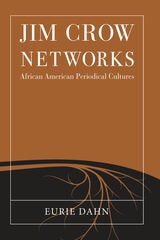
Jim Crow Networks
African American Periodical CulturesEurie Dahn
University of Massachusetts Press, 2021
Scholars have paid relatively little attention to the highbrow, middlebrow, and popular periodicals that African Americans read and discussed regularly during the Jim Crow era—publications such as the Chicago Defender, the Crisis, Ebony, and the Half-Century Magazine. Jim Crow Networks considers how these magazines and newspapers, and their authors, readers, advertisers, and editors worked as part of larger networks of activists and thinkers to advance racial uplift and resist racism during the first half of the twentieth century.
As Eurie Dahn demonstrates, authors like James Weldon Johnson, Nella Larsen, William Faulkner, and Jean Toomer wrote in the context of interracial and black periodical networks, which shaped the literature they produced and their concerns about racial violence. This original study also explores the overlooked intersections between the black press and modernist and Harlem Renaissance texts, and highlights key sites where readers and writers worked toward bottom-up sociopolitical changes during a period of legalized segregation.
As Eurie Dahn demonstrates, authors like James Weldon Johnson, Nella Larsen, William Faulkner, and Jean Toomer wrote in the context of interracial and black periodical networks, which shaped the literature they produced and their concerns about racial violence. This original study also explores the overlooked intersections between the black press and modernist and Harlem Renaissance texts, and highlights key sites where readers and writers worked toward bottom-up sociopolitical changes during a period of legalized segregation.
[more]
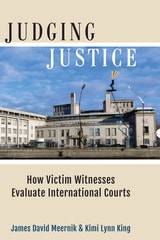
Judging Justice
How Victim Witnesses Evaluate International CourtsJames David Meernik and Kimi Lynn King
University of Michigan Press, 2019
Some injustices are so massive, so heinous, and so extraordinary that ordinary courts are no longer adequate. The creation of international courts and tribunals to confront major violations of human rights sought to bring justice to affected communities as well as to the entire world. Yet if justice is a righting of the imbalance between what has happened and what is reflected in the law, no amount of punishment and no judgment could compensate for that suffering and loss.
In order to understand the meaning of justice, James David Meernik and Kimi Lynn King studied the perspective of witnesses who have testified before the International Criminal Tribunal for the Former Yugoslavia (ICTY). Using a unique survey, Meernik and King look at the identity of the victims and their perception of the fairness of ICTY. Because of the need to justify the practical and emotional difficulties involved in testifying before an international tribunal, witnesses look not just to the institution to judge its effectiveness, but also to their own contribution, by testifying effectively. The central elements of the theory Meernik and King develop—identity, fairness, and experience—transcend specific conflicts and specific countries and are of importance to people everywhere.
In order to understand the meaning of justice, James David Meernik and Kimi Lynn King studied the perspective of witnesses who have testified before the International Criminal Tribunal for the Former Yugoslavia (ICTY). Using a unique survey, Meernik and King look at the identity of the victims and their perception of the fairness of ICTY. Because of the need to justify the practical and emotional difficulties involved in testifying before an international tribunal, witnesses look not just to the institution to judge its effectiveness, but also to their own contribution, by testifying effectively. The central elements of the theory Meernik and King develop—identity, fairness, and experience—transcend specific conflicts and specific countries and are of importance to people everywhere.
[more]