Results by title
275 books match the query 'Letters' and 2 start with j
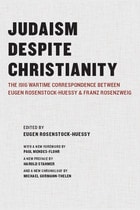
Judaism Despite Christianity
The 1916 Wartime Correspondence Between Eugen Rosenstock-Huessy and Franz RosenzweigEdited by Eugen Rosenstock-Huessy
University of Chicago Press, 2011
Before they were both internationally renowned philosophers, Eugen Rosenstock-Huessy and Franz Rosenzweig were young German soldiers fighting in World War I corresponding by letter and forming the foundation of their deep intellectual friendship. Collected here, this correspondence provides an intimate portrait of their views on history, philosophy, rhetoric, and religion as well as on their writings and professors. Most centrally, Rosenstock-Huessy and Rosenzweig discuss, frankly but respectfully, the differences between Judaism and Chiristianity and the reasons they have chosen their respective faiths.
This edition includes a new foreword by Paul Mendes-Flohr, a new preface by Harold Stahmer along with his original introduction, and essays by Dorothy Emmet and Alexander Altmann, who calls this correspondence “one of the most important religious documents of our age” and “the most perfect example of a human approach to the Jewish-Christian problem.”
[more]
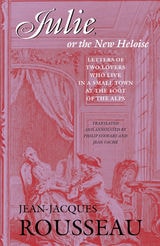
Julie, or the New Heloise
Letters of Two Lovers Who Live in a Small Town at the Foot of the AlpsJean-Jacques Rousseau
Dartmouth College Press, 1997
An elegant translation of one of the most popular novels of its time. Rousseau's great epistolary novel, Julie, or the New Heloise, has been virtually unavailable in English since 1810. In it, Rousseau reconceptualized the relationship of the individual to the collective and articulated a new moral paradigm. The story follows the fates and smoldering passions of Julie d'Etange and St. Preux, a one-time lover who re-enters Julie's life at the invitation of her unsuspecting husband, M. de Wolmar. The complex tones of this work made it a commercial success and a continental sensation when it first appeared in 1761, and its embodiment of Rousseau's system of thought, in which feelings and intellect are intertwined, redefined the function and form of fiction for decades. As the characters negotiate a complex maze of passion and virtue, their purity of soul and honest morality reveal, as Rousseau writes in his preface, "the subtleties of heart of which this work is full." A comprehensive introduction and careful annotations make this novel accessible to contemporary readers, both as an embodiment of Rousseau's philosophy and as a portrayal of the tension and power inherent in domestic life.
[more]