Results by title
204 books match the query 'Massachusetts' and 2 start with j
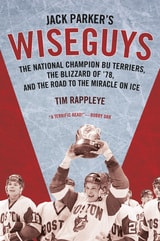
Jack Parker's Wiseguys
The National Champion BU Terriers, the Blizzard of ’78, and the Road to the Miracle on IceTim Rappleye
University Press of New England, 2017
Over the winter of 1977–78, anyone within shouting distance of a two-mile stretch of Boston’s Commonwealth Avenue—from Fenway Park to the trolley curve at Packard’s Corner—found themselves pulled into the orbit of college hockey. The hottest ticket in a sports-mad city was Boston University’s Terriers, a team so tough it was said they didn’t have fans—they took hostages. Eschewing the usual recruiting pools in Canada, Jack Parker and his coaching staff assembled a squad that included three stars from nearby Charlestown, then known as the “armed robbery capital of America.” Jack Parker’s Wiseguys is the story of a high-flying, headline-dominating, national championship squad led by three future stars of the Miracle on Ice, the medal-round game the 1980 U.S. Olympic hockey team won against the heavily favored Soviet Union. Now retired, Parker is a thoughtful statesman for the sport, a revered figure who held the longest tenure of any coach in Boston sports history. But during the 1977–78 season, he was just five years into his reign—and only a decade or so older than his players. Fiery, mercurial, as tough as any of his tough guys, Parker and his team were to face the pressure-cooker expectations of four previous also-ran seasons, further heightened by barroom brawls, off-the-ice shenanigans, and the citywide shutdown caused by one of the biggest blizzards to ever hit the Northeast. This season was to be Parker’s watershed, a roller-coaster ride of nail-biting victories and unimaginable tragedy, played out in increasingly strident headlines as his team opened the season with an unprecedented twenty-one straight wins. Only the second loss of the year eliminated the Terriers from their league playoffs and possibly from national contention; hours after the game Parker’s wife died from cancer. The story of how the team responded—coming back to win the national championship a week after Parker buried his wife—makes a compelling tale for Boston sports fans and everyone else who feels a thrill of pride at America’s unlikely win over the Soviet national team—a victory forged on Commonwealth Avenue in that bitter, beautiful winter of ’78.
[more]
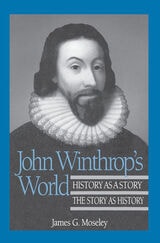
John Winthrop's World
History as a Story; The Story as HistoryJames G. Moseley
University of Wisconsin Press, 1992
One of the most famous American journals is that of seventeenth-century Puritan leader John Winthrop. As the first governor of the Massachusetts Bay Colony, an office he held with few interruptions for two decades, he worked to establish a society in which he thought true Christianity could flourish, beyond the reach of the unfaithful Church of England. Winthrop recorded the daily events of his life—the political infighting and religious disputes among Puritans, as well as their relations with other colonists, Indians, and England. His journal is a window into a world that, while unfamiliar, continues to influence our sense of the meaning of America.
In the first in-depth study of Winthrop since 1958, James G. Moseley provides a fascinating new look at this extraordinary man, paying careful attention to the connections between Winthrop’s political activity and his writing. Moseley first examines Winthrop as a writer, using the journal to analyze Winthrop as a man resolving challenges based as much on his acutely pragmatic intelligence as on his deeply felt religious convictions. Second, Moseley traces how historians have responded to Winthrop—how his famous journal has been read and misread by those who have filtered the man and his cultural context through many lenses.
By examining Winthrop’s ancestors and early life in England, especially the religious changes he experienced, Moseley removes the blinders of modernism, portraying Winthrop as never before. He shows how Winthrop’s successful struggle to accept the deaths of his first two wives led him away from moralistic views of Christianity, himself, and his world to more magnanimous views.
Arguing that writing was the medium through which Winthrop developed his capacity for leadership, Moseley shows how the journal enabled Winthrop to reflect objectively on his situation and to adjust his behavior. Winthrop was, Moseley suggests, not only a politician but a historian, and his interpretations of foundational events in American history in his journal are an invaluable resource for understanding the nature of leadership and the meaning of liberty in Puritan America.
Winthrop’s World is a very graceful, well-written, and engaging narrative that provides new insight into the Puritan way of life and into the man who provided a window between our world and his.
[more]