Results by title
308 books match the query 'Memory' and 4 start with j
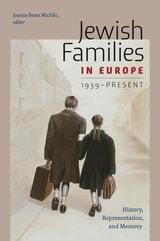
Jewish Families in Europe, 1939-Present
History, Representation, and MemoryEdited by Joanna Beata Michlic
Brandeis University Press, 2017
This book offers an extensive introduction and 13 diverse essays on how World War II, the Holocaust, and their aftermath affected Jewish families and Jewish communities, with an especially close look at the roles played by women, youth, and children. Focusing on Eastern and Central Europe, themes explored include: how Jewish parents handled the Nazi threat; rescue and resistance within the Jewish family unit; the transformation of gender roles under duress; youth’s wartime and early postwar experiences; postwar reconstruction of the Jewish family; rehabilitation of Jewish children and youth; and the role of Zionism in shaping the present and future of young survivors. Relying on newly available archival material and novel research in the areas of families, youth, rescue, resistance, gender, and memory, this volume will be an indispensable guide to current work on the familial and social history of the Holocaust.
[more]
Joseph Smith
History, Methods, and MemoryRonald O. Barney
University of Utah Press, 2020
The study of Joseph Smith and his writings have long been shaped by the polemical atmosphere that surrounds Smith’s claims to divine authorship. Even after a half-century of serious scholarship devoted to Smith, fundamental questions remain about how to best interpret features of his life and writing. Smith’s own History of Joseph Smith (edited and revised at the beginning of the twentieth century by B. H. Roberts) created an enduring image that influenced Mormon theology, doctrine, and polity for generations. With new historical documents now available, however, a reappraisal of Smith and the origins of Mormonism is necessary.
Ronald O. Barney, a former editor of the Joseph Smith Papers, applies new interpretations to Smith in history and memory, re-examining both his writings and contemporary accounts of him. The book explores the best methodologies for appraising the historical record, including a review of Smith’s world and its contextual background, an analysis of his foundational experiences, and a characterization of Smith as a man and prophet. Though the premise of re-evaluation may be unsettling to traditionalists, a modern reconsideration of the historical record’s entire range of sources is necessary to fashion a strategy for evaluating Smith and his enduring but complex legacy.
Ronald O. Barney, a former editor of the Joseph Smith Papers, applies new interpretations to Smith in history and memory, re-examining both his writings and contemporary accounts of him. The book explores the best methodologies for appraising the historical record, including a review of Smith’s world and its contextual background, an analysis of his foundational experiences, and a characterization of Smith as a man and prophet. Though the premise of re-evaluation may be unsettling to traditionalists, a modern reconsideration of the historical record’s entire range of sources is necessary to fashion a strategy for evaluating Smith and his enduring but complex legacy.
[more]
Joyce's Book of Memory
The Mnemotechnic of UlyssesJohn S. Rickard
Duke University Press, 1999
For James Joyce, perhaps the most crucial of all human faculties was memory. It represented both the central thread of identity and a looking glass into the past. It served as an avenue into other minds, an essential part of the process of literary composition and narration, and the connective tissue of cultural tradition. In Joyce’s Book of Memory John S. Rickard demonstrates how Joyce’s body of work—Ulysses in particular—operates as a “mnemotechnic,” a technique for preserving and remembering personal, social, and cultural pasts.
Offering a detailed reading of Joyce and his methods of writing, Rickard investigates the uses of memory in Ulysses and analyzes its role in the formation of personal identity. The importance of forgetting and repression, and the deadliness of nostalgia and habit in Joyce’s paralyzed Dublin are also revealed. Noting the power of spontaneous, involuntary recollection, Rickard locates Joyce’s mnemotechnic within its historical and philosophical contexts. As he examines how Joyce responded to competing intellectual paradigms, Rickard explores Ulysses’ connection to medieval, modern, and (what would become) postmodern worldviews, as well as its display of tensions between notions of subjective and universal memory. Finally, Joyce’s Book of Memory illustrates how Joyce distilled subjectivity, history, and cultural identity into a text that offers a panoramic view of the modern period.
This book will interest students and scholars of Joyce, as well as others engaged in the study of modern and postmodern literature.
[more]
Joyce's Ghosts
Ireland, Modernism, and MemoryLuke Gibbons
University of Chicago Press, 2015
For decades, James Joyce’s modernism has overshadowed his Irishness, as his self-imposed exile and association with the high modernism of Europe’s urban centers has led critics to see him almost exclusively as a cosmopolitan figure.
In Joyce’s Ghosts, Luke Gibbons mounts a powerful argument that this view is mistaken: Joyce’s Irishness is intrinsic to his modernism, informing his most distinctive literary experiments. Ireland, Gibbons shows, is not just a source of subject matter or content for Joyce, but of form itself. Joyce’s stylistic innovations can be traced at least as much to the tragedies of Irish history as to the shock of European modernity, as he explores the incomplete project of inner life under colonialism. Joyce’s language, Gibbons reveals, is haunted by ghosts, less concerned with the stream of consciousness than with a vernacular interior dialogue, the “shout in the street,” that gives room to outside voices and shadowy presences, the disruptions of a late colonial culture in crisis.
Showing us how memory under modernism breaks free of the nightmare of history, and how in doing so it gives birth to new forms, Gibbons forces us to think anew about Joyce’s achievement and its foundations.
[more]