Results by title
1210 books match the query 'Mexico' and 8 start with j
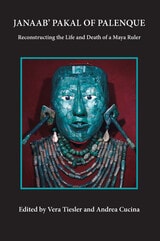
Janaab' Pakal of Palenque
Reconstructing the Life and Death of a Maya RulerEdited by Vera Tiesler and Andrea Cucina
University of Arizona Press, 2006
This volume communicates the broad scope of applied interdisciplinary research conducted on the Pakal remains to provide answers to old disputes over the accuracy of both skeletal and epigraphic studies, along with new questions in the field of Maya dynastic research. Contributions by scholars in epigraphy, anthropology, and bioarchaeology bring to light new evidence regarding the ruler’s age, clarify his medical history and the identification of the remains found with him, reevaluate his role in life, and offer modern insights into ritual and sacrificial practices associated with Pakal.
The book leads readers through the history of Pakal’s discovery, skeletal analysis, and interpretation of Maya biographies, and also devotes considerable attention to the tomb of the “Red Queen” discovered at the site. Findings from the new Transition Analysis aging method, histomorphometric analysis, and taphonomic imagery are presented to shed new light on the perplexing question of Pakal’s age at death. Royal Maya life and death histories from the written record are also analyzed from a regional perspective to provide a broad panorama of the twisted power politics of rulers’ families and the entangled genealogies of the Maya Classic period.
A benchmark in biological anthropology, this volume reconsiders assumptions concerning the practices and lives of Maya rulers, posing the prospect that researchers too often find what they expect to find. In presenting an updated study of a well-known personage, it also offers innovative approaches to the biocultural and interdisciplinary re-creation of Maya dynastic history.
Contributors
Jesper K. Boldseh
Jane E. Buikstra
James H. Burton
Andrea Cucina
Nikolai Grube
Patricia Hernández
Lourdes Márquez
Simon Martin
George R. Milner
T. Douglas Price
Arturo Romano
Carlos Serrano
Sam D. Stout
Margaret Streeter
Vera Tiesler
John W. Verano
Jarano
By Ramón Beteta
University of Texas Press, 1970
Ramón Beteta was an important figure in Mexican life: politician, Cabinet member, diplomat, economist, professor, journalist. The manuscript of Jarano was found among his papers after his death in 1965 and was published in Mexico in 1966. "Jarano," the kind of broad sombrero worn by charros, was the secret nickname—partly disrespectful, partly amused, partly affectionate—which Ramón and his brother gave to their father. Except for part of the last chapter, the book is about Ramón's childhood and youth: sketches of family life, school experiences, a trip to Veracruz, and incidents of the Revolution.
Beteta brought to these reminiscences the skills of the short story writer, making superb use of dialogue, descriptive details, characterization, and mood. For a small book, the range of emotions is unusually wide, from the comedy of an evening meal to which Jarano has come home drunk to the tragedy of the indio and his wife in the chapter entitled "San Vicente Chicoloapan"—a chapter that gives more of the "feel" of the Revolution than do many longer works.

Jericho
By Charles Bowden, Foreword by Charles D'Ambrosio
University of Texas Press, 2020
When Charles Bowden died in 2014, he left behind an archive of unpublished manuscripts. Jericho marks the fifth installment in his venerable “Unnatural History of America” sextet. In it he invokes the cycles of destruction and rebirth that have defined the ancient biblical city over millennia. From the ruins of Jericho’s walls Bowden reflects on the continuum of war and violence—the many conquests of the Americas; the US-Mexican War; the Vietnam War; and the ongoing militarization of our southern border—to argue against the false promise of security that is offered when men “build that wall.” Walls—both real and imagined—will always come tumbling down.
Along the way, Bowden tells stories of loss and violence, like that of David Hartley, who mysteriously vanishes on Falcon Lake; of murdered drug runners and their cartel bosses; and of a haunted sicario, or hitman, who is running from his past and compulsively confesses his sins as he searches for an absolution that will never come. Set against these scenes of trauma and violence are Bowden’s gorgeous meditations on nature: dancing cranes, soaring eagles, winding paths that traverse mountains, lakes, and deserts. And threaded throughout are the heroic narratives of men like Martin Luther King Jr., who defied the boundaries that surrounded him and was able to reshape the arc of history. Jericho is a remarkable affirmation of our shared humanity and a timely rejection of violence and nationalism by one of our most prophetic writers working at the height of his powers.
Juan Soldado
Rapist, Murderer, Martyr, SaintPaul J. Vanderwood
Duke University Press, 2004
In addition to conducting extensive archival research, Vanderwood interviewed central actors in the events of 1938, including Olga Camacho’s mother, citizens who rioted to demand Morales’s release to a lynch mob, those who witnessed his execution, and some of the earliest believers in his miraculous powers. Vanderwood also interviewed many present-day visitors to the shrine at Morales’s grave. He describes them, their petitions—for favors such as health, a good marriage, or safe passage into the United States—and how they reconcile their belief in Juan Soldado with their Catholicism. Vanderwood puts the events of 1938 within the context of Depression-era Tijuana and he locates people’s devotion, then and now, within the history of extra-institutional religious activity. In Juan Soldado, a gripping true-crime mystery opens up into a much larger and more elusive mystery of faith and belief.
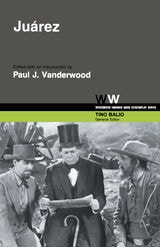
Juarez
Edited, with an introduction by Paul J. Vanderwood; Tino T. Balio, Series Editor
University of Wisconsin Press, 1983
Juárez was Warner Brothers' cinematic attempt to answer the major international question of the 1930s: would democracy or dictatorship prevail? Eager to further the foreign policy objectives of its friend Franklin Delano Roosevelt and equally willing to add to its prestigious and profitable biography series, the stuido set a record high budget and assembled special film stock, extensive scholarly research, a loose time schedule, a renowned director, and a stellar cast that included Paul Muni, Brian Aherne, and Bette Davis. The film was meant to be an ideologically clear-cut statement against fascism. The ways in which this artistic propaganda backfired make Juárez a significant historical document for students of film, Latin American history, and U.S. foreign relations.
Judicial Review in Mexico
A Study of the Amparo SuitBy Richard D. Baker
University of Texas Press, 1971
The amparo suit is a Mexican legal institution similar in its effects to such Anglo-American procedures as habeas corpus, error, and the various forms of injunctive relief. It has undergone a long evolution since it was incorporated into the Constitution of 1857. Today, its principal purpose is to protect private individuals in the enjoyment of the rights guaranteed by the first twenty-nine articles of the Constitution.
Mexico after its independence produced many constitutions. One of the earliest problems was to find an adequate means of defending the Constitution against ill-founded interpretations of its precepts. Like the United States, Mexico has developed a system of constitutional defense in which the judiciary is the supreme interpreter of what this document means. Unlike the United States Supreme Court, however, the Mexican Supreme Court has not been innovative in its decisions or contradicted the administration on major policy decisions. This difference must be attributed to the civil law system of Mexico as well as to the political climate.
The first part of Richard D. Baker’s book describes the historical background of amparo and other methods of constitutional defense in Mexico. The three men most closely associated with creating a judicial form of constitutional defense in Mexico were Manuel Crescencio Rejón, José Fernando Ramírez, and Mariano Otero. Their own writings indicate that the immediate source of amparo must be found in the American institution of judicial review that was transmitted to Mexicans through Alexis de Tocqueville’s Democracy in America.
The second part is an exposition of the workings of the amparo suit in the twentieth century and the constitutional and statutory provisions affecting it. Since 1857, when it was incorporated into article 102 of the Constitution, the amparo suit has evolved into a highly complex institution performing three functions: the defense of the civil liberties enumerated in the first twenty-nine articles of the Constitution, the determination of the constitutionality of federal and state legislation, and cassation. The Supreme Court is primarily limited to defending civil liberties through the amparo suit; it remains less innovative and more restricted than the United States system of judicial review, especially in the effect of its judgments on political agencies.
Baker’s study is the first one in English dealing with this subject and is one of the most extensive in any language. It should be welcome as a valuable tool to all students of Mexican law, history, and political thought.
Jungle Laboratories
Mexican Peasants, National Projects, and the Making of the PillGabriela Soto Laveaga
Duke University Press, 2009
Soto Laveaga traces the political, economic, and scientific development of the global barbasco industry from its emergence in the 1940s, through its appropriation by a populist Mexican state in 1970, to its obsolescence in the mid-1990s. She focuses primarily on the rural southern region of Tuxtepec, Oaxaca, where the yam grew most freely and where scientists relied on local, indigenous knowledge to cultivate and harvest the plant. Rural Mexicans, at first unaware of the pharmaceutical and financial value of barbasco, later acquired and deployed scientific knowledge to negotiate with pharmaceutical companies, lobby the Mexican government, and ultimately transform how urban Mexicans perceived them. By illuminating how the yam made its way from the jungles of Mexico, to domestic and foreign scientific laboratories where it was transformed into pills, to the medicine cabinets of millions of women across the globe, Jungle Laboratories urges us to recognize the ways that Mexican peasants attained social and political legitimacy in the twentieth century, and positions Latin America as a major producer of scientific knowledge.
Juárez Girls Rising
Transformative Education in Times of DystopiaClaudia G. Cervantes-Soon
University of Minnesota Press, 2017
Working-class girls in Ciudad Juárez grow up in a context marked by violence against women, the devastating effects of drug cartel wars, unresponsive and abusive authorities, and predatory U.S. capitalism: under constantly precarious conditions, these girls are often struggling to shape their lives and realize their aspirations. Juárez native Claudia G. Cervantes-Soon explores the vital role that transformative secondary education can play in promoting self-empowerment and a spirit of resistance to the violence and social injustice these girls encounter.
Bringing together the voices of ten female students at Preparatoria Altavista, an innovative urban high school founded in 1968 on social justice principles, Cervantes-Soon offers a nuanced analysis of how students and their teachers together enact a transformative educational philosophy that promotes learning, self-authorship, and hope. Altavista’s curriculum is guided by the concept of autogestión, a holistic and dialectical approach to individual and collective identity formation rooted in the students’ experiences and a critical understanding of their social realities. Through its sensitive ethnography, this book shows how female students actively construct their own meaning of autogestión by making choices that they consider liberating and empowering.
Juárez Girls Rising provides an alternative narrative to popular and often simplistic, sensationalizing, and stigmatizing discourses about those living in this urban borderland. By merging the story of Preparatoria Altavista with the voices of its students, this singular book provides a window into the possibilities and complexities of coming of age during a dystopic era in which youth hold on to their critical hope and cultivate their wisdom even as the options for the future appear to crumble before their eyes.