Results by title
618 books match the query 'Motion pictures' and 5 start with j

Jamaica's Difficult Subjects
Negotiating Sovereignty in Anglophone Caribbean Literature and CriticismSheri-Marie Harrison
The Ohio State University Press, 2014
Harrison turns to Jamaican novels, creative nonfiction, and films from the 1960s to the present and demonstrates how they complicate standard notions of the relationship between national identity and sovereignty. She constructs a lineage between the difficult subjects in classic Caribbean texts like Wide Sargasso Sea by Jean Rhys and The Harder they Come by Perry Henzell and contemporary writing by Marlon James and Patricia Powell. What results is a sweeping new history of Caribbean literature and criticism that reconfigures how we understand both past and present writing. Jamaica’s Difficult Subjects rethinks how sovereignty is imagined, organized, and policed in the postcolonial Caribbean, opening new possibilities for reading multiple generations of Caribbean writing.

Japanese Brazilian Saudades
Diasporic Identities and Cultural ProductionIgnacio López-Calvo
University Press of Colorado, 2019
López-Calvo addresses the complex creation of Japanese Brazilian identities and the history of immigration, showing how the community has used writing as a form of reconciliation and affirmation of their competing identities as Japanese, Brazilian, and Japanese Brazilian. Japanese in Brazil have employed a twofold strategic, rhetorical engineering: the affirmation of ethno-cultural difference on the one hand, and the collective assertion of citizenship and belonging to the Brazilian nation on the other. López-Calvo also grapples with the community’s inclusion and exclusion in Brazilian history and literature, using the concept of “epistemicide” to refer to the government’s attempt to impose a Western value system, Brazilian culture, and Portuguese language on the Nikkeijin, while at the same time trying to destroy Japanese language and culture in Brazil by prohibiting Japanese language instruction in schools, Japanese-language publications, and even speaking Japanese in public.
Japanese Brazilian Saudades contributes to the literature criticizing the “cognitive injustice” that fails to acknowledge the value of the global South and non-Western ways of knowing and being in the world. With important implications for both Latin American studies and Nikkei studies, it expands discourses of race, ethnicity, nationality, and communal belonging through art and narrative.
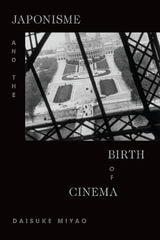
Japonisme and the Birth of Cinema
Daisuke Miyao
Duke University Press, 2020
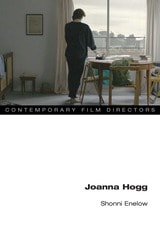
Joanna Hogg
Shonni Enelow
University of Illinois Press, 2024
Films like The Eternal Daughter and the diptych The Souvenir and The Souvenir Part II have cemented Joanna Hogg’s reputation as an original voice in contemporary cinema. Her rigorous and quiet style draws on the histories of film and art to tell stories that weave autobiography with studies in human opacity.
Shonni Enelow analyzes Hogg’s six feature films around the concepts of turning away, the reality effect, and the impossible encounter. Throughout, Enelow explores the tension between absorption, in which characters are immersed in a diegetic fiction, and self-reflexivity, as the filmmaker comments on her techniques of representation. An in-depth interview with Hogg delves into the director’s process, approach to creating character, and use of artistic and literary references.
Sophisticated and innovative, Joanna Hogg illuminates the work of one of today’s most original filmmakers.
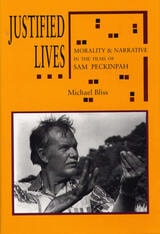
Justified Lives
Morality and Narrative in the Films of Sam PeckinpahMichael Bliss
Southern Illinois University Press, 1993
In the first book to critically examine each of the fourteen feature films Sam Peckinpah directed during his career, Michael Bliss stresses the persistent moral and structural elements that permeate Peckinpah’s work.
By examining the films in great detail, Bliss makes clear the moral framework of temptation and redemption with which Peckinpah was concerned while revealing the director’s attention to narrative. Bliss shows that each of Peckinpah’s protagonists is involved with attempting, in the words of Ridethe High Country’s Steve Judd, "to enter my house justified."
The validity of this systematic method is clearly demonstrated in the chapter devoted to The Wild Bunch. Byenumerating the doublings and triplings of action and dialogue found in the film, Bliss underscores its symbolic and structural complexity. Beginning the chapters treating Junior Bonner and The Getaway with analyses of their important title sequences, Bliss shows how these frequently disregarded pieces present in miniature the major moral and narrative concerns of the films. In his chapter on The Osterman Weekend, Bliss makes apparent Peckinpahs awareness of and concern with the self-reflexive nature of filmmaking itself.
Bliss shows that like John Ford, Peckinpah moved from optimism to pessimism. The films of the director’s early period, from The Deadly Companions to Cable Hogue, support the romantic ideals of adventure and camaraderie and affirm a potential for goodness in America. In his second group of films, which begins with Straw Dogs and ends with Bring Me the Head of Alfredo Garcia, both heroes and hope have vanished. It is only in The Osterman Weekend that Peckinpah appears finally to have renewed his capacity for hope, allowing his career to close in a positive way.