Results by title
405 books match the query 'Natural history' and 4 start with j
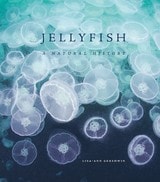
Jellyfish
A Natural HistoryLisa-ann Gershwin
University of Chicago Press, 2016
Jellyfish presents these aquarium favorites in all their extraordinary and captivating beauty. Fifty unique species, from stalked jellyfish to black sea nettles, are presented in stunning color photographs along with the most current scientific information on their anatomy, history, distribution, position in the water, and environmental status. Foremost jellyfish expert Lisa-ann Gershwin provides an insightful look at the natural history and biology of each of these spellbinding creatures, while offering a timely take on their place in the rapidly changing and deteriorating condition of the oceans. Readers will learn about immortal jellyfish who live and die and live again as well as those who camouflage themselves amid sea grasses and shells, hiding in plain sight.
Approachably written and based in the latest science and ecology, this colorful book provides an authoritative guide to these ethereal marine wonders.
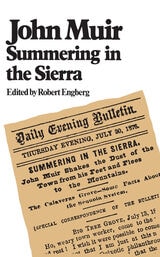
John Muir Sierra
Robert E. Engberg
University of Wisconsin Press, 1984
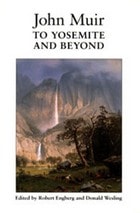
John Muir To Yosemite And Beyond
Robert Engberg
University of Utah Press, 1999
When John Muir died in 1914, the pre-eminent American naturalist, explorer, and conservationist had not yet written the second volume of his autobiography, in which he planned to cover his Yosemite years. Editors Robert Engberg and Donald Wesling have here provided a remedy.
Their account begins in 1863, the year Muir left the University of Wisconsin for what he termed the "University of the Wilderness." Following an accident in 1867 that nearly left him blind, he vowed to turn from machines and continue to study nature. That led, in 1868, to his first visit to Yosemite Valley, where he began his glacier studies. Muir spent much time exploring the Yosemite region, Tuolumne, and both the southern and northern Sierras, publishing articles, and keeping extensive journals through 1875, when he began to write for the San Francisco Bulletin and expanded his travels to areas throughout the west.
Mining a rich vein of sources—Muir’s letters, journals, articles, and unpublished manuscripts, as well as selections drawn from biographical pieces written about Muir by people who met him in Yosemite in the early 1870s—Engberg and Wesling have assembled what they term a "composite autobiography," providing brief interpretive and transitional passages throughout the book. This work is especially valuable because it documents Muir’s formative years, when he is maturing away from "conventional cultural paradigms of work and materialism toward new ways of thinking about nature and its impact on human development."
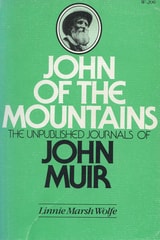
John of the Mountains
The Unpublished Journals of John MuirEdited by Linnie Marsh Wolfe
University of Wisconsin Press, 1979
The sixty extant journals and numerous notes in this volume were written from 1867 to 1911. They start seven years after the time covered in The Story of My Boyhood and Youth, Muir’s uncompleted autobiography. The earlier journals capture the essence of the Sierra Nevada and Alaska landscapes. The changing appearance of the Sierras from Sequoia north and beyond the Yosemites enthralled Muir, and the first four years of the journals reveal his dominating concern with glacial action. The later notebooks reflect his changes over the years, showing a mellowing of spirit and a deep concern for human rights.
Like all his writings, the journals concentrate on his observations in the wilderness. His devotion to his family, his many warm friendships, and his many-sided public life are hardly mentioned. Very little is said about the quarter-century battle for national parks and forest reserves. The notebooks record, in language fuller and freer than his more formal writings, the depth of his love and transcendental feeling for the wilderness. The rich heritage of his native Scotland and the unconscious music of the poetry of Burns, Milton, and the King James Bible permeate the language of his poetic fancy.
In his later life, Muir attempted to sort out these journals and, at the request of friends, published a few extracts. A year after his death in 1914, his literary executor and biographer, William Frederick Badè, also published episodes from the journals. Linnie Marsh Wolfe set out to salvage the best of his writings still left unpublished in 1938 and has thus added to our understanding of the life and thought of a complex and fascinating American figure.