Results by title
62 books match the query 'Naturalists' and 7 start with j
James Oliver Curwood
God's Country and the ManJudith A. Eldridge
University of Wisconsin Press, 1993
When the wounded bear he faced on a mountain ledge that day turned aside, James Curwood felt that he had been spared. From this encounter he became an avid conservationist. He wrote relentlessly—magazine stories and books and then for the new medium of motion pictures. Like many authors of his time, he was actively involved in movie-making until the plight of the forests and wildlife in his home state of Michigan turned his energies toward conservation.
A man ahead of his time, and quickly forgotten after his death in 1927, his gift of himself to his readers and to nature has finally come to be appreciated again two generations later.
John Muir Sierra
Robert E. Engberg
University of Wisconsin Press, 1984
John Muir To Yosemite And Beyond
Robert Engberg
University of Utah Press, 1999
When John Muir died in 1914, the pre-eminent American naturalist, explorer, and conservationist had not yet written the second volume of his autobiography, in which he planned to cover his Yosemite years. Editors Robert Engberg and Donald Wesling have here provided a remedy.
Their account begins in 1863, the year Muir left the University of Wisconsin for what he termed the "University of the Wilderness." Following an accident in 1867 that nearly left him blind, he vowed to turn from machines and continue to study nature. That led, in 1868, to his first visit to Yosemite Valley, where he began his glacier studies. Muir spent much time exploring the Yosemite region, Tuolumne, and both the southern and northern Sierras, publishing articles, and keeping extensive journals through 1875, when he began to write for the San Francisco Bulletin and expanded his travels to areas throughout the west.
Mining a rich vein of sources—Muir’s letters, journals, articles, and unpublished manuscripts, as well as selections drawn from biographical pieces written about Muir by people who met him in Yosemite in the early 1870s—Engberg and Wesling have assembled what they term a "composite autobiography," providing brief interpretive and transitional passages throughout the book. This work is especially valuable because it documents Muir’s formative years, when he is maturing away from "conventional cultural paradigms of work and materialism toward new ways of thinking about nature and its impact on human development."
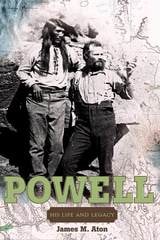
John Wesley Powell
His Life and LegacyJames M Aton
University of Utah Press, 2010
“John Wesley Powell: explorer, writer, geologist, anthropologist, land planner, bureaucrat. Which one do we focus on?” This is the question author James M. Aton poses at the beginning of his biography of Powell, though he soon decides that it is impossible to ignore any facet of Powell’s life. Powell was a polymath, one whose “divergent interests resemble one of those braided streambeds in his beloved canyon country, branching out in many directions, but ultimately beginning and ending in the same stream."
Aton beautifully tells the multidimensional stories of Powell’s childhood, his military and teaching careers, his famous and exciting explorations of the Colorado River, and the battles he waged from his influential positions within the Smithsonian’s Bureau of Ethnology and the United States Geological Survey. This new edition of John Wesley Powell: His Life and Legacy, first printed as an issue of the Boise State University Western Writers Series, includes the original biography, but also features Aton’s new interpretations of Powell’s writings on exploration, land-planning, anthropology, and irrigation, and incorporates the author’s distinguished faculty lecture on Powell and cash-register dams in the Colorado River Basin.

John Xántus
The Fort Tejon Letters, 1857–1859Ann Zwinger
University of Arizona Press, 1986
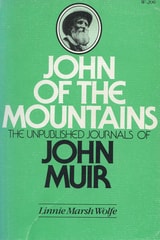
John of the Mountains
The Unpublished Journals of John MuirEdited by Linnie Marsh Wolfe
University of Wisconsin Press, 1979
The sixty extant journals and numerous notes in this volume were written from 1867 to 1911. They start seven years after the time covered in The Story of My Boyhood and Youth, Muir’s uncompleted autobiography. The earlier journals capture the essence of the Sierra Nevada and Alaska landscapes. The changing appearance of the Sierras from Sequoia north and beyond the Yosemites enthralled Muir, and the first four years of the journals reveal his dominating concern with glacial action. The later notebooks reflect his changes over the years, showing a mellowing of spirit and a deep concern for human rights.
Like all his writings, the journals concentrate on his observations in the wilderness. His devotion to his family, his many warm friendships, and his many-sided public life are hardly mentioned. Very little is said about the quarter-century battle for national parks and forest reserves. The notebooks record, in language fuller and freer than his more formal writings, the depth of his love and transcendental feeling for the wilderness. The rich heritage of his native Scotland and the unconscious music of the poetry of Burns, Milton, and the King James Bible permeate the language of his poetic fancy.
In his later life, Muir attempted to sort out these journals and, at the request of friends, published a few extracts. A year after his death in 1914, his literary executor and biographer, William Frederick Badè, also published episodes from the journals. Linnie Marsh Wolfe set out to salvage the best of his writings still left unpublished in 1938 and has thus added to our understanding of the life and thought of a complex and fascinating American figure.
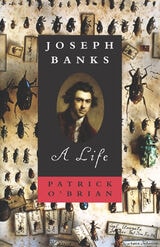
Joseph Banks
A LifePatrick O'Brian
University of Chicago Press, 1997
"It is in his description of that arduous three-year voyage [on the ship Endeavor] that Mr. O'Brian is at his most brilliant. . . . He makes us understand what life within this wooden world was like, with its 94 male souls, two dogs, a cat and a goat."—Linda Colley, New York Times
"An absorbing, finely written overview, meant for the general reader, of a major figure in the history of natural science."—Frank Stewart, Los Angeles Times
"[This book is] the definitive biography of an extraordinary subject."—Robert Taylor, Boston Globe
"His skill at narrative and his extensive knowledge of the maritime history . . . give him a definite leg up in telling this . . . story."—Tom Clark, San Francisco Chronicle