Results by title
2817 books match the query 'Nature' and 15 start with j

Jack London and the Sea
Anita Duneer
University of Alabama Press, 2022
The first book-length study of London as a maritime writer
Jack London’s fiction has been studied previously for its thematic connections to the ocean, but Jack London and the Sea marks the first time that his life as a writer has been considered extensively in relationship to his own sailing history and interests. In this new study, Anita Duneer claims a central place for London in the maritime literary tradition, arguing that for him romance and nostalgia for the Age of Sail work with and against the portrayal of a gritty social realism associated with American naturalism in urban or rural settings. The sea provides a dynamic setting for London’s navigation of romance, naturalism, and realism to interrogate key social and philosophical dilemmas of modernity: race, class, and gender. Furthermore, the maritime tradition spills over into texts that are not set at sea.
Jack London and the Sea does not address all of London’s sea stories, but rather identifies key maritime motifs that influenced his creative process. Duneer’s critical methodology employs techniques of literary and cultural analysis, drawing on extensive archival research from a wealth of previously unpublished biographical materials and other sources. Duneer explores London’s immersion in the lore and literature of the sea, revealing the extent to which his writing is informed by travel narratives, sensational sea yarns, and the history of exploration, as well as firsthand experiences as a sailor in the San Francisco Bay and Pacific Ocean.
Organized thematically, chapters address topics that interested London: labor abuses on “Hell-ships” and copra plantations, predatory and survival cannibalism, strong seafaring women, and environmental issues and property rights from San Francisco oyster beds to pearl diving in the Paumotos. Through its examination of the intersections of race, class, and gender in London’s writing, Jack London and the Sea plumbs the often-troubled waters of his representations of the racial Other and positions of capitalist and colonial privilege. We can see the manifestation of these socioeconomic hierarchies in London’s depiction of imperialist exploitation of labor and the environment, inequities that continue to reverberate in our current age of global capitalism.
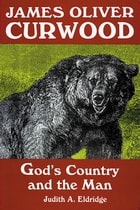
James Oliver Curwood
God's Country and the ManJudith A. Eldridge
University of Wisconsin Press, 1993
When the wounded bear he faced on a mountain ledge that day turned aside, James Curwood felt that he had been spared. From this encounter he became an avid conservationist. He wrote relentlessly—magazine stories and books and then for the new medium of motion pictures. Like many authors of his time, he was actively involved in movie-making until the plight of the forests and wildlife in his home state of Michigan turned his energies toward conservation.
A man ahead of his time, and quickly forgotten after his death in 1927, his gift of himself to his readers and to nature has finally come to be appreciated again two generations later.
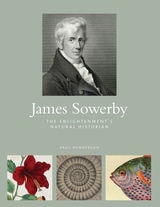
James Sowerby
The Enlightenment's Natural HistorianPaul Henderson
Royal Botanic Gardens, Kew, 2015
Henderson explores Sowerby’s artistic achievements as well as his place at the center of a thriving network of artists and scientists. Sowerby worked closely with key botanists of the time, influencing the likes of Sir Joseph Banks and James Smith, as well as Dawson Turner, James Dickson, Aylmer Lambert, and William Woodville. He also contributed illustrations to the earliest volumes of The Botanical Magazine (later known as Curtis's Botanical Magazine). Specimens from his collection round out the holdings of museums around the world, and he has become the paterfamilias of a talented line of botanical and natural science illustrators.
Henderson’s Sowerby’s Botany is beautifully illustrated with Sowerby’s artwork and includes extracts from letters, manuscripts, and natural history publications. It is a fascinating story of an influential artist working at the intersections of art and nature at a time of unprecedented scientific enlightenment.
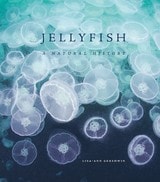
Jellyfish
A Natural HistoryLisa-ann Gershwin
University of Chicago Press, 2016
Jellyfish presents these aquarium favorites in all their extraordinary and captivating beauty. Fifty unique species, from stalked jellyfish to black sea nettles, are presented in stunning color photographs along with the most current scientific information on their anatomy, history, distribution, position in the water, and environmental status. Foremost jellyfish expert Lisa-ann Gershwin provides an insightful look at the natural history and biology of each of these spellbinding creatures, while offering a timely take on their place in the rapidly changing and deteriorating condition of the oceans. Readers will learn about immortal jellyfish who live and die and live again as well as those who camouflage themselves amid sea grasses and shells, hiding in plain sight.
Approachably written and based in the latest science and ecology, this colorful book provides an authoritative guide to these ethereal marine wonders.
Jens Jensen
Nature’s ArtistWilliam H. Tishler
University of Illinois Press, 2026
Revealing and expert, Jens Jensen illuminates the processes, challenges, and passion that shaped a visionary’s work and world.
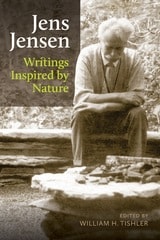
Jens Jensen
Writings Inspired by NatureWilliam H. Tishler
Wisconsin Historical Society Press, 2012
Today, Jensen is perhaps best remembered for establishing The Clearing on Wisconsin's Door County Peninsula. But the outspoken views in his writings - many of which were included in ephemeral planning reports, early newspapers, and now out-of-print journals - are virtually forgotten, with the exception of his two small books. "Jens Jensen: Writings Inspired by Nature" is an anthology of Jensen's most significant yet lesser-known articles, including a "Saturday Evening Post" piece that enabled him to reach the largest audience of his publishing career. The scope of Jensen's thoughts represented in this collection will further solidify his legacy and rightful place alongside conservation leaders such as John Muir and Aldo Leopold.
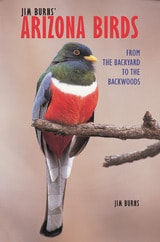
Jim Burns' Arizona Birds
From the Backyard to the BackwoodsJim Burns
University of Arizona Press, 2008
Veteran birders will appreciate Burns’ unique incorporation of natural history and other details beyond the usual taxonomic data, and will enjoy reminders of their own triumphs and heartbreaks in his colorful personal accounts of vehicular breakdowns, photographic faux pas, and egregious identification errors in the field. Illustrated in full color by seventy-five of the author’s own outstanding photographs, this book also features a five-level rating system, beginning with birds you can see in your own backyard and ending with those requiring either pure dumb luck or years of study and perseverance to spot. But whether you have spent years in search of the Flammulated Owl or are just curious about the wildlife in your desert backyard, this book will have you laughing, learning, and reaching for the binoculars in hopes of creating your own encounters with Arizona’s incredible bird species.
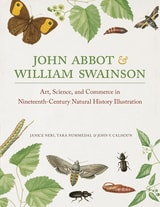
John Abbot and William Swainson
Art, Science, and Commerce in Nineteenth-Century Natural History IllustrationJanice Neri, Tara Nummedal, and John V. Calhoun
University of Alabama Press, 2019
During his lifetime (1751–ca. 1840), English-born naturalist and artist John Abbot rendered more than 4,000 natural history illustrations and profoundly influenced North American entomology, as he documented many species in the New World long before they were scientifically described. For sixty-five years, Abbot worked in Georgia to advance knowledge of the flora and fauna of the American South by sending superbly mounted specimens and exquisitely detailed illustrations of insects, birds, butterflies, and moths, on commission, to collectors and scientists all over the world.
Between 1816 and 1818, Abbot completed 104 drawings of insects on their native plants for English naturalist and patron William Swainson (1789–1855). Both Abbot and Swainson were artists, naturalists, and collectors during a time when natural history and the sciences flourished. Separated by nearly forty years in age, Abbot and Swainson were members of the same international communities and correspondence networks upon which the study of nature was based during this period.
The relationship between these two men—who never met in person—is explored in John Abbot and William Swainson: Art, Science, and Commerce in Nineteenth-Century Natural History Illustration. This volume also showcases, for the first time, the complete set of original, full-color illustrations discovered in 1977 in the Alexander Turnbull Library in Wellington, New Zealand. Originally intended as a companion to an earlier survey of insects from Georgia, the newly rediscovered Turnbull manuscript presents beetles, grasshoppers, butterflies, moths, and a wasp. Most of the insects are pictured with the flowering plants upon which Abbot thought them to feed. Abbot’s journal annotations about the habits and biology of each species are also included, as are nomenclature updates for the insect taxa.
Today, the Turnbull drawings illuminate the complex array of personal and professional concerns that informed the field of natural history in the eighteenth and nineteenth centuries. These illustrations are also treasured artifacts from times past, their far-flung travels revealing a world being reshaped by the forces of global commerce and information exchange even then. The shared project of John Abbot and William Swainson is now brought to completion, signaling the beginning of a new phase of its significance for modern readers and scholars.
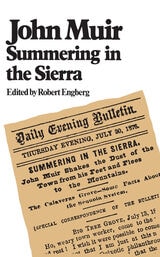
John Muir Sierra
Robert E. Engberg
University of Wisconsin Press, 1984
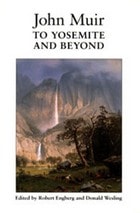
John Muir To Yosemite And Beyond
Robert Engberg
University of Utah Press, 1999
When John Muir died in 1914, the pre-eminent American naturalist, explorer, and conservationist had not yet written the second volume of his autobiography, in which he planned to cover his Yosemite years. Editors Robert Engberg and Donald Wesling have here provided a remedy.
Their account begins in 1863, the year Muir left the University of Wisconsin for what he termed the "University of the Wilderness." Following an accident in 1867 that nearly left him blind, he vowed to turn from machines and continue to study nature. That led, in 1868, to his first visit to Yosemite Valley, where he began his glacier studies. Muir spent much time exploring the Yosemite region, Tuolumne, and both the southern and northern Sierras, publishing articles, and keeping extensive journals through 1875, when he began to write for the San Francisco Bulletin and expanded his travels to areas throughout the west.
Mining a rich vein of sources—Muir’s letters, journals, articles, and unpublished manuscripts, as well as selections drawn from biographical pieces written about Muir by people who met him in Yosemite in the early 1870s—Engberg and Wesling have assembled what they term a "composite autobiography," providing brief interpretive and transitional passages throughout the book. This work is especially valuable because it documents Muir’s formative years, when he is maturing away from "conventional cultural paradigms of work and materialism toward new ways of thinking about nature and its impact on human development."
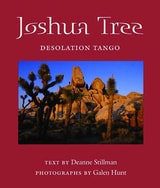
Joshua Tree
Desolation TangoText by Deanne Stillman; Photographs by Galen Hunt
University of Arizona Press, 2006
Additional Information and Publicity
Electric Politics Review
World Hum Excerpt
Arroyo Monthly
San Bernardino Sun Christmas Pick
Los Angeles Times Profile
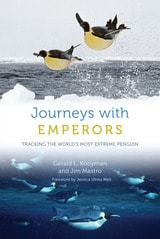
Journeys with Emperors
Tracking the World's Most Extreme PenguinGerald L. Kooyman and Jim Mastro
University of Chicago Press, 2023
The primary mission was to record the birds’ activities at sea, and the data revealed important aspects of emperor penguin behavior and physiology: for instance, that in the course of hunting for food, some of the penguins dive to depths of greater than five hundred meters (a third of a mile, which is deeper than for any other diving bird). The researchers also discovered that, crucially, most of the emperor’s life is actually spent at sea, with fledged chicks and adults making separate, perilous journeys through icy water. When chick nurturing is complete, the fledglings abandon the colony in large groups, heading north to the Southern Ocean. The adults leave at the same time, traveling one thousand kilometers eastward across the Ross Sea to a sea-ice sanctuary for molting. During this journey, they must gain enough weight to survive the month-long molt, when every feather is replaced and the birds cannot enter the water to feed. After the molt, many if not most return to the colony to breed once again. For the males, this means another fast—this time for 120 days as they incubate their eggs. The nearness of the colony to the ice edge spared the penguins the long, energy-draining march for which other colonies are well-known. It also allowed researchers to observe the penguins’ departures to and arrivals from their foraging journeys, as well as their dangerous interactions with leopard seals and killer whales.
Featuring original color photographs and complemented with online videos, Journeys with Emperors is both an eye-opening overview of the emperor penguin’s life and a thrilling tale of scientific discovery in one of the most remote, harsh, and beautiful places on Earth.
Joy (Or Something Darker, but Like It)
poetry & parentingNathaniel Perry
University of Michigan Press, 2024
Each of the twelve essays considers a different poet—Edward Thomas, Henry W. Longfellow, George Scarbrough, Elizabeth Bishop, Geoffrey Hill, Primus St. John, Robert Hayden, Elizabeth Coatsworth, Gwendolyn Brooks, Robert Frost, E.A. Robinson, and Belle Randall—and, alongside them, different concerns of parenting and living. Organized in chronological order, they track the growth of Nathaniel Perry’s own children who pop up from time to time in a believable way. Essays consider the idea of devotion and belief, the idea of imperfection, the small details we can focus on as parents, and the conceptions of the world we pass along to our children. Together these essays not only represent the author's personal canon of poets who have been important to him in his life and work, but also present a diverse slice of American poetry, in voice, form, identity, origin, and time period.
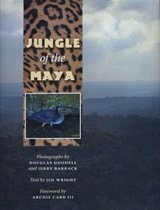
Jungle of the Maya
Photographs by Douglas Goodell and Jerry Barrack, Text by Jim Wright
University of Texas Press, 2006
The Selva Maya (Jungle of the Maya) is one of the world's most magical yet least appreciated places—an enormous tropical forest that encompasses much of Belize, Guatemala, and Mexico's Yucatan Peninsula. At 9,000,000 acres, it is the largest contiguous tropical forest north of the Amazon in the Western Hemisphere. Within its borders, the Selva Maya provides habitat for an astonishing diversity of plants and animals—more than 500 species of birds alone. The forest also contains the fascinating ruins of ancient Maya cities, which attract visitors and researchers from all over the globe.
Jungle of the Maya presents a stunning photographic portrait of this irreplaceable natural treasure. Nature photographers Douglas Goodell and Jerry Barrack capture the living wonders of the jungle—jaguars and other cats; spider and howler monkeys; hummingbirds and butterflies; and snakes, amphibians, and insects—as well as the region's hallmark Maya sites, including Tikal, Chichen Itza, Uxmal, and Tulum. Environmental writer Jim Wright invitingly describes the Selva Maya's natural and human history, helping visitors and residents appreciate the riches to be found in the forest and the need to protect and preserve them for generations to come.
Because human activities are encroaching more and more on the Mayan forest, Jungle of the Maya is a beautiful book with a timely message. As renowned naturalist Archie Carr III sums it up in his foreword, "Today, the Selva Maya is at risk again. As modern beings, can we manage the forest better than we believe the ancient Maya did? We should. We have the archaeological record to draw from. We have modern science. And we still have inspiration whispered to us by spirits in the great plazas of Tikal and beyond. Turn the pages, and witness."
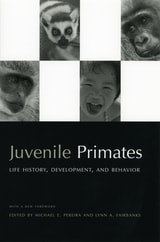
Juvenile Primates
Life History, Development and Behavior, with a new ForewordEdited by Michael E. Pereira and Lynn A. Fairbanks
University of Chicago Press, 2003
Contributors:
Filippo Aureli, Bernard Chapais, Marina Cords, Carolyn M. Crockett, Frans B. M. de Waal, Carolyn Pope Edwards, Robert Fagen, Carole Gauthier, Paul H. Harvey, Charlotte K. Hemelrijk, Loek A. M. Herremans, Julia A. Horrocks, Wayne Hunte, Charles H. Janson, Nicholas Blurton Jones, Katharine Milton, Leanne T. Nash, Timothy G. O'Brien, Mark D. Pagel, Theresa R. Pope, Anne E. Pusey, Lal Singh Rajpurohit, John G. Robinson, Thelma Rowell, Daniel I. Rubenstein, Volker Sommer, Elisabeth H. M. Sterck, Karen B. Strier, Carel P. van Schaik, Maria A. van Noordwijk, David P. Watts, and Carol M. Worthman.