Results by title
1148 books match the query 'Political Ideologies' and 16 start with j
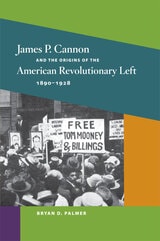
James P. Cannon and the Origins of the American Revolutionary Left, 1890-1928
Bryan D. Palmer
University of Illinois Press, 2010
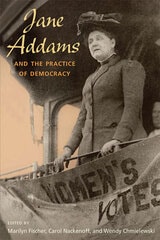
Jane Addams and the Practice of Democracy
Edited by Marilyn Fischer, Carol Nackenoff, and Wendy Chmielewski
University of Illinois Press, 2008
Using a rich array of newly available sources and contemporary methodologies from many disciplines, the ten original essays in this volume give a fresh appraisal of Addams as a theorist and practitioner of democracy. In an increasingly interdependent world, Addams's life work offers resources for activists, scholars, policy makers, and theorists alike. This volume demonstrates how scholars continue to interpret Addams as a model for transcending disciplinary boundaries, generating theory out of concrete experience, and keeping theory and practice in close and fruitful dialogue.
Contributors are Harriet Hyman Alonso, Victoria Bissell Brown, Wendy Chmielewski, Marilyn Fischer, Shannon Jackson, Louise W. Knight, Carol Nackenoff, Karen Pastorello, Wendy Sarvasay, Charlene Haddock Seigfried, and Camilla Stivers.

Japan's Holy War
The Ideology of Radical Shinto UltranationalismWalter A. Skya
Duke University Press, 2009
Skya documents a transformation in the ideology of State Shintō in the late nineteenth century and the early twentieth. He shows that within the religion, support for the German-inspired theory of constitutional monarchy that had underpinned the Meiji Constitution gave way to a theory of absolute monarchy advocated by the constitutional scholar Hozumi Yatsuka in the late 1890s. That, in turn, was superseded by a totalitarian ideology centered on the emperor: an ideology advanced by the political theorists Uesugi Shinkichi and Kakehi Katsuhiko in the 1910s and 1920s. Examining the connections between various forms of Shintō nationalism and the state, Skya demonstrates that where the Meiji oligarchs had constructed a quasi-religious, quasi-secular state, Hozumi Yatsuka desired a traditional theocratic state. Uesugi Shinkichi and Kakehi Katsuhiko went further, encouraging radical, militant forms of extreme religious nationalism. Skya suggests that the creeping democracy and secularization of Japan’s political order in the early twentieth century were the principal causes of the terrorism of the 1930s, which ultimately led to a holy war against Western civilization.

Jean Paul Marat
Tribune of the French RevolutionClifford D. Conner
Pluto Press, 2012
Jean-Paul Marat’s role in the French Revolution has long been a matter of controversy among historians. Often he has been portrayed as a violent, sociopathic demagogue. This biography challenges that interpretation and argues that without Marat’s contributions as an agitator, tactician, and strategist, the pivotal social transformation that the Revolution accomplished might well not have occurred.
Clifford D. Conner argues that what was unique about Marat - which set him apart from all other major figures of the Revolution, including Danton and Robespierre - was his total identification with the struggle of the propertyless classes for social equality.
This is an essential book for anyone interested in the history of the revolutionary period and the personalities that led it.
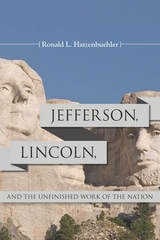
Jefferson, Lincoln, and the Unfinished Work of the Nation
Ronald L. Hatzenbuehler
Southern Illinois University Press, 2016
In this groundbreaking new study—the first extended examination of the ideas of Lincoln and Jefferson—Hatzenbuehler provides readers with a succinct guide to their opinions, comparing and contrasting their reasoned judgments on America’s republican form of government. Each chapter is devoted to one key area of common interest: race and slavery, the pros and cons of political parties, state rights versus federal authority, religion and the presidency, presidential powers under the Constitution, or the proper political economy for a republic. Relying on the pair’s own words in their letters, writings, and speeches, Hatzenbuehler explores similarities and differences between the two men on contentious issues. Both, for instance, wrote that they were antislavery, but Jefferson never acted on this belief, while Lincoln moved toward a constitutional amendment banning slavery. The book’s title, taken from the Gettysburg Address, builds on both presidents’ expectations that Americans should dedicate themselves to the unfinished work of returning the nation to its founding principles.
Jefferson and Lincoln wrestled with many of the same issues and ideas that intrigue and divide Americans today. In his thought-provoking work, Hatzenbuehler details how the two presidents addressed these issues and ideas, which are essential to understanding not only America’s history but also the continuing influence of the past on the present.
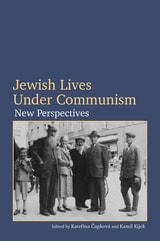
Jewish Lives under Communism
New PerspectivesKaterina Capková
Rutgers University Press, 2022
Jews and Diaspora Nationalism
Writings on Jewish Peoplehood in Europe and the United StatesEdited by Simon Rabinovitch
Brandeis University Press, 2012
Jews and the Italian Left
Socialism, Zionism, and Antisemitism from 1892 to 1992Alessandra Tarquini, Translated by Max Matukhin
University of Wisconsin Press, 2026
Tarquini’s research fills an important lacuna by analyzing the antisemitism of twentieth-century socialist movements. Crucially, however, Tarquini makes important distinctions between antisemitism on the Italian left and right, and identifies the relationship between leftism and antisemitism as a distinct formation.

Jews, Turks, and Other Strangers
Roots of Prejudice in Modern GermanyJerome S. Legge, Jr.
University of Wisconsin Press, 2003
Scholarly, objective, insightful, and analytical, Jews, Turks, and Other Strangers studies the causes of prejudice against Jews, foreign workers, refugees, and emigrant Germans in contemporary Germany. Using survey material and quantitative analyses, Legge convincingly challenges the notion that German xenophobia is rooted in economic causes. Instead, he sees a more complex foundation for German prejudice, particularly in a reunified Germany where perceptions of the "other" sometimes vary widely between east and west, a product of a traditional racism rooted in the German past. By clarifying the foundations of xenophobia in a new German state, Legge offers a clear and disturbing picture of a conflicted country and a prejudice that not only affects Jews but also fuels a larger, anti-foreign sentiment.
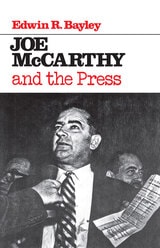
Joe McCarthy and the Press
Edwin R. Bayley
University of Wisconsin Press, 2003

Johann Most
Life of a RadicalTom Goyens
University of Illinois Press, 2025

Journal of Practical Ethics, Vol. 11, No. 1
Liz Sanders
Michigan Publishing Services, 2023
Judging Inequality
State Supreme Courts and the Inequality CrisisJames L. Gibson
Russell Sage Foundation, 2021
Drawing on an analysis of an original database of nearly 6,000 decisions made by over 900 judges on 50 state supreme courts over a quarter century, Judging Inequality documents two ways that state high courts have crafted policies relevant to inequality: through substantive policy decisions that fail to advance equality and by rulings favoring more privileged litigants (typically known as “upperdogs”). The authors discover that whether court-sanctioned policies lead to greater or lesser inequality depends on the ideologies of the justices serving on these high benches, the policy preferences of their constituents (the people of their state), and the institutional structures that determine who becomes a judge as well as who decides whether those individuals remain in office.
Gibson and Nelson decisively reject the conventional theory that state supreme courts tend to protect underdog litigants from the wrath of majorities. Instead, the authors demonstrate that the ideological compositions of state supreme courts most often mirror the dominant political coalition in their state at a given point in time. As a result, state supreme courts are unlikely to stand as an independent force against the rise of inequality in the United States, instead making decisions compatible with the preferences of political elites already in power. At least at the state high court level, the myth of judicial independence truly is a myth.
Judging Inequality offers a comprehensive examination of the powerful role that state supreme courts play in shaping public policies pertinent to inequality. This volume is a landmark contribution to scholarly work on the intersection of American jurisprudence and inequality, one that essentially rewrites the “conventional wisdom” on the role of courts in America’s democracy.

Jungle Heart of the Khmer Rouge
The memoirs of Phi Phuon, Pol Pot’s Jarai aide-de-camp, and the role of Ratanakiri and its tribal minorities in the Cambodian revolutionHenri Locard
National University of Singapore Press, 2023
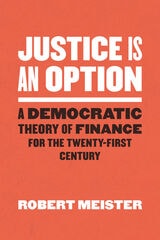
Justice Is an Option
A Democratic Theory of Finance for the Twenty-First CenturyRobert Meister
University of Chicago Press, 2021
Justice Is an Option uses those problems—and the framework of finance that created them—to reimagine historical justice. Robert Meister returns to the spirit of Marx to diagnose our current age of finance. Instead of closing our eyes to the political and economic realities of our era, we need to grapple with them head-on. Meister does just that, asking whether the very tools of finance that have created our vastly unequal world could instead be made to serve justice and equality. Meister here formulates nothing less than a democratic financial theory for the twenty-first century—one that is equally conversant in political philosophy, Marxism, and contemporary politics. Justice Is an Option is a radical, invigorating first page of a new—and sorely needed—leftist playbook.
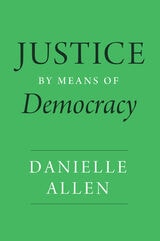
Justice by Means of Democracy
Danielle Allen
University of Chicago Press, 2023
“A sweeping vision.”—Ezra Klein, The New York Times • “An important book.”—Peter Coy, The New York Times • “Liberals and non-liberals alike should applaud its arrival.”—Max Foley-Keene, Commonweal • “A major work of political philosophy.”—Gregory Laski, Public Books • “Compelling. . . . Superb.”—Josiah Ober • “Without doubt one of the most important books ever written on democracy.”—Margeret Levi
From leading thinker Danielle Allen, a bold and urgent articulation of a new political philosophy: power-sharing liberalism.
At a time of great social and political turmoil, when many residents of the leading democracies question the ability of their governments to deal fairly and competently with serious public issues, and when power seems more and more to rest with the wealthy few, this book reconsiders the very foundations of democracy and justice. Scholar and writer Danielle Allen argues that the surest path to a just society in which all are given the support necessary to flourish is the protection of political equality; that justice is best achieved by means of democracy; and that the social ideals and organizational design principles that flow from recognizing political equality and democracy as fundamental to human well-being provide an alternative framework not only for justice but also for political economy. Allen identifies this paradigm-changing new framework as “power-sharing liberalism.”
Liberalism more broadly is the philosophical commitment to a government grounded in rights that both protect people in their private lives and empower them to help govern public life. Power-sharing liberalism offers an innovative reconstruction of liberalism based on the principle of full inclusion and non-domination—in which no group has a monopoly on power—in politics, economy, and society. By showing how we all might fully share power and responsibility across all three sectors, Allen advances a culture of civic engagement and empowerment, revealing the universal benefits of an effective government in which all participate on equal terms.