Results by title
1668 books match the query 'Popular culture' and 17 start with j

J. K. Rowling and the Anti-Trans Panic
Gina Gwenffrewi
The Ohio State University Press, 2026
In J. K. Rowling and the Anti-Trans Panic, Gina Gwenffrewi weaves her own experience as a trans woman living in Edinburgh, Scotland, with analysis of political and pop cultural discourses and artifacts to deliver a trenchant study of how fellow Edinburgh resident J. K. Rowling’s emergence as a major anti-trans campaigner and the years-long entrenchment of existing anti-trans forces have converged. Analyzing Rowling’s output since 2020, a series of anti-trans events at the University of Edinburgh, the transphobic comedy of Ricky Gervais within the British media landscape, YouTube commentaries, and more, Gwenffrewi creates a potent taxonomy of the rhetorical devices and foundational assumptions of anti-trans discourse. While the 2020s UK has proved fertile ground for “gender-critical” feminism, she argues, it has also provided the foundation for sites of resistance and for bolstering transgender voices worldwide. In celebrating trans activism and trans joy amid adversity, Gwenffrewi beautifully captures the light and dark of being out as trans in the city that—if it can fairly be called ground zero for anti-trans fervor—also embodies liberatory possibilities for trans people worldwide.
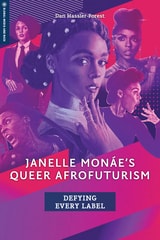
Janelle Monáe's Queer Afrofuturism
Defying Every LabelDan Hassler-Forest
Rutgers University Press, 2022
Janelle Monáe is all these things and more, making her one of the most fascinating artists to emerge in the twenty-first century. This provocative new study explores how Monáe’s work has connected different media platforms to strengthen and enhance new movements in art, theory, and politics. It considers not only Monáe’s groundbreaking albums The ArchAndroid, The Electric Lady, and Dirty Computer, but also Monáe’s work as an actress in such films as Hidden Figures and Antebellum, as well as her soundtrack appearances in socially-engaged projects ranging from I May Destroy You to Us. Examining Monáe as a cultural icon whose work is profoundly intersectional, this book maps how she is actively reshaping discourses around race, gender, sexuality, and capitalism. Tracing Monáe’s performances of joy, desire, pain, and hope across a wide range of media forms, it shows how she imagines Afrofuturist, posthumanist, and postcapitalist utopias, while remaining grounded in the realities of being a Black woman in a white-dominated industry. This is an exciting introduction to an audacious innovator whose work offers us fresh ways to talk about identity, desire, and power.

Japan After Japan
Social and Cultural Life from the Recessionary 1990s to the PresentTomiko Yoda and Harry Harootunian, eds.
Duke University Press, 2006
Several of the essayists reflect on the politics of history, considering changes in the relationship between Japan and the United States, the complex legacy of Japanese colonialism, Japan’s chronic unease with its wartime history, and the postwar consolidation of an ethnocentric and racist nationalism. Others analyze anxieties related to the role of children in society and the weakening of the gendered divide between workplace and home. Turning to popular culture, contributors scrutinize the avid consumption of “real events” in formats including police shows, quiz shows, and live Web camera feeds; the creation, distribution, and reception of Pokémon, the game-based franchise that became a worldwide cultural phenomenon; and the ways that the behavior of zealous fans of anime both reinforces and clashes with corporate interests. Focusing on contemporary social and political movements, one essay relates how a local citizens’ group pressed the Japanese government to turn an international exposition, the Aichi Expo 2005, into a more environmentally conscious project. Another essay offers both a survey of emerging political movements and a manifesto identifying new possibilities for radical politics in Japan. Together the contributors to Japan After Japan present much-needed insight into the wide-ranging transformations of Japanese society that began in the 1990s.
Contributors. Anne Allison, Andrea G. Arai, Eric Cazdyn, Leo Ching, Harry Harootunian, Marilyn Ivy, Sabu Kohso, J. Victor Koschmann, Thomas LaMarre, Masao Miyoshi, Yutaka Nagahara, Naoki Sakai, Tomiko Yoda, Yoshimi Shunya, Mitsuhiro Yoshimoto
Jazz Journeys to Japan
The Heart WithinWilliam Minor
University of Michigan Press, 2004
Part music history, part cultural meditation, part travel narrative, Jazz Journeys to Japan is the first book to address the experiences of individual players -- Japanese jazz greats such as Toshiko Akiyoshi, Masahiko Satoh, Makoto Ozone, and Yosuke Yamashita.
William Minor navigates the converging streams of Western music and Eastern tradition, revealing through interviews with musicians, critics, and producers the unique synthesis that results from this convergence. And, turning conventional wisdom on its ear, he disproves the widely held notion that Japanese jazz artists don't "swing." Along the way, we experience Minor's growing appreciation of Japanese culture, which mirrors his subjects' discovery of American jazz.
William Minor's previous books include Unzipped Souls: A Jazz Journey through the Soviet Union, and Monterey Jazz Festival: Forty Legendary Years. He has written for Downbeat, Jazz Times, Jazz Notes, Coda, and Swing Journal.
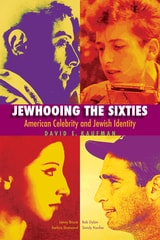
Jewhooing the Sixties
American Celebrity and Jewish Identity—Sandy Koufax, Lenny Bruce, Bob Dylan, and Barbra StreisandDavid E. Kaufman
Brandeis University Press, 2012
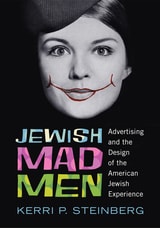
Jewish Mad Men
Advertising and the Design of the American Jewish ExperienceSteinberg, Kerri P
Rutgers University Press, 2015

Jewish in America
Sara Blair and Jonathan Freedman, Editors
University of Michigan Press, 2004
-From the Introduction
This rare and original work of cultural studies offers uncommon and engaging perspectives-as well as provocative and humorous insights-on what it means to be Jewish in America.
Jewish in America features poetry, art, essays, and stories from an impressive and respected list of contributors, including among others Stephen Greenblatt, Richard Kostelanetz, Jacqueline Osherow, Robert Pinsky, Sharon Pomerantz, Nancy Reisman, Grace Schulman, Louis Simpson, Alisa Solomon, and Stephen J. Whitfield.
In addition to pieces by some of the country's leading writers, the book features a stunning gallery of original photographs that transport the viewer from the crowded Coney Island beaches of the 1940s to the landscapes of Oaxaca, Mexico in the 1990s.
Jews in Nevada
A HistoryJohn P. Marschall
University of Nevada Press, 2011
Jews have always been one of Nevada’s most active and influential ethnic minorities. They were among the state’s earliest Euro-American settlers, and from the beginning they have been involved in every area of the state’s life as businessmen, agrarians, scholars, educators, artists, politicians, and civic, professional, and religious leaders. Jews in Nevada is an engaging, multilayered chronicle of their lives and contributions to the state. Here are absorbing accounts of individuals and families who helped to settle and develop the state, as well as thoughtful analyses of larger issues, such as the reasons Jews came to Nevada in the first place, how they created homes and interacted with non-Jews, and how they preserved their religious and cultural traditions as a small minority in a sparsely populated region.

Jews, Germans, Memory
Reconstructions of Jewish Life in GermanyY. Michal Bodemann, Editor
University of Michigan Press, 1996

John Dickson Carr
A Critical StudyS. T. Joshi
University of Wisconsin Press, 1990

John Williams's Film Music
<i>Jaws</i>, <i>Star Wars</i>, <i>Raiders of the Lost Ark</i>, and the Return of the Classical Hollywood Music StyleEmilio Audissino
University of Wisconsin Press, 2014
Combining accessible writing with thorough scholarship, and rigorous historical accounts with insightful readings, John Williams’s Film Music explores why Williams is so important to the history of film music. Beginning with an overview of music from Hollywood’s Golden Age (1933–58), Emilio Audissino traces the turning points of Williams’s career and articulates how he revived the classical Hollywood musical style. This book charts each landmark of this musical restoration, with special attention to the scores for Jaws and Star Wars, Williams’s work as conductor of the Boston Pops Orchestra, and a full film/music analysis of Raiders of the Lost Ark. The result is a precise, enlightening definition of Williams’s “neoclassicism” and a grounded demonstration of his lasting importance, for both his compositions and his historical role in restoring part of the Hollywood tradition.
Best Special Interest Books, selected by the American Association of School Librarians
Best Books for General Audiences, selected by the Public Library Reviewers
Johnny Cash International
How and Why Fans Love the Man in BlackMichael Hinds and Jonathan Silverman
University of Iowa Press, 2020
2023 Peggy O'Brien Book Prize, winner
Across all imaginable borders, Johnny Cash fans show the appeal of a thoroughly American performer who simultaneously inspires people worldwide. A young Norwegian shows off his Johnny Cash tattoo. A Canadian vlogger sings “I Walk the Line” to camel herders in Egypt’s White Desert. A shopkeeper in Northern Ireland plays Cash as his constant soundtrack. A Dutchwoman coordinates the activities of Cash fans worldwide and is subsequently offered the privilege of sleeping in Johnny’s bedroom. And on a more global scale, millions of people watch Cash’s videos online, then express themselves through commentary and debate.
In Johnny Cash International, Hinds and Silverman examine digital and real-world fan communities and the individuals who comprise them, profiling their relationships to Cash and each other. Studying Johnny Cash’s international fans and their love for the man reveals new insights about music, fandom, and the United States.

Joinings and Disjoinings
The Significance of Marital Status in LiteratureJoAnna Stephens Mink
University of Wisconsin Press, 1991
Joy to the World
The Performance of Collective PleasureGary Alan Fine
University of Chicago Press, 2026
A celebration and exploration of the idea of pleasure and the unique role it serves in bringing individuals and communities together.
There are innumerable ways to take pleasure in life: a bite of cake in the late afternoon, a walk in the warm springtime air after a long winter, a listen to the opening chords of your favorite song. But each of these pleasures is transformed by the presence of others. In Joy to the World, sociologist Gary Alan Fine takes up one of the major themes of his lifetime of work: pleasure. Fine gives us the conceptual basis for a sociology of pleasure: a joyous view of the world that, at times, inspires us, through expectations of interaction, shared cultures, and routine practices that make life worth living in community.
Fine focuses on the impact of group relations as the platform for satisfaction, emphasizing the power of communities of practice. While pleasures may be enjoyed alone, the pleasure that occurs in social spaces performs a unique function in our personal and social lives; they help us understand ourselves as individuals who are part of a group. What is pleasurably transgressive in one context might seem inappropriate, cruel, or just plain nonsensical in another, and these shades of difference serve to solidify the bonds of the group.
Joy to the World urges us to understand what draws us together as well as to appreciate what drives us apart. Our joys, as well as our challenges, help us to be a part of a caring, conscientious, committed community.
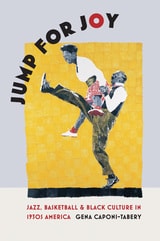
Jump for Joy
Jazz, Basketball, and Black Culture in 1930s AmericaGena Caponi-Tabery
University of Massachusetts Press, 2008
If the 1930s was the Swing Era, then the years from 1937 on might well be called the Jump Era. That summer Count Basie recorded “Jumping at the Woodside,” and suddenly jump tunes seemed to be everywhere. Along with the bouncy beat came a new dance step—the high-flying aerials of the jitterbuggers—and the basketball games that took place in the dance halls of African America became faster, higher, and flashier. Duke Ellington and a cast of hundreds put the buoyant spirit of the era on stage with their 1941 musical revue, Jump for Joy, a title that captured the momentum and direction of the new culture of exuberance.
Several high-profile public victories accompanied this increasing optimism: the spectacular successes of African American athletes at the 1936 Olympics, the 1937 union victory of the Brotherhood of Sleeping Car Porters, and Joe Louis's 1937 and 1938 heavyweight championship fights. For the first time in history, Black Americans emerged as cultural heroes and ambassadors, and many felt a new pride in citizenship.
In this book, Gena Caponi-Tabery chronicles these triumphs and shows how they shaped American music, sports, and dance of the 1930s and beyond. But she also shows how they emboldened ordinary African Americans to push for greater recognition and civil liberties—how cultural change preceded and catalyzed political action.
Tracing the path of one symbolic gesture—the jump—across cultural and disciplinary boundaries, Caponi-Tabery provides a unique political, intellectual, and artistic analysis of the years immediately preceding World War II.
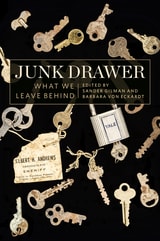
Junk Drawer
What We Leave BehindSander Gilman
University of Delaware Press, 2026
Junk Drawer: What We Leave Behind explores the personal objects that were once treasured by their owners yet were ultimately consigned to online “junk drawer” sales. Photographer and coeditor Barbara Von Eckardt acquired these random assortments from estate remnants on eBay and has documented their contents through evocative, sepia-toned images. In doing so, she has breathed new life into items that the world had deemed valueless, but that hint at the stories and identities of those who once owned them.
In addition to the photographs, Von Eckardt and coeditor Sander L. Gilman have gathered essays by scholars across disciplines, each offering a unique perspective on how such everyday objects can carry profound meaning. The result is a “junk drawer” of reflections, as varied and thought-provoking as the artifacts themselves. It is a moving testament to the emotional and cultural resonance of ordinary things—and an invitation to look more deeply at the objects surrounding us.
Just Like Us
Digital Debates on Feminism and FameCaitlin E. Lawson
Rutgers University Press, 2023