Results by title
83 books match the query 'Pragmatism' and 4 start with j
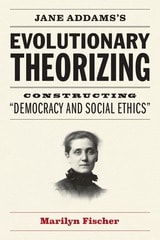
Jane Addams's Evolutionary Theorizing
Constructing “Democracy and Social Ethics”Marilyn Fischer
University of Chicago Press, 2019
Examining essays Addams wrote in the 1890s and showing how they were revised for Democracy and Social Ethics, Fischer draws from philosophy, history, literature, rhetoric, and more to uncover the array of social evolutionary thought Addams engaged with in her texts—from British socialist writings on the evolution of democracy to British and German anthropological accounts of the evolution of morality. By excavating Addams’s evolutionary reasoning and rhetorical strategies, Fischer reveals the depth, subtlety, and richness of Addams’s thought.

John Dewey and Continental Philosophy
Edited by Paul Fairfield
Southern Illinois University Press, 2010
“These essays build a valuable, if virtual, bridge between the thought of John Dewey and that of a host of modern European philosophers. They invite us to entertain a set of imagined conversations among the mighty dead that no doubt would have intrigued Dewey and each of the interlocutors gathered here.”—Robert Westbrook, author of John Dewey and American Democracy and/or Democratic Hope: Pragmatism and the Politics of Truth.
John Dewey and Continental Philosophy provides a rich sampling of exchanges that could have taken place long ago between the traditions of American pragmatism and continental philosophy had the lines of communication been more open between Dewey and his European contemporaries. Since they were not, Paul Fairfield and thirteen of his colleagues seek to remedy the situation by bringing the philosophy of Dewey into conversation with several currents in continental philosophical thought, from post-Kantian idealism and the work of Friedrich Nietzsche to twentieth-century phenomenology, hermeneutics, and poststructuralism.
John Dewey and Continental Philosophy demonstrates some of the many connections and opportunities for cross-traditional thinking that have long existed between Dewey and continental thought, but have been under-explored. The intersection presented here between Dewey’s pragmatism and the European traditions makes a significant contribution to continental and American philosophy and will spur new and important developments in the American philosophical debate.
John Dewey's Educational Philosophy in International Perspective
A New Democracy for the Twenty-First CenturyEdited by Larry A. Hickman and Giuseppe Spadafora
Southern Illinois University Press, 2009
John Dewey’s Educational Philosophy in International Perspective brings together eleven experts from around the globe to examine the international legacy of the famous philosopher. Placing special emphasis on Dewey’s theories of education, Larry A. Hickman and Giuseppe Spadafora have gathered some of the world’s most noted scholars of educational philosophy to present a thorough exploration of Dewey’s enduring relevance and potential as a tool for change in twenty-first-century political and social institutions.
This collection offers close examinations of the global impact of Dewey’s philosophies, both in his time and our own. Included are discussions of his reception as a much-respected yet criticized philosopher among European Catholics both before and after World War I; the utilization of his pragmatic theories in Italian education and the continuing quest to reinterpret them; his emergence as a source of inspiration to new democracies in Central and Eastern Europe; and his recently renewed popularity in the Hispanic world, particularly in South America and Spain. In addition, authors delve into Dewey’s notion of democracy as a personal way of life and his views on the important ties between education and the democratic state.
Also discussed are Dewey’s philosophies regarding school and society, including the understanding of educational trends as reflections of their social context; the contrast between his methods of applying intelligence to ethical problems and the theory of orthodox utilitarianism; responses to criticisms of Dewey’s controversial belief that the sciences can be applied directly to educational practices; and incisive queries into how he would have responded to the crucial role the Internet now plays in primary and secondary education.
This well-rounded volume provides international insight into Dewey’s philosophies and contains a wealth of information never before published in English, resulting in an indispensable resource for anyone interested in John Dewey and his lasting role in education around the world.
Contributors
Viviana Burza
Franco Cambi
Giorgio Chiosso
Jim Garrison
Jaime Nubiola
Hilary Putnam
Ruth Anna Putnam
Giuseppe Spadafora
Emil Višnovský
Leonard J. Waks
Krystyna Wilkoszewska
John Dewey's Liberalism
Individual, Community, and Self-DevelopmentDaniel Savage
Southern Illinois University Press, 2001
John Dewey's classical pragmatism, Daniel M. Savage asserts, can be used to provide a self-development-based justification of liberal democracy that shows the current debate between liberal individualism and republican communitarianism to be based largely on a set of pseudoproblems.
From Dewey's classical pragmatism, Savage derives a conception of individual autonomy that, while meeting all of the criteria for a conception of autonomy, does not, as the dominant Kantian variant does, require transcendence from any particular language community. The Deweyan conception of autonomy that Savage derived from classical pragmatism, in fact, requires that the individual be situated within a context of cultural beliefs. Savage argues that this particular conception of autonomy is necessary if one wants to conceive of life, as communitarians do, as a quest for the good life within a social context.
Thus, Savage constructs a conception of autonomy that consists of a set of intellectual virtues, each of which can be understood, like Aristotle's moral virtues, as a mean between two extremes (or vices). The virtue of critical reflection is the mean between the vices of dogmatism on the one hand and philosophical skepticism on the other. The virtue of creative individuality is the mean between the opposing vices of conformity and eccentricity. Finally, the virtue of sociability is the mean between the extremes of docility and rebelliousness.
The three virtues together provide a natural method of adapting to change. The method is natural because it is in accord with a continuous cycle of activity—tension/movement/harmony—that is generic to all living things, Dewey's method of adapting to change requires, in both the individual and in the community, the synthesis of integrating and differentiating forces.